
PLC Beginner's Complete Guide: What is a PLC and How to Choose One
Meta Title: VFD Basics & Selection Guide: How to Choose a Variable Frequency Drive (2026)
Meta Description: Complete VFD guide covering how variable frequency drives work, why use a VFD, key selection parameters, and brand comparison of Mitsubishi FR-E800, Danfoss FC101, Schneider ATV320.
Variable Frequency Drives (VFDs) — also called Variable Speed Drives (VSDs) or Inverters — are among the most widely used components in industrial automation. A VFD controls the speed of an AC electric motor by varying the frequency and voltage of the power supply. The result: energy savings of 20-50%, improved process control, and extended motor lifespan.
This guide covers VFD working principles, when and why to use them, key selection parameters, and a practical comparison of leading VFD brands: Mitsubishi FR-E800, Danfoss FC101, Schneider Altivar 320, and ABB ACS580.
A VFD is an electronic power converter that takes fixed-frequency AC input (50/60Hz) and converts it to adjustable-frequency, adjustable-voltage output. By controlling the output frequency, you directly control motor speed:
Motor Speed (RPM) = 120 × Frequency (Hz) / Number of Poles
For a 4-pole motor connected to a 60Hz supply: Full speed = 1800 RPM. With VFD set to 30Hz: Motor speed = 900 RPM. This relationship makes VFDs indispensable for fans, pumps, conveyors, compressors, and any application where variable speed saves energy.
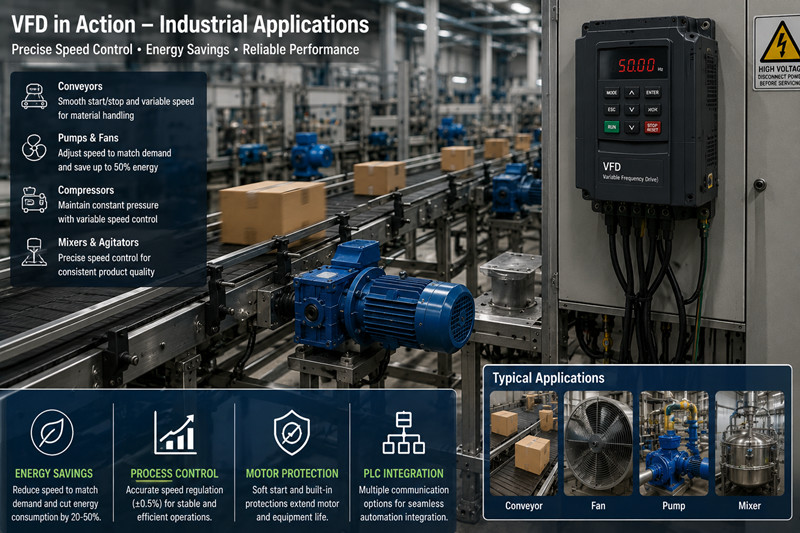
Reducing motor speed by 20% saves approximately 50% energy (power follows the cube of speed). For a 50HP fan running at 80% speed, annual savings can exceed $5,000.
VFDs ramp up voltage and frequency gradually, eliminating the 6-8× locked rotor current surge during direct-on-line starting. This protects motors and reduces mechanical stress.
Variable speed control enables smooth acceleration/deceleration, precise speed regulation (±0.5%), and synchronized multi-axis motion. Critical for packaging lines, CNC machines, and mixing.
Soft starts and controlled stops reduce belt wear, gearbox stress, and bearing load. Maintenance intervals extend by 2-3× on average.
Modern VFDs support EtherNet/IP, PROFINET, Modbus RTU/TCP, CANopen for seamless PLC integration and SCADA remote monitoring.
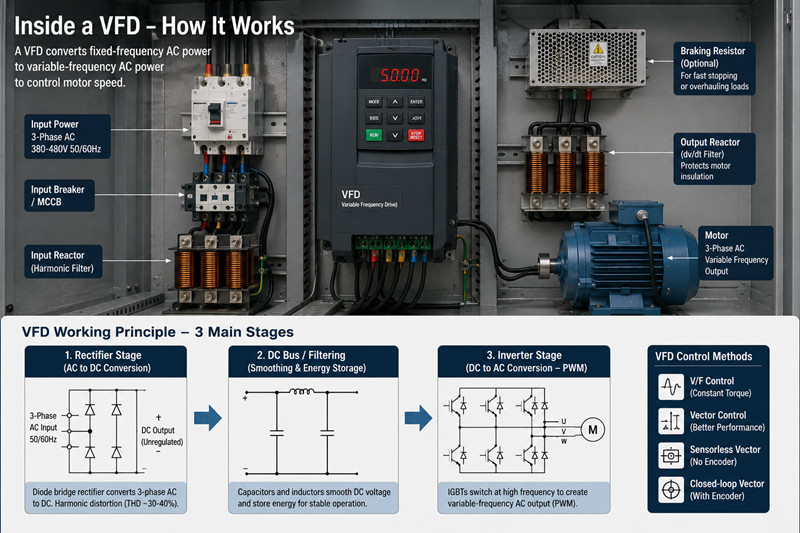
A VFD consists of three main stages:
AC input is converted to DC using a diode bridge rectifier. This creates harmonic distortion (THD ~30-40%).
DC voltage is smoothed by capacitors and inductors. The DC bus stores energy to handle momentary power interruptions and motor regeneration.
IGBTs switch at high frequency (2-16kHz) to create a pseudo-sine-wave AC output at the desired frequency. This is Pulse Width Modulation (PWM).
Key VFD control methods:
· V/F Control: Standard for constant torque loads
· Vector Control: Better low-speed torque and regulation
· Sensorless Vector: Motor flux estimation without encoder
· Closed-loop Vector (with encoder): ±0.01% speed accuracy
Match the VFD power to the motor nameplate current and voltage. Choose a VFD rated at least equal to — preferably 10-20% above — the motor FLA (Full Load Amps). Undersizing causes overheating.
Common ratings: 200-240V single-phase (small VFDs), 380-480V three-phase (industrial standard), 500-690V (high-power). Never connect a single-phase VFD to a three-phase motor.
Constant Torque (conveyors, compressors): Requires high starting torque. Variable Torque (fans, pumps): Maximum energy savings. Match VFD to load profile.
Match your PLC ecosystem: EtherNet/IP (Allen Bradley), PROFINET (Siemens/Schneider), Modbus RTU (universal). For motion: CANopen or EtherCAT.
IP20 (inside cabinet). IP54/55 (dusty/humid). IP66 (outdoor/washdown). High ambient temps (>40°C) require derating or enclosure cooling.
For frequent braking or overhauling loads (cranes, conveyors), add a braking resistor. Otherwise DC bus voltage rises and triggers overvoltage fault.
|
Feature |
Mitsubishi FR-E800 |
Danfoss FC101 |
Schneider ATV320 |
ABB ACS580 |
|
Power Range |
0.1-630kW |
0.12-75kW |
0.18-30kW |
0.75-250kW |
|
Voltage |
200-240V / 380-480V |
200-240V / 380-480V |
200-240V / 380-480V |
380-480V |
|
Communication |
Built-in Ethernet |
Modbus RTU, fieldbus |
Modbus RTU, CANopen, Profinet |
Built-in Modbus RTU |
|
Programming |
FR Configurator 2 |
MCT 10 / built-in display |
SoMove / Display |
DriveComposer Pro |
|
Key Strength |
Ethernet & motion control |
HVAC/pump optimization |
Compact, easy commissioning |
Industrial robustness |
· Mitsubishi FR-E800: Best for machines requiring built-in Ethernet (CC-Link IE Field, Modbus TCP) and high-speed motion. Excellent encoder feedback support.
· Danfoss FC101: Purpose-built for HVAC and water treatment. Exceptional vCurve optimization for pumps and fans. Competitive price for 0.75-75kW range.
· Schneider Altivar 320: Compact and easy to set up via SoMove or built-in display. Good for simple pump/fan/conveyor applications.
· ABB ACS580: Industrial-grade, reliable from the ABB ACS880 platform. Excellent for heavy industrial loads. Strong global service network.
Conclusion
Selecting the right VFD comes down to matching power rating, voltage, communication protocol, and load type with your application. Mitsubishi FR-E800 leads in connectivity and motion control. Danfoss FC101 is optimized for HVAC and pump applications. Schneider ATV320 offers simplicity and compactness. ABB ACS580 brings industrial robustness.
Q: What is the difference between a VFD and a soft starter?
A: A soft starter only controls voltage during start/stop. It cannot vary motor speed. A VFD controls both frequency and voltage continuously, enabling variable speed and energy savings throughout the process.
Q: Can a VFD damage a motor?
A: If properly sized and configured, a VFD extends motor life. Main risks: (1) overheating from low-speed operation, (2) voltage spikes from long motor cables. Use output filters for cable runs >50m.
Q: How much energy can a VFD save?
A: For variable-torque loads (fans, pumps), reducing speed by 20% saves ~50% energy. A 50HP fan at 75% speed for 8,000 hours/year can save $8,000-$12,000/year. Payback: 1-3 years.
Q: Do VFDs cause harmonic distortion?
A: Yes. Standard 6-pulse VFD rectifiers create THDi ~30-40%. Use input reactors, active front end (AFE) drives, or multi-pulse (12/18-pulse) VFDs to reduce below 5% THDi.
Q: Can I run a motor at 90Hz via VFD?
A: Standard motors are rated for 50/60Hz. Running at 90Hz requires a VFD-rated motor (class F/H insulation, balanced bearings). Consult manufacturer before exceeding nameplate frequency by >20%.
· Mitsubishi FR-E800 VFD
· High-performance VFD with built-in Ethernet and advanced motion functions. 0.1-630kW range.
· Danfoss FC101 VFD
· HVAC and pump optimized VFD with intuitive commissioning. 0.12-75kW.
· Schneider Altivar 320
· Compact VFD for simple to medium complexity applications. 0.18-30kW.
· ABB ACS580 VFD
· General purpose industrial VFD with robust build quality. 0.75-250kW.
· VFD Input Reactor (Harmonic Filter)
· Reduces harmonic distortion from VFD rectifiers. Essential for plants with sensitive equipment.

Please read on, stay posted, subscribe, and we welcome you to tell us what you think.


Sitemap | Blog | XML | Privacy Policy
In addition, with your permission, we want to place cookies to make your visit anointeraction with slOC more personal. For this we use analytical and advertisingcookies. With these cookies we and third parties can track and collect yourinternet behawior inside and outside super-instrument.com. With this we and third parties adapt super-instrument.com and advertisementsto your interest. By clicking Accept you agree to this. If you decline, we only usethe necessary cookies and you unfortunately will not receive any personalizedcontent. Please visit our Cookie policy for more information or to change yourconsent in the future.
Accept and continue Decline cookies