
How PLCs Run Water Treatment Plants in the Middle East and Europe: 2026 Automation Guide
URL Slug: plc-water-treatment-automation-middle-east-europe-2026
PLC in water treatment plants automation Middle East Europe 2026 — search this and you get vendor pages, academic papers, and a few outdated white papers. What you do not get is a straight answer from someone who has actually specified the hardware for a working plant. This article fixes that. It covers how PLCs actually run water and wastewater treatment facilities: which platforms are deployed, what they control, how they integrate with SCADA, and what the regulatory landscape looks like in 2026 for both regions.
The reason this matters: water treatment is one of the most demanding PLC applications because it combines continuous process control, safety-critical chemical dosing, harsh environments (corrosive atmospheres, humidity), and regulatory reporting requirements that make SCADA integration non-negotiable. A PLC failure in a water treatment plant is not an inconvenience — it can be a public health event.
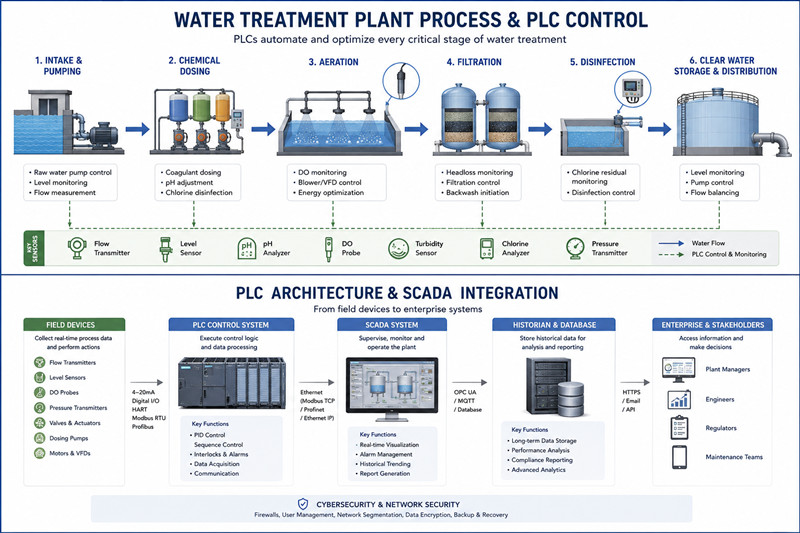
A modern municipal or industrial water treatment plant automates four core processes: chemical dosing, aeration, filtration, and backwash cycles. PLCs also handle auxiliary functions like pumping, level control, and flow balancing. The complexity varies significantly between a small package plant (a few thousand gallons per day) and a large metropolitan treatment facility (hundreds of millions of gallons per day).
Chemical dosing is the most safety-critical function. Chlorine (or chloramine) dosing prevents pathogen breakthrough. Coagulants (aluminum sulfate, ferric chloride) aggregate suspended solids. pH adjustment chemicals (lime, sulfuric acid) correct alkalinity. Phosphorus removal chemicals (ferric chloride, alum) target nutrient loads.
The PLC controls dosing pumps in response to online analyzer readings. A typical configuration:
· Flow transmitter on the inlet header (measures flow rate, GPM)
· Residual chlorine analyzer downstream of the contact tank
· PLC calculates the required dose rate (mg/L) based on flow-proportional dosing
· Analog output (4–20mA) drives the dosing pump stroke or speed
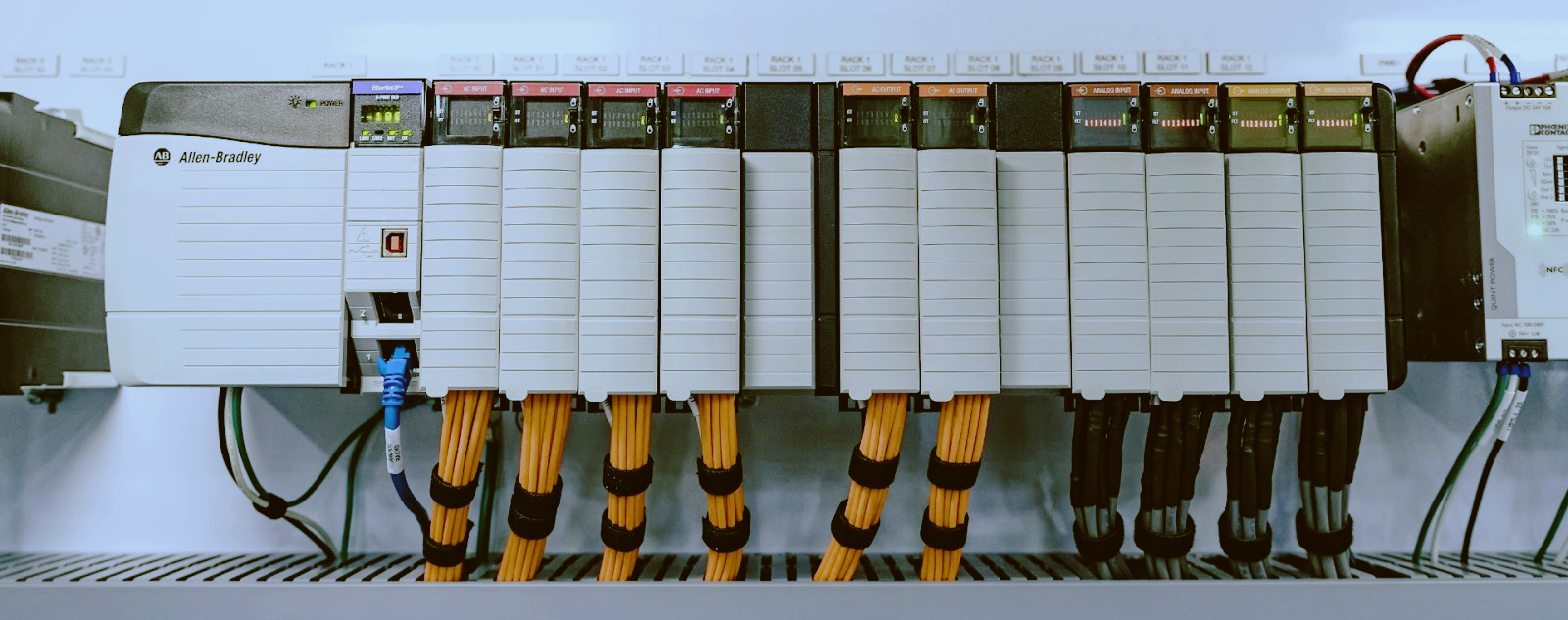
Siemens S7-1500 systems handle this well in UAE municipal projects — the built-in PID control functions (PID_Compact, PID_3Step) are well-suited for dosing loops, and the TIA Portal libraries include pre-built water treatment function blocks that reduce programming time. Allen Bradley ControlLogix with 1756-IF8 analog inputs and 1756-OF4 analog outputs handles the same function in US plants — the RSLogix and Studio 5000 environment is familiar to US water utilities, and the Allen Bradley platform has deep integration with Rockwell Automation PlantPAx process automation system.
Aeration serves two purposes: biological oxidation of organic matter (BOD removal) and maintaining dissolved oxygen (DO) levels for nitrification. In activated sludge processes, the PLC modulates aeration air flow to each aeration basin based on DO readings from online probes.
A typical aeration control loop:
· DO probe (polarographic or optical) in each aeration basin
· PLC reads DO (4–20mA signal)
· PLC adjusts the air damper or blower VFD speed via analog output or Modbus/Profibus to a variable frequency drive
· Goal: maintain DO setpoint (typically 2 mg/L) while minimizing energy consumption
ABB AC500 systems are common in European water utilities, including a Spanish regional water company that operates multiple treatment plants on the Mediterranean coast. The ABB platform's AC500 CPU handles the computational load of multi-zone aeration control (which requires coordinating DO readings across 4–8 aeration basins simultaneously) and integrates cleanly with the utility's existing ABB VFDs over Modbus RTU. The ABB automation builder platform also includes a water treatment library that covers aeration control, sludge wasting, and chemical dosing — useful for standardization across a multi-plant operator.
Granular media filtration (sand filters, multimedia filters) removes suspended solids. The filtration cycle runs in production mode until a headloss setpoint is reached (indicating filter fouling), at which point the PLC initiates a backwash cycle.
The backwash sequence:
1. Drain down the filter (controlled via automated weir valve)
2. Air scour (air scour blower for 2–5 minutes)
3. Slow rinse (filtered water for 2–5 minutes)
4. Return to service
The PLC executes this sequence using ladder logic or structured text, with interlock logic preventing the filter from returning to service until the full sequence completes. Timing is critical — too short a backwash and the filter carries forward solids; too long and you waste treated water and energy.
In the Middle East, many plants use dual-media filters (anthracite + sand) with automated backwash controlled by Siemens S7-1500 PLCs. The S7-1500 system's high-speed counter inputs handle the flow totalization required for backwash volume tracking, and the built-in RTC (real-time clock) timestamps backwash events for regulatory logs.
No modern water treatment PLC operates in isolation. Plant-level PLCs communicate with a SCADA (Supervisory Control and Data Acquisition) system that provides:
· Real-time visualization of process parameters (tank levels, flows, DO, chlorine residual)
· Historical data logging and trending
· Alarm management and escalation
· Regulatory reporting (monthly DMRs in the US, EU Water Information System in Europe)
Common SCADA platforms in the Middle East: Siemens WinCC (often paired with S7 PLCs), Wonderware (Schneider Electric), and Ignition (Inductive Automation). In Europe, you see a wider mix: WinCC, Rockwell Automation FactoryTalk, and PI System (OSIsoft) for historians.
Communication protocols: Modbus RTU (serial, common in legacy European plants), Modbus TCP/IP (Ethernet, increasingly common), Profinet (Siemens plants), EtherNet/IP (Allen Bradley plants), and OPC-UA (for IT/OT integration and multi-vendor plants).
---
The Dubai Electricity and Water Authority (DEWA) sets standards for water treatment automation in the UAE. DEWA's regulatory framework requires:
· Online monitoring and data logging for all critical parameters (flow, pressure, chlorine residual, turbidity)
· Alarm management with defined response procedures
· Periodic calibration records for all instruments (pH, chlorine, flow)
· SCADA integration with DEWA's central monitoring system for large-capacity plants
Siemens S7-1500 with TIA Portal is the most common platform for new UAE municipal water projects because Siemens has strong local support in Dubai and Abu Dhabi, DEWA engineers are familiar with the platform, and the S7-1500 system supports the Profinet protocol required for integration with DEWA-compliant SCADA systems.
UAE projects typically specify ABB or Siemens for new plants, with Allen Bradley appearing more in industrial (non-municipal) water treatment, particularly at petrochemical complexes where the parent company has an existing Allen Bradley infrastructure.
Pricing signals: UAE municipal water treatment projects (particularly those funded by government infrastructure budgets) have remained robust through 2025–2026, with no significant slowdown in new plant construction or upgrades. Budget allocations for automation upgrades at existing plants are increasing as operators prioritize energy efficiency (aeration is the largest energy consumer in a typical activated sludge plant).
The EU Water Framework Directive (WFD, 2000/60/EC) and its daughter directives set the regulatory baseline for water treatment across the EU. Key requirements affecting PLC and automation specifications:
· Mandatory monitoring of priority substances and chemical status
· Real-time continuous monitoring for certain parameters (ammonia, nitrate, DO)
· Electronic reporting to the Water Information System Europe (WISE)
· Energy efficiency requirements increasingly driving aeration optimization projects
European water utilities are more conservative about platform changes than Middle Eastern operators — an existing ABB AC500 installation at a Spanish water utility will typically be expanded or upgraded with ABB modules rather than migrated to a competing platform, due to the cost of re-engineering and re-validation.
Allen Bradley ControlLogix is common in Northern European water utilities (UK, Netherlands, Scandinavia) where the Rockwell Automation ecosystem has strong local support. The UK's water sector (operated by companies like Thames Water, Severn Trent, United Utilities) uses Allen Bradley extensively, and many treatment works have been upgraded with ControlLogix as part of AMP (Asset Management Programme) investment cycles.
A 50 MLD (million liters per day) municipal water treatment plant in Dubai uses a Siemens S7-1500 (CPU 1516-3 PN/DP) as the main PLC, with ET 200SP distributed I/O on the process units. TIA Portal handles programming, with custom function blocks for chemical dosing and aeration PID loops. The SCADA system is Siemens WinCC OA. The plant operates under DEWA oversight, with data pushed to DEWA's central monitoring system via OPC-UA. The dosing system uses 4–20mA loops from Siemens SM531 analog input modules to the dosing pump VFDs, with PID_Compact controllers managing chlorine and coagulant dosing.
A Spanish regional water company operates 12 treatment plants across the Valencia and Catalonia regions. The standard platform is ABB AC500 (PM573-ETH CPU) with S500 I/O modules. Automation Builder (CODESYS-based) provides the engineering environment. The largest plant (85 MLD) uses a multi-zone aeration control strategy coordinated across 6 aeration tanks. The ABB platform's ability to handle multiple Modbus RTU networks (one per aeration basin) on a single CPU was a key selection criterion. SCADA is Wonderware InTouch with an OSIsoft PI historian for regulatory reporting to the Spanish Ministry of Environment.
A 35 MGD (million gallons per day) municipal wastewater treatment plant in the US Midwest uses an Allen Bradley ControlLogix system (1756-L85E CPU, 1756-IF8 / 1756-OF4 analog modules, 1756-IB16 / 1756-OB16 digital modules) for secondary treatment control. The plant runs a conventional activated sludge process with chemical phosphorus removal. Dosing pumps (aluminum sulfate and polymer) are controlled via 4–20mA signals from 1756-OF4 analog outputs. Aeration is modulated by Allen Bradley PowerFlex VFDs communicating with the PLC over EtherNet/IP. The SCADA platform is Rockwell Automation FactoryTalk View SE with a PI System historian. The plant reports electronically to the state environmental agency via ECHO (EPA Enforcement and Compliance History Online) and its state equivalent.
---
Municipal water treatment automation spending in 2026 is driven by three factors:
5. Energy efficiency mandates — Aeration optimization projects (which require PLC upgrades and DO probe networks) are receiving significant budget allocation in both regions. EU operators are under pressure to meet the WFD's energy efficiency provisions; UAE operators are driven by DEWA's demand-side management programs.
6. Regulatory reporting requirements — Online monitoring upgrades (adding instruments, upgrading PLCs to support SCADA connectivity) continue to drive capital projects. The EU's push toward real-time nutrient monitoring (ammonia, nitrate, phosphorus) is creating demand for additional analog input capacity and improved data historian systems.
7. Aging infrastructure replacement — Many treatment plants in Europe and North America have PLC infrastructure installed in the 2000s (original Siemens S7-300, early Allen Bradley ControlLogix, ABB AC500) that is reaching end-of-life. The S7-300 end-of-life situation (affecting legacy Siemens installations) is particularly acute in European plants where many were installed in the 2008–2015 period.
---
Q: What PLC platform is best for water treatment plants?
A: The platform that your maintenance team already knows. Siemens, Allen Bradley, and ABB are all capable. Siemens S7-1500 is the most common choice for new UAE municipal projects due to DEWA familiarity and local support. ABB AC500 is strong in European utilities due to standardization and CODESYS flexibility. Allen Bradley ControlLogix dominates US municipal water and wastewater. All three integrate with major SCADA platforms.
Q: How do water treatment PLCs handle chemical dosing safety?
A: Dosing loops are typically configured with multiple layers of protection: high/high and low/low alarms on the analyzer reading, hardwired safety interlocks on the dosing pump (enable/disable via PLC output and physical relay), and a cascade arrangement where the PLC sets the dosing pump speed but the analyzer reading independently triggers an alarm and auto-shutdown if it exceeds the setpoint. The PLC's role is optimization and setpoint control; the physical interlocks handle safety.
Q: What communication protocols do water treatment plants use?
A: Modbus RTU (serial) is still common in legacy European plants. Modbus TCP/IP is increasingly prevalent for Ethernet-based systems. Profinet is standard in Siemens-centric plants in the Middle East. EtherNet/IP is standard in Allen Bradley-centric plants in the Americas and Northern Europe. OPC-UA is the go-to protocol for IT/OT integration and multi-vendor environments.
Q: How often do water treatment PLCs need to be upgraded?
A: A typical PLC lifecycle in water treatment is 15–20 years. However, the supporting infrastructure (network switches, SCADA servers, historians) may require refresh at 7–10 years. Platform end-of-life announcements (like the Siemens S7-300 discontinuation) can force an earlier upgrade. Budget cycles for municipal utilities (5-year capital programs in the US, regulatory investment periods in the EU) often drive the timing.
Q: Can water treatment PLCs be remotely monitored?
A: Yes. Remote access is common via VPN connections to the plant's SCADA network. In the EU, remote access for PLC programming and troubleshooting is standard practice and regulated under the NIS2 Directive (EU). In the Middle East, remote access varies by operator and regulatory body. Always verify that remote access complies with your local regulatory framework before implementing.
Q: What is the biggest automation challenge in water treatment?
A: Instrument reliability. The PLC does what you program it to do, but it is only as good as the field instruments feeding it data. Turbidity meters, chlorine analyzers, DO probes, and flow meters in water and wastewater applications operate in harsh environments (corrosive atmosphere, biofilm, fouling) and require regular calibration and maintenance. A well-programmed aeration PID loop running on bad DO probe data will not produce good results. Investing in instrument maintenance and calibration is as important as investing in the PLC itself.
---
*For PLC solutions, visit tztechio.com. For Siemens solutions, see tztechio.com/siemens. For Allen Bradley, see tztechio.com/allen-bradley. For ABB, see tztechio.com/abb.*

Please read on, stay posted, subscribe, and we welcome you to tell us what you think.


Sitemap | Blog | XML | Privacy Policy
In addition, with your permission, we want to place cookies to make your visit anointeraction with slOC more personal. For this we use analytical and advertisingcookies. With these cookies we and third parties can track and collect yourinternet behawior inside and outside super-instrument.com. With this we and third parties adapt super-instrument.com and advertisementsto your interest. By clicking Accept you agree to this. If you decline, we only usethe necessary cookies and you unfortunately will not receive any personalizedcontent. Please visit our Cookie policy for more information or to change yourconsent in the future.
Accept and continue Decline cookies