
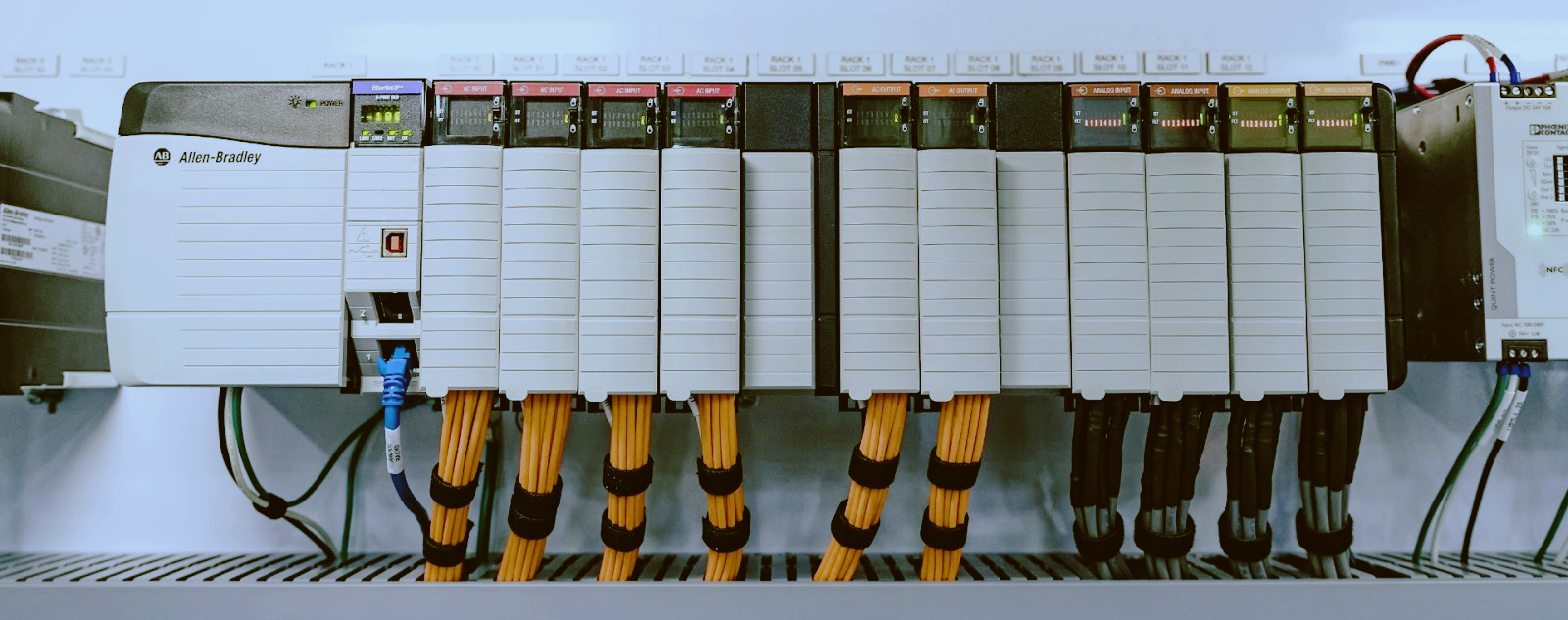
Why Do Bently Nevada 3500 Modules Keep Failing? The 6 Problems Every Technician Hits
URL Slug: bently-nevada-3500-troubleshooting-guide-common-faults
Bently Nevada 3500 common faults troubleshooting keeps plant floor technicians up at night. You pull a shift at a Saudi Aramco gas processing facility or a UAE refinery on the Gulf Coast, and that 3500 rack starts throwing channel faults the moment you think everything is stable. Prox probe wear kills accuracy. Power supply modules drop out under load. Software config mistakes take down an entire machinery protection system trip chain. If you run Bently Nevada equipment in any serious industrial setting, at least one of these six failures has hit your rack already — and if it hasn't, the day it does, you need to know exactly what to do.
This guide covers the six most frequent 3500 module failures: what causes them, how to diagnose them, and how to fix them right the first time. We focus on the 3500/22 Transient Data Interface, 3500/40 Machinery Protection Monitor, and 3500/15 Power Supply modules because those three account for the bulk of downtime calls in oil and gas, petrochemical, and turbine applications across the Middle East and North America.
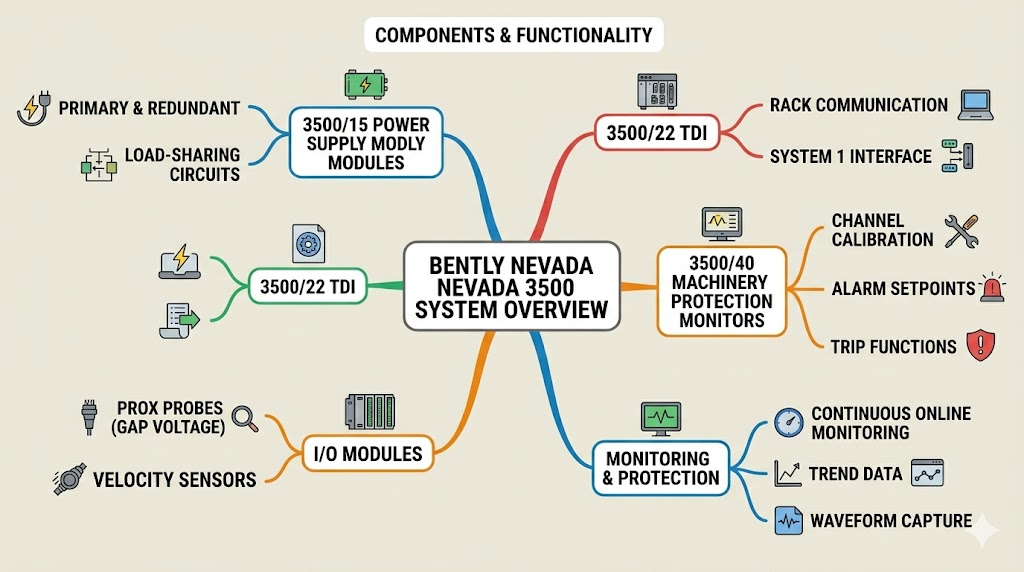
The Bently Nevada 3500 is a rack-based machinery protection system designed for continuous online monitoring of turbines, compressors, pumps, and other rotating equipment. Unlike simple alarm units, the 3500 provides both protection (trip functions) and monitoring (trend data, waveform capture) in a single architecture.
A typical 3500 rack holds:
· 3500/15 Power Supply Modules (primary and redundant)
· 3500/22 Transient Data Interface (TDI) for communication
· 3500/40 (or 3500/44, 3500/45) Machinery Protection Monitors with specific channel counts
· Various I/O modules for prox probes, velocity sensors, and ROTA (Rotating Termal Analyzer) inputs
The rack communicates via Ethernet or serial to a host system, and the 3500 software (System 1 or 3500 Fleet software) handles configuration, alarm routing, and data logging.
The problem: when any module in that rack fails or misbehaves, the root cause is almost never obvious — and the fix requires understanding how the modules interact.
Symptoms: Intermittent channel fault LEDs on the 3500/40 monitor. Alarm trips with no corresponding machinery event. Bad channel readings that drift over weeks.
Cause: Prox probe (inductive eddy current) sensors have a finite life. The probe tip wears against the shaft runout surface, the calibration gap shifts, and the 3500 channel goes into fault when the gap voltage exceeds the configured window. In high-temperature environments like gas turbine bearing housings, probe lifespan drops significantly.
Fix: Check the channel gap voltage in 3500 Fleet software — each channel displays a gap voltage in volts. A healthy reading sits within ±2V of the calibrated value. If it's drifting, replace the probe. Calibration a new probe requires the machinery to be offline and the shaft centered. Document the new gap voltage before returning to service.
Regional note: At Saudi Arabia oil & gas facilities, probe replacement cycles run 12–18 months in high-vibration turbomachinery. UAE refinery operators report shorter cycles (9–14 months) due to higher ambient temperatures in compressor houses.
---
Symptoms: The 3500 rack trips the machine unexpectedly. The trip cause appears in the event log but the alarm seems disproportionate to the machinery condition.
Cause: Incorrect alarm setpoints. A common mistake: alarm levels set too close to the trip setpoint, or the trip relay configuration (normally open vs. normally closed) mismatched with the host logic. Another cause: test function accidentally activated during online operation, triggering a real trip.
Fix: Review the 3500/22 configuration in System 1. Verify the alarm and trip setpoints against the original machinery vendor specifications. Check relay output configuration — the 3500/22 has relay outputs that can be mapped to alarm or trip functions. If the trip was triggered by a test function, reset the system and review the event log for the test timestamp. Always perform test functions with the machine in a pre-agreed state and the host operator informed.
---
Symptoms: 3500/22 shows a communication fault or the host system loses contact with the rack. The LED on the 3500/22 may show a steady red or amber pattern.
Cause: The Ethernet or serial link between the 3500/22 and the host has failed, or the internal rack communication (ribbon cable or backplane) is disrupted. The 3500/22 can also lose communication if multiple racks are networked and an IP address conflict occurs.
Fix: First, check physical connections — Ethernet cable seating, serial cable integrity. Verify the 3500/22 IP address against the host configuration. A power cycle of the entire rack (remove and reapply power to 3500/15 modules) often restores communication. If the 3500/22 itself has failed, it must be replaced and reconfigured with the correct rack address and channel configuration. Always back up the 3500 configuration (via System 1) before replacing any module.
---
Symptoms: A channel that previously read correctly now shows a persistent offset from expected values. The machinery is healthy but the 3500 channel indicates a warning or alarm.
Cause: The 3500/40 monitor uses software-based channel calibration. Over time, the calibration constants can drift, particularly in monitors that have been running for years without a firmware update. The issue is exacerbated in environments with high vibration or temperature cycling.
Fix: Perform a channel calibration using the 3500 Fleet software calibration wizard. This requires a known calibration signal source (a calibrator capable of outputting the sensor's rated range — typically 200 mV/mil for proximity probes). Follow the on-screen wizard, save the calibration to the monitor, and verify the channel reading. If drift persists after recalibration, the monitor module may be failing and should be replaced.
---
Symptoms: 3500/15 module shows a fault LED, or the entire rack goes dark. Redundant power supply does not take over cleanly during a failure event.
Cause: The 3500/15 is a switching power supply. In environments with unstable mains power or significant electrical noise (common near large motors or variable frequency drives), the supply can fail. Aging capacitors in older 3500/15 units are a common failure point. If the redundant supply fails to pick up load, the issue is often in the power distribution wiring or the supply's load-sharing circuit.
Fix: Replace the failed 3500/15 with a known-good unit. Before replacement, verify input voltage at the supply terminals — nominal 24V DC or 115/230V AC depending on the module variant. After replacement, the new supply should immediately show a green LED. Test the redundant supply by temporarily removing the primary — the rack should stay powered and the event log should record the switchover. If the redundant supply does not take over, check the load-sharing wiring between the two 3500/15 modules.
---
Symptoms: Channels map to the wrong inputs. Alarms trigger on inactive channels. The 3500/22 shows correct data but the host system receives garbage. The rack functions correctly in standalone mode but fails when integrated with the plant DCS.
Cause: Configuration errors after a firmware update, module replacement, or a change to the System 1 project file. The 3500 architecture stores channel configuration in each monitor module, not centrally — so replacing a 3500/40 without loading the correct configuration file results in a blank or miswired monitor. Another common mistake: incorrect channel normalization (scaling) after replacing a prox probe with a different model.
Fix: Always back up the full rack configuration (System 1 → Save As) before any module swap. When replacing a monitor, use the "Upload from Monitor" function to pull the existing configuration, then apply it to the new module. For integration with a DCS or SCADA host, verify the Modbus register map or Ethernet/IP explicit message configuration matches the 3500 channel layout. A mismatch in byte order (big-endian vs. little-endian) is a frequent culprit in Modbus integrations.
Feature | Bently Nevada 3500 | Bently Nevada 3300
Architecture | Rack-based, modular | Rack-based, modular
Channel Density | Up to 16 channels per monitor module | Up to 8 channels per module
Communication | Ethernet, Modbus, serial | Serial, limited Ethernet
Protection Capability | Full trip and monitoring | Monitoring primarily
Firmware Updates | Field-upgradeable | Limited
Redundant Power Supply | Yes (3500/15) | Optional
Typical Application | Turbines, compressors, critical machinery | Pumps, fans, general-purpose monitoring
Price Range (used) | Higher | Lower
Regional Availability | Widely stocked in ME distributors | More common in North America
Recommendation: Use 3500 for any application where machinery protection (trip functionality) is required — particularly turbines, compressors, and large reciprocating machines in oil & gas. Use 3300 for auxiliary monitoring where the full trip function is handled by a separate protection system. In Saudi Arabia and UAE, 3500 is the standard for new installations; 3300 units are typically found in older plants or secondary monitoring roles.
---
Saudi Arabia (Saudi Aramco, SABIC): Prox probe wear and MPS trips dominate service calls. Saudi facilities run 3500 racks at very high utilization rates on gas injection compressors. Power supply failures are also common due to the harsh inland climate (high temperatures, sand intrusion).
UAE (ADNOC, Dubai refineries): Channel calibration drift is the most reported issue, attributed to rapid temperature cycling in coastal facilities where seawater cooling creates condensation. 3500/22 communication errors are also frequent due to network integration complexity with multiple DCS platforms.
US Gulf Coast: Software configuration mistakes lead the failure list, driven by the high number of third-party integrators and frequent module swaps during turnaround maintenance. ROTA-related faults (rotating thermal analyzer inputs on 3500/45 modules) are more common here due to the large installed base of gas turbines in combined-cycle plants.
---
Q: How often should prox probes be replaced on a Bently Nevada 3500 system?
A: Typical probe replacement intervals run 12–24 months depending on the application. High-temperature, high-vibration environments (gas turbines, compressors) require replacement at the shorter end. Always gap-check after replacement and document the new baseline voltage.
Q: Can I replace a 3500/40 monitor without taking the machinery offline?
A: The monitor module can be swapped with the machine running as long as the specific channel being replaced is not in a trip-active state and the redundant protection (if configured) is healthy. However, the replacement monitor must be pre-configured with the correct channel settings before installation. Never remove a monitor while its channel is actively in alarm.
Q: What causes a 3500/22 to lose communication with the host?
A: The most common causes are physical connection failure (Ethernet cable, serial cable), IP address conflict on a networked rack, or power supply issues affecting the 3500/22 specifically. A power cycle of the rack usually restores communication. If the 3500/22 itself has failed, it must be replaced and reconfigured.
Q: My 3500 rack keeps tripping unexpectedly. What's the most likely cause?
A: Check the alarm setpoints first. If alarm levels are set too close to trip setpoints, normal operational vibration can trigger a trip. Also verify that the relay output configuration matches the host system's expected logic (normally open vs. normally closed). Review the event log — it will record the exact channel, value, and timestamp of the trip-triggering event.
Q: How do I know if my 3500/15 power supply is failing?
A: A failing 3500/15 typically shows a fault LED (amber or red) before complete failure. You may also notice intermittent communication drops or channel faults that coincide with mains supply disturbances. Replace at the first sign of a fault LED — do not wait for complete failure, as a dead primary with a failed redundant supply will take the entire rack offline.
Q: Is the Bently Nevada 3500 still a current product?
A: Bently Nevada continues to sell and support the 3500 system, though the product line has been supplemented by newer platforms. The 3500 remains the standard for critical machinery protection in oil & gas, power generation, and petrochemical industries globally. However, some legacy modules (particularly older 3500/22 variants) have reached end-of-life — check with Honeywell (parent company of Bently Nevada) for current availability.
---
For Bently Nevada products, visit tztechio.com/bently-nevada. For PLC and automation solutions, see tztechio.com/plc.
TZ Tech is a professional supplier for industrial automation and electrical parts, as well as some instrumentation, telecommunication parts. We mostly sell the ready stock of distributor, with competitive price and short lead time. Even discontinued parts we may also can supply as we have a large inventory here.
We understand what you concern, so we will ensure the quality. We strictly screen the components you require, so you don’t need worry about any quality issues with the goods you receive. For specialized parts that have long since been discontinued, we will sincerely inform you the actual condition of the goods. All brand new parts we will support 1 year warranty.
If you need any related parts, please feel free to send an inquiry. Our staff will support quick response within 6 hours. (except weekend here)


Please read on, stay posted, subscribe, and we welcome you to tell us what you think.


Sitemap | Blog | XML | Privacy Policy
In addition, with your permission, we want to place cookies to make your visit anointeraction with slOC more personal. For this we use analytical and advertisingcookies. With these cookies we and third parties can track and collect yourinternet behawior inside and outside super-instrument.com. With this we and third parties adapt super-instrument.com and advertisementsto your interest. By clicking Accept you agree to this. If you decline, we only usethe necessary cookies and you unfortunately will not receive any personalizedcontent. Please visit our Cookie policy for more information or to change yourconsent in the future.
Accept and continue Decline cookies