MASTERING THE CORE OF MODERN MANUFACTURING: A COMPREHENSIVE GUIDE TO PLC TECHNOLOGY
The landscape of modern production has been irrevocably changed by a single device: the Programmable Logic Controller, or **PLC**. Whether you are exploring the basics of Industrial Automation or seeking advanced insights into IIoT (Industrial Internet of Things) integration, understanding the **PLC** is fundamental to navigating the future of the factory floor. This guide delves into the mechanics, programming, and troubleshooting of these robust industrial computers that keep the world’s assembly lines moving.
The Evolution: From Relays to Software-Defined Logic
Before the **PLC** was introduced in the late 1960s, industrial control relied on massive banks of mechanical relays. If a manufacturer wanted to change a production sequence, technicians had to physically rewire thousands of connections—a process that was time-consuming, expensive, and prone to human error.
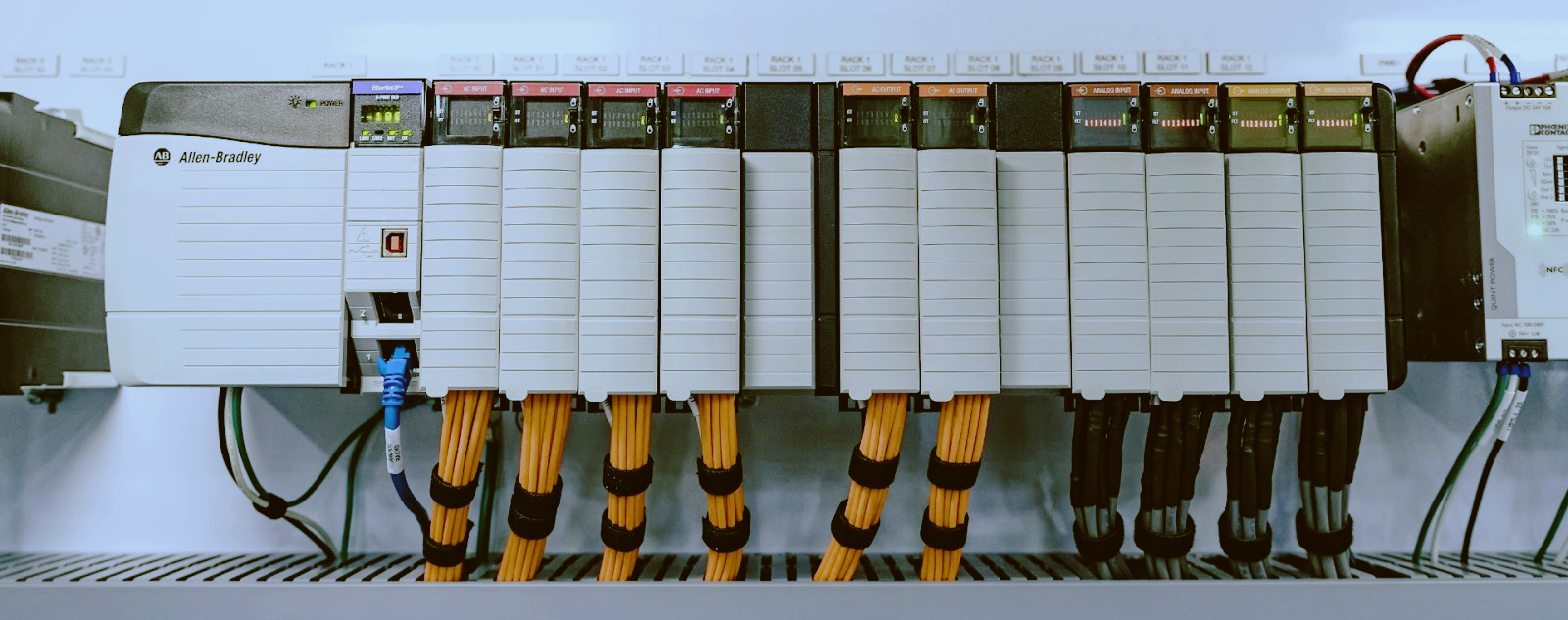
The birth of the first **PLC**, the Modicon 084, revolutionized the industry by allowing logic to be programmed via software rather than physical wires. Today, global leaders like **Siemens**, **Allen-Bradley** (Rockwell Automation), and **Schneider Electric** have pushed this technology to the edge, creating controllers that are not just binary switches, but powerful data hubs capable of complex calculations and high-speed communication.
Decoding PLC Programming: The Languages of Automation
For many entering the field, **PLC programming** is the most daunting yet rewarding aspect of the technology. The international standard IEC 61131-3 defines five distinct languages, each suited for different tasks within Industrial Automation.
1. Ladder Logic (LD): The most iconic language, modeled after electrical relay diagrams. It is the go-to for technicians because it is highly visual and easy to monitor in real-time.
2. Structured Text (ST): A high-level language similar to Pascal or C. It is increasingly popular for complex mathematical algorithms and data handling, favored by a new generation of engineers who are comfortable with traditional IT coding.
3. Function Block Diagram (FBD): This graphical language allows programmers to "wire" blocks of pre-written code together. It is widely used in process industries by brands like **ABB** and **Honeywell**.
4. Sequential Function Chart (SFC): Ideal for step-by-step processes, such as a batch mixing sequence in a food plant.
5. Instruction List (IL): A low-level assembly style, now less common but still found in older legacy systems.
The IIoT Revolution: Connecting the Shop Floor to the Top Floor
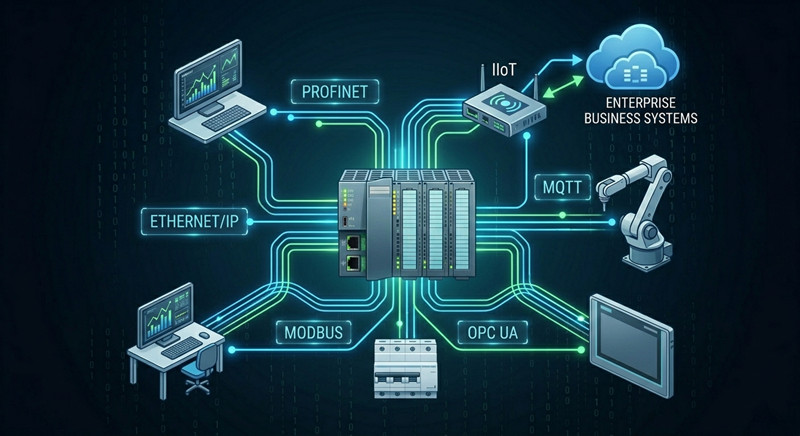
The most significant trend in 2026 is the convergence of OT (Operational Technology) and IT (Information Technology). This is where the **IIoT** comes into play. Modern **PLC** systems are no longer isolated. Through protocols like OPC UA and MQTT, a **PLC** can now stream real-time performance data directly to cloud platforms like AWS or Azure.
Why does this matter? For a business owner, it means "Data-Driven Decision Making." If an **Omron** or **Keyence** controller on the line detects a slight increase in motor temperature or a millisecond delay in cycle time, that data is instantly analyzed by AI in the cloud to predict a failure before it happens. This transition from reactive maintenance to predictive maintenance is the hallmark of Industry 4.0.
Professional PLC Troubleshooting: A Systematic Approach
Even the most sophisticated systems encounter issues. Masterful **PLC troubleshooting** is what separates a senior engineer from a novice. When a machine stops, the **PLC** is your best diagnostic tool.
- Hardware Diagnostics: Always start with the physical layer. Check the power supply and look for "Fault" lights on the CPU. Brands like **Mitsubishi** and **Delta** have intuitive LED indicators that can pinpoint a failed I/O module in seconds.
- Software Monitoring: By going "online" with the controller using software like TIA Portal or Studio 5000, you can see the logic execute in real-time. If a "rung" isn't turning green, you can trace the input back to a faulty limit switch or a broken wire.
- Forcing I/O: This is a powerful but dangerous technique. You can manually "force" an output to turn on to test a valve or motor. However, professional **PLC troubleshooting** safety protocols dictate that you must ensure no personnel are near the moving parts before doing so.

Please read on, stay posted, subscribe, and we welcome you to tell us what you think.


Sitemap | Blog | XML | Privacy Policy
In addition, with your permission, we want to place cookies to make your visit anointeraction with slOC more personal. For this we use analytical and advertisingcookies. With these cookies we and third parties can track and collect yourinternet behawior inside and outside super-instrument.com. With this we and third parties adapt super-instrument.com and advertisementsto your interest. By clicking Accept you agree to this. If you decline, we only usethe necessary cookies and you unfortunately will not receive any personalizedcontent. Please visit our Cookie policy for more information or to change yourconsent in the future.
Accept and continue Decline cookies