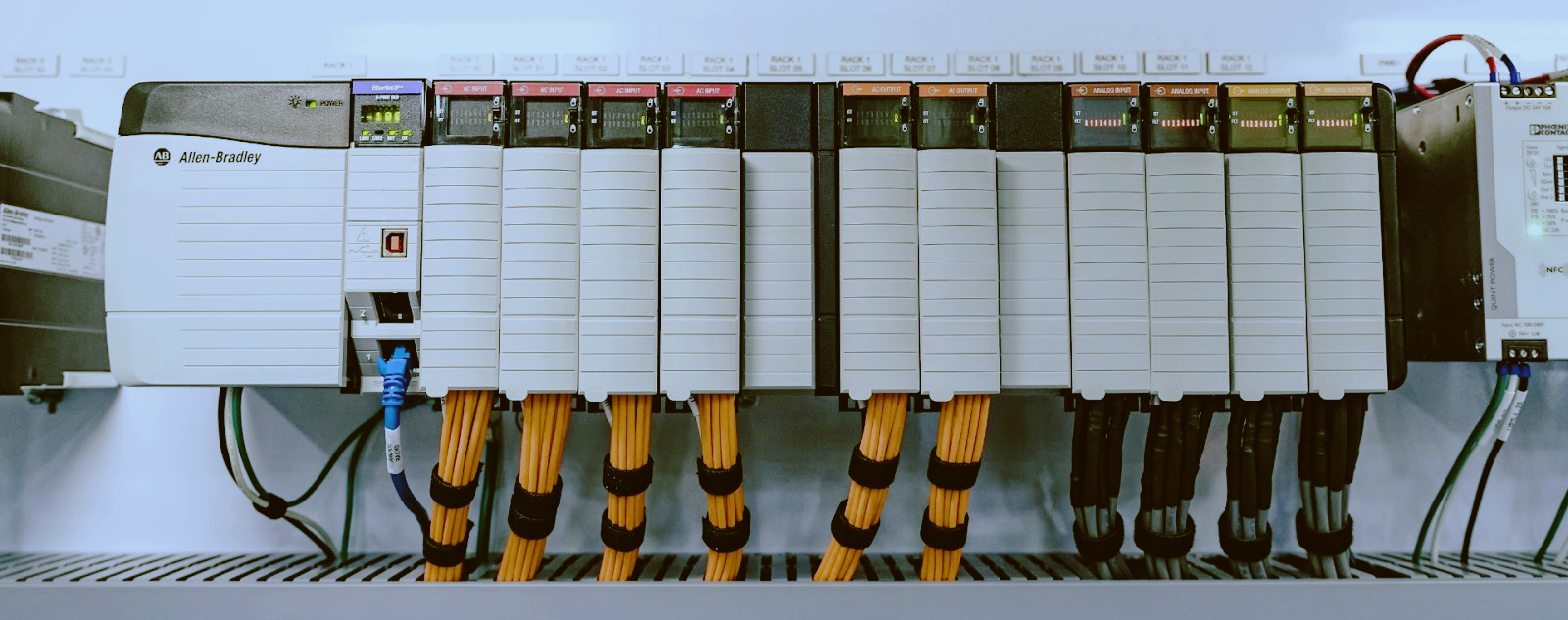

*Industry news | October 12, 2026* Rockwell Automation has set October 31, 2026 as the discontinuation date for the FLEX I/O ControlNet adapter, and there is no successor product named. The affected part numbers are 1794-ACN15, the standard ControlNet adapter, and 1794-ACNR15, the redundant-media version. That gives a plant roughly three weeks from today to place a last-time buy. After that, the adapter comes off the shelf in Rockwell's catalog, and the only route to a replacement is whatever distributors and independent suppliers still hold in stock. A stopped line does not care how clever the migration plan is. It cares that the adapter on the shelf fits. So the October 31 date is not an engineering footnote, it is a purchase order deadline, and it arrives in three weeks. Read the rest of the picture before you decide how much stock to buy. The ControlNet adapter is one part in a wider FLEX I/O retirement cycle, and the lead times on what remains tell you how much slack you actually have. The date that matters is October 31 October 31 is the last day the 1794-ACN15 and 1794-ACNR15 can be ordered from Rockwell. The product page carries lifecycle status End of Life with that discontinuation date, and the wording is direct enough to leave no room for interpretation: "Rockwell Automation announces that as of October 31, 2026, the Flex ControlNet Adapter will be discontinued and no longer available for sale. Customers are encouraged to remove references to the affected product(s)." That last sentence is the one worth reading twice. Rockwell is telling you to scrub the part number from your drawings, your bills of material and your maintenance procedures. It is not telling you what to put in its place. The replacement category on the product page is "Engineering Replacement." That is a specific and unhelpful phrase for anyone who owns this hardware. A functional replacement drops in and does the same job. An engineering replacement means the job can still be done, but the design changes, and the people who do the design work are not the ones holding the maintenance budget. No successor part number is listed. That is the detail that should drive your purchasing decision this month. When a vendor names a replacement, you can plan around it. You read the data sheet, you check the dimensions, you order one for the bench and you find out what breaks. When the replacement field is blank, you are the one writing the migration plan, and you are doing it without a vendor telling you which way to go. For a plant that keeps legacy ControlNet running because it works and because the capital was approved in a different decade, this is the moment where the platform question lands on the desk. Either you buy shelf stock to extend the life of what you have, or you accept that the ControlNet footprint is now on a countdown that you have not defined. The countdown is real either way. Rockwell has stopped selling. Every adapter in the field is now one failure away from being a problem you cannot buy your way out of at the usual channel. What is going out of production, and what is not The retirement does not touch every FLEX I/O adapter at once, and the gaps between the dates matter more than the dates themselves. Here is the model list, with what each one means for the shelf. 1794-ACN15, the FLEX I/O ControlNet adapter, non-redundant media. Lifecycle status: End of Life. Discontinued October 31, 2026. Replacement category: Engineering Replacement. No successor named. 1794-ACNR15, the FLEX I/O ControlNet adapter with redundant media. Lifecycle status: End of Life. Discontinued October 31, 2026. Replacement category: Engineering Replacement. No successor named. 1794-ACNR15XT, the Flex XT ControlNet adapter for extended temperature environments. Lifecycle status: End of Life. Discontinued December 31, 2027. Replacement product named: 5094-AENTRXT. 1794-AENT, the FLEX EtherNet/IP adapter with 10BaseT. Lifecycle status: End of Life. Discontinued September 30, 2028. Replacement category: Functional Replacement. Replacement product named: 1794-AENTR. 1794-AENTR, the FLEX I/O dual port EtherNet/IP adapter. Lifecycle status: Active Mature, which means it is still current. Rockwell lists an estimated lead time of 5 days. The two ControlNet adapters go first, and they go together. The XT variant, the one built for hot, cold and dirty conditions, gets an extra fourteen months and a named destination. The EtherNet/IP adapter gets almost two more years and a clean functional replacement. That pattern is not random. The platform is not being killed in one stroke. It is being retired from one network protocol at a time, and ControlNet is at the front of the queue. If you keep both a standard ControlNet adapter and an XT unit in the same plant, which is common on sites with a mix of climate-controlled panels and outdoor or washdown enclosures, the two are not on the same clock. Do not let one date blur into the other during a budget conversation. The XT users have a named successor and more time. The standard ControlNet users have neither. The EtherNet/IP side is the part of the answer that is still comfortable. The 1794-AENTR is Active Mature and Rockwell posts a 5 day lead time. That is not a part that is about to strand you. It is a part you can order through normal channels and get in the same week. The reason that matters here is that the EtherNet/IP adapter is the natural landing spot if the plant moves off ControlNet. It exists, it ships fast and it is not on a discontinuation list. That combination gives you an option, and the option costs less sleep than the blank field next to the ControlNet part. Start with what a FLEX I/O adapter actually does. One adapter connects up to eight FLEX I/O modules to the network. On the ControlNet side, that traffic runs on ControlNet V1.5. The adapter is the single point where a rack of I/O either talks to the controller or goes dark. One adapter, up to eight modules, one network connection. When that adapter fails, you do not lose one input point. You lose the whole rack. That is the number to hold onto when you are deciding how many to buy. The exposure per adapter is not the cost of the adapter. It is everything wired through it. Why a 73-day lead time makes this worse than it looks The 1794-ACN15 product page lists an estimated lead time of 73 days. Seven hundred and thirty hours of waiting, and that is Rockwell's own estimate on a part that is being discontinued in three weeks. Sit with that for a moment. The last date to order is roughly three weeks away. The lead time to receive is roughly ten and a half weeks. Those two numbers do not line up, and that mismatch is the whole story. An order placed on the last day of October does not arrive in October. It arrives somewhere in the first half of January, if the estimate holds. That is the trap in a last-time buy. People hear "last order date" and picture a firm deadline they can work backward from. In practice, a last-time buy is a commitment to wait, and you place it before you know what the next twelve months of failures will look like. For a maintenance planner, this changes the shape of the decision. You are not choosing between buying now and buying later at the same price and the same availability. You are choosing between securing stock at a known lead time and gambling that nothing in the rack fails while the channel is closing behind you. A 73 day lead time is also a signal about the supply chain behind the part. Long lead times on end-of-life hardware usually mean the part is built to order, or drawn from shrinking inventory, or subject to allocation. None of those conditions improve after the discontinuation date. They get worse, then they get scarce, then the only stock left is what is already sitting on shelves. The EtherNet/IP adapter's 5 day lead time sits right next to that 73 day figure on the same catalog, and the contrast is the point. One is a part you can order this afternoon. The other is a part you commit to months in advance to receive it at all. The practical reading is straightforward. Availability after October 31 is not a question of price. It is a question of whether anyone still holds the part. Distributor stock and independent suppliers are the channel, and that channel thins every month. If you have a critical rack, the lead time is the argument for acting this month rather than in the first week of November. The difference between ordering on October 24 and ordering on November 3 is not three percent of a purchase order. It is the difference between Rockwell's supply chain and whatever is left in the secondary market. If you need help locating what is still available, discontinued Allen-Bradley parts is a reasonable place to start a search, and it is worth doing it before the last sale date passes rather than after. The two realistic paths: keep the platform, or move to EtherNet/IP Once the adapter is gone from the catalog, the plant has two honest options. Everything else is a variation on one of them. The first path is to keep the platform. You buy enough adapters to carry the ControlNet racks through the horizon you are willing to plan for, you store them properly, and you keep running. This path does not require a capital project, a controller change or a shutdown window. It requires a purchase order and a shelf. The cost of this path is the shelf itself. Adapters that sit for years draw no power and cost nothing to hold, but they tie up working capital, they have to be stored somewhere dry and stable, and someone has to keep track of them. The benefit is that a failure on a Tuesday afternoon becomes a fifteen minute swap instead of a production event. The second path is to move to EtherNet/IP. This is where the plant stops treating ControlNet as a permanent fixture and starts treating it as a project. The 1794-AENTR exists, it is Active Mature, it ships in about 5 days, and it is the adapter the FLEX I/O platform is heading toward. Moving means more than changing the adapter. The controller side has to speak the same protocol, the network layout changes, the addressing changes, and the people who maintain the system have to learn a different set of tools. That is why this path is a project and not a purchase order. It is worth being clear about the size of the gap. ControlNet V1.5 and EtherNet/IP are different networks with different cable plants, different topology rules and different diagnostics. A rack does not migrate by swapping one card. The rack has to be rehosted on a network that the rest of the control system may or may not already speak. For some plants, that work is already underway. Any site that has been modernizing its control layer for the past decade probably has an EtherNet/IP backbone somewhere, and the FLEX racks are the last ControlNet island still connected. For those sites, the discontinuation is a schedule nudge, not a crisis. For other plants, the FLEX I/O ControlNet racks are the backbone. They were installed as the smart, flexible option at the time, and the rest of the plant grew up around them. For those sites, the second path is a genuine capital conversation, and the first path is the one that keeps the lights on while that conversation happens. The practical answer for most operations is a blend. Buy shelf stock for the adapters that carry the racks you cannot afford to stop, and start the engineering work on moving the racks that are either less critical or already near a planned outage. The one thing the blend is not, is free. Every month you spend deciding is a month the last-time-buy window is shorter, and the price and availability of whatever is left in the secondhand channel is a moving target. If you are weighing both paths, Rockwell Automation spares is a useful reference point for what is still being sourced and supplied in the aftermarket, so you can price the stock side of the decision against the project side. What an unplanned adapter failure actually costs the operation This is where people want a number, and this is where a responsible article refuses to give one. Downtime cost depends entirely on the plant, and any single figure quoted here would be invented, wrong for your site and useless as a budgeting input. Here is how to build your own number instead. Start with your line rate or your product throughput, whatever unit you already track output in. Multiply by the value of that output. That gives you the cost of an idle hour. Now add the labor that stands around while the line is down. Add the restart cost, which for some processes is real scrap and for others is hours of warm-up and re-qualification. Add overtime if you recover the lost volume with extra shifts. The result is your cost per stopped hour. That is the number that belongs in the decision, and it is a number only you can calculate. Then do the arithmetic that matters. If the adapter is on the shelf, the failure costs you a swap: call the electrician, power down the rack, change the card, power up, verify. A couple of hours on the wide end, often less. If the adapter is not on the shelf, the clock keeps running. You call your suppliers, you find out nobody has immediate stock, you wait. Now add the freight cost of an expedited shipment, and the premium that any scarce part commands when the seller knows you need it today. That gap between a swap and a wait is the entire justification for holding spares. It is also the number that makes a shelf of adapters look cheap. The 73 day lead time on the 1794-ACN15 turns a normal supply order into a production event. A part that is normally a next-week purchase becomes, after October 31, a part that might not be purchasable at all at the price or speed you are used to. There is a second cost that is easy to forget. A rack that has lost its adapter takes its up to eight I/O modules offline with it. If those modules feed a safety interlock, a batch recipe or a quality measurement, a "two hour electrical fix" can turn into a batch rejection or a quality hold that outlasts the repair by a wide margin. That is why the spares question is never really about the adapter. It is about the rack, and the rack is about whatever the plant does with the signals. If you have never built a downtime cost figure for your own site, do it now, while the part is still purchasable. It is much easier to justify a stock purchase with a real number on a spreadsheet than with a feeling that spare parts are probably a good idea. For plants keeping older platforms alive, legacy PLC hardware is often the practical source for the parts the original vendor no longer sells, and knowing your source before a failure is part of the same calculation. A spares audit you can run this week This is a walk-the-floor exercise and it does not need a project code. The goal is a single honest number: how many 1794-ACN15 and 1794-ACNR15 adapters your site actually depends on. Start at the panel. List every FLEX I/O rack that has a ControlNet adapter. For each one, write down the panel name, the process it serves, and whether the process is critical or can wait. Do not skip the awkward ones in remote corners of the plant; those are the racks most likely to be forgotten during planning and most painful to reach during a failure. Now count the adapters. Note whether each one is a 1794-ACN15 or a 1794-ACNR15. If your site uses redundant media anywhere, the ACNR15 count is the one to watch, because both versions share the same October 31 discontinuation and neither has a named successor. Next, check your own storeroom before you check anyone else's. Some sites are sitting on adapters they bought years ago and never recorded. A shelf count is free information, and it can change your whole buying plan in an afternoon. Then compare what you need against what you hold. The gap between those two numbers is what you are buying this month. As you go, note the failures. If an adapter has failed in the last couple of years, write down why. An adapter does not fail in isolation. Heat, vibration, dirty power and loose backplane connections all take a toll, and a rack with a history of failures will keep failing after the catalog closes. Racks with clean histories are the better candidates for the longer migration timeline. Two more things go on the audit sheet. First, list the XT racks separately. The 1794-ACNR15XT runs to December 31, 2027 with a named replacement in the 5094-AENTRXT, so it is a different line item with a different urgency. Mixing it into the standard ControlNet count will either overstate or understate your exposure. Second, write down who owns the decision. Every last-time-buy that stalls does so because the maintenance department wants the stock, the finance department wants the justification, and nobody wrote down whose signature is on the purchase order. Fix that before the last week of October. Once the audit sheet is done, the buying decision is arithmetic, not opinion. You know how many racks you carry, how many adapters you hold, and how many months of coverage you want. Multiply the gap by the unit cost, present it against your own downtime cost figure, and the conversation with finance runs itself. Do the audit this week even if the answer is "we already have enough." The audit is cheap. Finding out you were short is expensive. If your audit turns up gaps you need filled fast, industrial automation spares is the kind of source to have on standby before the deadline, not after it. The rest of the FLEX I/O lifecycle picture Zoom out, because the ControlNet adapter is not the only date on the calendar, and a plant that only reacts to this one will be doing the same exercise again in a year. Here is the sequence, in the order it arrives. October 31, 2026: 1794-ACN15 and 1794-ACNR15, the FLEX I/O ControlNet adapters, discontinued. Engineering Replacement, no successor named. December 31, 2027: 1794-ACNR15XT, the Flex XT ControlNet adapter, discontinued. Replacement product 5094-AENTRXT named. September 30, 2028: 1794-AENT, the FLEX EtherNet/IP adapter with 10BaseT, discontinued. Functional Replacement, replacement product 1794-AENTR named. Still current: 1794-AENTR, the FLEX I/O dual port EtherNet/IP adapter, Active Mature, estimated lead time 5 days. No discontinuation date listed. Read that as one continuous retirement of the FLEX I/O adapter family, protocol by protocol. ControlNet first, in two waves, with the standard adapters leading and the XT variant following fourteen months later. Then the oldest EtherNet/IP adapter, the 10BaseT version, with a functional replacement already named and a target two years out. The destination is consistent. Every retired adapter points, directly or eventually, at the EtherNet/IP side of the platform. The 5094-AENTRXT is the named replacement for the XT ControlNet adapter. The 1794-AENTR is the named replacement for the 1794-AENT. The 1794-AENTR itself remains Active Mature, shipping in about 5 days, with no retirement date announced. The pattern tells you what the platform wants to be. FLEX I/O stays. ControlNet goes. EtherNet/IP is where the racks are expected to land. For a maintenance manager, that pattern is more useful than any single part number. It means the migration plan you write today, whether it finishes next year or in five years, has one obvious direction. It also means the 1794-AENTR is the part you should understand now, because it is the adapters' future, and it is the one part in this whole family that is still easy to buy. Be precise about what Rockwell has and has not announced, because imprecision here costs money. What is documented is the sales discontinuation and the dates above. Rockwell has not announced an end of repair, an end of support, or a cut-off for spare parts through its own service channels. Do not let anyone in your next planning meeting claim otherwise. What the discontinuation does mean is concrete enough. The part is no longer sold. Availability becomes a question of existing stock. And the farther you get from October 31, the thinner that stock gets and the more the secondary market sets the price. That is the whole reason to treat the date as a purchase order deadline. It is not the day the part dies. It is the day the part stops being an order and starts being a search. Three weeks is not much runway, but it is enough to run the audit, count the racks, and place the order while the part is still a part number in a catalog rather than an inquiry to a supplier. The plants that will come out of this cleanly are the ones that spend the next week on the floor with a clipboard, not the ones that will spend the first week of November on the phone. The calendar is set. The successor field is blank. The only variable left is how many you decide to put on the shelf.
View More
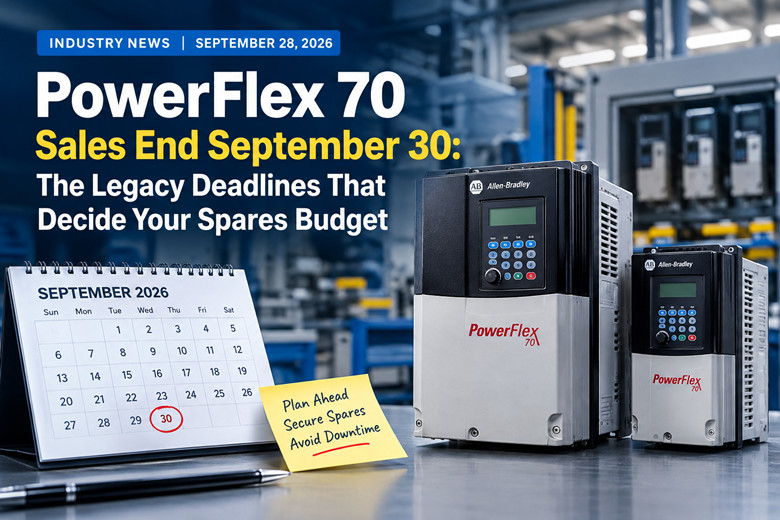
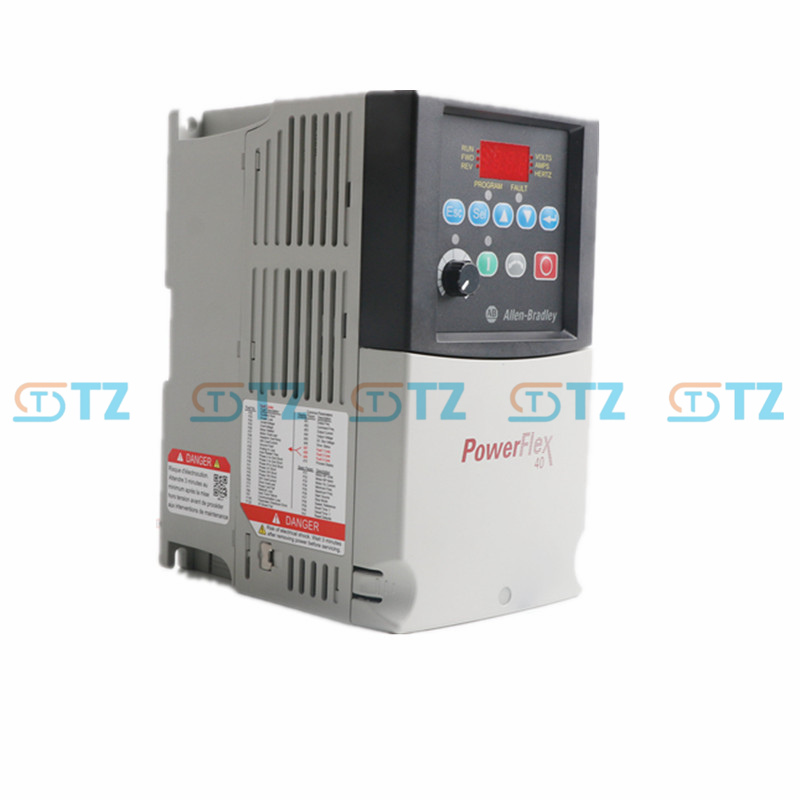
On Wednesday, Rockwell Automation stops selling new PowerFlex 70 drives. Not all of them, but the ones most plants actually have bolted into a cabinet. If you have a line running on a PowerFlex 70 and you have not yet decided what happens when the next one fails, that decision has now been forced on you. It is two days out. I have watched three of these transitions in fifteen years. The pattern does not change. The vendor announces, everyone nods, nobody budgets, and eighteen months later a maintenance tech is on a phone at 2 a.m. trying to find a rebuilt unit from a broker who will not answer the provenance question. That is the bill I am trying to keep you from paying. This is not a technical piece. You know what a drive does. This is about what the calendar costs, which parts you can still buy and when, and what you should put on a shelf before the dates arrive. What exactly ends on September 30, and what does not Read the announcement carefully, because the headline oversells it and the detail is where your budget lives. Rockwell's own PowerFlex 70 product page states: "Rockwell Automation announces the PowerFlex 70 AC Drive will be discontinued and no longer available for sale as of September 30, 2026. End of life status and discontinuation date only apply to the IP20/NEMA UL Type 1, IP54/NEMA UL Type 12, and Flange versions. The NEMA 4X versions remain in Active Mature status. To support your transition, we recommend modernizing to the PowerFlex 750 family of AC drives." That is the vendor's language, not mine. Two things matter in it. First, the NEMA 4X versions stay in Active Mature. If your washdown or outdoor installations run 4X enclosures, you keep a sales channel for now. Active Mature is not the same as Active, and it is not a promise of forever, but it is not a stop date either. Do not lump your 4X units in with the rest of the fleet when you build the audit. You will overspend on parts you can still order normally. Second, the stop applies to specific enclosure families, and Rockwell points users to its Product Lifecycle Status search tool to check individual catalog numbers. That is not a formality. A plant with forty PowerFlex 70 nameplates on a spreadsheet thinks it has forty problems. In practice the mix of frames, enclosures and option cards means you have maybe six or eight distinct catalog numbers that actually matter, and some of them are in a different lifecycle status than the rest. Pull the numbers. Read them one at a time. Do not trust the family name. The other half of this news cycle is Mitsubishi Electric, and there the deadlines are longer but the details are sharper. Two Sales and Service bulletins, both issued April 2026 and revised in August 2026, both citing difficulty obtaining components, cover the HF-KN series AC servo motors (Bulletin No. 26-07AE) and the MR-JN series AC servo amplifiers (Bulletin No. 26-06AE). The HF-KN has been on the market 17 years, since 2009. That is a long run for a servo motor, and it means the installed base across packaging, food processing and light assembly lines is deep. The bulletin sets a made-to-order transition on March 31, 2027, order acceptance through March 31, 2028, last shipment and production end on March 31, 2029, and repair acceptance and parts supply through March 31, 2036. A third bulletin, No. 26-09AE, covers the MR-EM340GF Simple Motion board and the SW1DND-EMSDK-B MELSOFT EM Software Development Kit. Same dates. More on that one shortly, because the replacement part is the awkward one. The calendar, in the order it will hit you Here is the sequence. No table, just the dates in the order they land, because that is how you build a purchase order schedule. · September 30, 2026: new PowerFlex 70 sales end for IP20/NEMA UL Type 1, IP54/NEMA UL Type 12, and Flange versions. Two days from now. If you need a new unit in one of those enclosures, this is the last full business week and it is already ending. · December 2026: the FX3G series PLC reaches its discontinuation date, following a June 2025 Mitsubishi announcement that set a last order date of June 2026 with the FX5UJ as the recommended successor. If you missed that order date, you are already in the secondary market for FX3G hardware. Note this one, because it is the case study for the whole article: the notice came eighteen months ahead, the last order date passed quietly in June, and the discontinuation date arrives in December with nobody's attention on it. · March 31, 2027: HF-KN servo motors, MR-JN servo amplifiers and the MR-EM340GF motion board and its SDK all move to made-to-order. This is the first real pinch point. Made-to-order means lead times stretch and the vendor is building to demand, not to stock. If you have a project commissioning late 2027, that date is on your critical path whether your project manager knows it or not. · April 2027: CE and UKCA marking removal takes effect on orders received on or after that date, for the same three Mitsubishi product groups. This is a different kind of deadline, and I will give it its own section below. · March 31, 2028: order acceptance closes on HF-KN, MR-JN and the MR-EM340GF. After this date you cannot place an order at all. This is the hard buy date. Everything before it is planning. After it, you are buying from someone else's shelf. · March 31, 2029: last shipment, and production ends, for HF-KN, MR-JN and the MR-EM340GF. Whatever was ordered by March 2028 ships by this date and then the factory stops. · March 31, 2036: repair acceptance and parts supply end for the same Mitsubishi product groups. Seven years of repair window after production ends. That is generous compared to what most drive lines get, and it is the single most important line in this article for anyone panicking about a 2029 date. Read that list once more and notice what is missing. Rockwell has published a sales end for the PowerFlex 70. Rockwell has not, on the material I can find, published an end of repair, end of support or spare parts cut-off for the same drive. I am not going to invent one for them, and you should be suspicious of any supplier who tells you a Rockwell repair window that the vendor has not stated. The absence of a date is not a runway. It is an absence of a date. Plan accordingly. Why April 2027 is not like the other dates Every other date on that calendar is about volume: can I order it, will it ship, can it be repaired. April 2027 is about paperwork, and paperwork is the deadline that catches European and UK plants off guard. Both the HF-KN and MR-JN bulletins state, in Mitsubishi Electric's own words: "The CE marking will be removed from the [series] because it does not comply with the EU Cyber Resilience Act (CRA). In conjunction with the removal of the CE marking, the UKCA marking will also be removed. The orders received by Mitsubishi Electric on or after April 2027 will be supplied without the CE marking and UKCA marking." I am reporting that as the vendor's statement. I am not going to argue the legal reading of it, because that is for your compliance people, not for a spares buyer at 6 a.m. on a Monday. What I will tell you is the practical consequence, and it is a procurement consequence, not a technical one. If your plant is in the EU or the UK and your machinery documentation references CE or UKCA marked components, an order placed in April 2027 arrives with a rating plate that looks different from the one in your existing drawings. That is a conversation with your quality manager, your notified body if you have one, and whatever customer audit sits over your head. It is not a conversation you want to have for the first time the week you need the part. The hazard gets worse, and the bulletins say so plainly: both the former and the new versions may be in distribution at the same time depending on stock status. That means a distributor with old marked stock and a distributor with new unmarked stock can both quote you the same catalog number on the same day, and the marking on the plate may differ. If you need a specific marking, you have to specify it on the purchase order and you have to confirm it at goods-in. Assume nothing from a part number alone. For a plant in the Middle East or the Americas, this matters less directly, though it matters if you export machinery into Europe or if your OEM builds to European documentation. And it matters for resale value on anything you later sell into the EU. Know which of your three audiences applies before you decide how much of the April 2027 date is your problem. The MR-EM340GF has one more wrinkle. Mitsubishi states that the recommended replacements, the motion control software SWM-G or the motion control board MR-EM441G, are not compatible with the MR-EM340GF and differ in specification. That is the vendor's language, and it is about as clear as a vendor gets. There is no drop-in. The replacement SDK is SW1DND-EMMSDK-B, and the bulletin references Mitsubishi document No. 26-21E, titled "Change in Packaging Labels and Rating Plates due to Enforcement of EU Cyber Resilience Act." If you run an MR-EM340GF, the part is not a stock buy. It is a migration project with its own engineering hours, and it belongs in the capital plan, not the consumables budget. What this costs, and what it does not Let me separate the fear from the bill, because the two are not the same number. The fear is that September 30 means your PowerFlex 70 fleet is orphaned and every failure is a line-down event. That is not what the announcement says. Sales end is not support end. Rockwell stops selling new units in three enclosure families. It has not announced a repair cut-off. Your existing drives keep running, and the installed base is large enough that the third-party repair and remanufacturing market will serve it for years. For legacy drive spares, the practical question is not whether parts exist. It is who has them and what condition they are in. The fear on the Mitsubishi side is the same, and the bill is smaller than you think. The repair window runs to March 31, 2036. That is seven years past production end. Most plants will have migrated off HF-KN and MR-JN long before that, because the replacement lines exist and are documented: HF-KN053(B) to HK-KT053W(B), HF-KN13(B) to HK-KT13W(B), HF-KN23(B) to HK-KT23W(B), HF-KN43(B) to HK-KT43W(B), HF-KN73(B) to HK-KT7M3W(B) on the motor side, and MR-JN-10A to MR-J5-10A, MR-JN-10A1 to MR-J5-10A, MR-JN-20A to MR-J5-20A, MR-JN-20A1 to MR-J5-20A, MR-JN-40A to MR-J5-40A on the amplifier side. If your architecture runs an MR-JN-10A1 or MR-JN-20A1 on a 1-phase 100 V AC input, note that Mitsubishi requires the MR-CM08K1 simple converter in combination. That is a line item people miss when they quote the swap. The Mitsubishi bulletins do add one honest caveat worth reading twice: repairs may not be possible once component inventory is exhausted. So the repair window is a maximum, not a guarantee. Anyone telling you 2036 is a certainty has not read past the date line. That leaves the real variable, and it is not the vendor. It is the secondary market. Once orders close, every part you buy comes off someone's shelf. Condition and provenance become the deciding factors, and those do not appear on a data sheet. A remanufactured MR-JN that has been tested on a load bank with a documented repair record is a different asset than a unit pulled from a decommissioned panel and wiped down. Both can be quoted at the same price. Only one belongs on a critical line. The way you control that is by knowing your supplier's testing procedure before the emergency, by keeping serial numbers on your own units so you can trace what came back from repair, and by deciding in advance which of your lines can tolerate a used unit and which cannot. For a plant, servo drive parts and drive spares bought from the secondary market are a legitimate, budget-saving route, provided the supplier tests, documents and warrants. The moment a supplier cannot describe their incoming inspection, the price stops being the point. The decisions this forces this quarter You have a short list and a long list. Do the short list in the next ninety days, before the March 2027 date starts pulling lead times. 1. Run a spares shelf audit against actual installed units. Walk the floor, pull every nameplate, and record catalog number, serial number, enclosure type and date of installation. This is the step everyone skips and it is the step that saves the most money. You will find drives on the shelf that belong to lines you decommissioned in 2019, and you will find lines running hardware that nobody has a spare for. 2. Build a clean catalog number list, one line per distinct number, with quantity installed and quantity on the shelf. On the PowerFlex 70 side, sort the list by enclosure family and check each number against Rockwell's Product Lifecycle Status tool rather than assuming the family status applies. On the Mitsubishi side, separate the three groups: HF-KN, MR-JN, MR-EM340GF. 3. Set a stock buy date tied to the real deadline, not the scary one. For Rockwell that date is now, for the IP20, IP54 and Flange units you still run. For Mitsubishi the hard date is March 31, 2028 for order acceptance, and the made-to-order transition on March 31, 2027 is the date by which lead times start hurting you. Anything you intend to buy new, buy before March 2027 or accept the lead time. 4. Start the migration case for the capital plan, not for the emergency. A migration case is a one-page document: how many units, what the replacement part number is, what changes in the panel, what the engineering hours look like, and what the plant loses if it does not do it. For MR-EM340GF that document is mandatory because the replacement is explicitly not compatible. For PowerFlex 70, Rockwell recommends the PowerFlex 750 family, so the case is a modernization, and modernizations go in next year's budget, not this month's emergency account. 5. Brief your quality or compliance contact on the April 2027 marking change, before it becomes a goods-in problem. It is a fifteen-minute conversation today and a stranded shipment later. That list is small on purpose. You are not going to migrate forty drives this quarter, and you should not try. You are going to know what you have, buy the parts that go away first, and put the rest on a documented track. Where a spare parts supplier fits I am not going to pretend a parts supplier solves a lifecycle problem. We do not. What a good supplier does is narrower and more useful: it holds stock on the numbers you are about to lose, it can tell you which units it has tested and how, and it does not disappear during the week you actually need the part. What you should ask any supplier quoting you on discontinued hardware, and ask before you need them: Do they test, and on what? A load test on a drive and a run test on a servo are minimums. Ask for the procedure. Can they trace provenance on a used or remanufactured unit? If they cannot describe where a part came from, treat the unit as unknown condition. Do they hold buffer stock on the numbers you care about, or do they source to order? Sourcing to order means your lead time equals their lead time, which is exactly the problem you were trying to solve. Will they confirm the marking on the rating plate for Mitsubishi parts after April 2027? If you need CE or UKCA, this is the question that separates a supplier who understands the change from one who has not read the bulletin. The honest answer for most plants is a mixed model. Critical lines get new or vendor-repaired units. Non-critical lines and low-frequency spares come from tested secondary stock. Automation spares sourced that way, with documented testing, beat an unplanned line-down every time. Get that mix decided before the calendar decides it for you. FAQ Does September 30, 2026 mean my PowerFlex 70 drives stop working or stop being supported? No. It means Rockwell stops selling new units in the IP20/NEMA UL Type 1, IP54/NEMA UL Type 12 and Flange families. Your installed drives keep running. Rockwell's published material documents the sales end and points users to its Product Lifecycle Status tool for individual catalog numbers. It does not publish a repair or support cut-off for this drive, and you should not accept a supplier's claim that it does. My plant runs NEMA 4X PowerFlex 70 units. Am I affected? Not by this date. Rockwell states the NEMA 4X versions remain in Active Mature status. Active Mature is not the same as Active, so keep it on your watch list, but you are not in the September 30 stop. What is the actual last date I can buy HF-KN motors and MR-JN amplifiers? Per the Mitsubishi bulletins, order acceptance runs through March 31, 2028, and last shipment and production end is March 31, 2029. The made-to-order transition happens earlier, on March 31, 2027, so treat March 2027 as the date lead times start working against you. Is the April 2027 CE marking change a reason to stop using these parts? That is a decision for your compliance function, not for the parts buyer. Mitsubishi Electric states that CE marking will be removed because the series does not comply with the EU Cyber Resilience Act, that UKCA marking will also be removed, and that orders received on or after April 2027 will be supplied without either marking. What it means for your machinery documentation depends on your market and your customer requirements. Can I buy the replacement part and drop it in? On the motor and amplifier side, the replacement lines are documented (HF-KN to HK-KT, MR-JN to MR-J5), and there are combination notes, including the MR-CM08K1 simple converter for certain 1-phase 100 V AC configurations. On the MR-EM340GF, Mitsubishi states plainly that the recommended replacements are not compatible and differ in specification. That one is an engineering project, not a part swap. How long should I plan on the repair route? Mitsubishi bulletins set repair acceptance and parts supply through March 31, 2036 for HF-KN, MR-JN and the MR-EM340GF, with the caution that repairs may not be possible once component inventory is exhausted. Plan the repair route as a bridge, not as a permanent strategy. The FX3G situation is already past its last order date. What does that tell me? It tells you the notices are accurate and the dates are real. Mitsubishi announced the FX3G discontinuation in June 2025, set a December 2026 discontinuation date and a June 2026 last order date, with the FX5UJ as successor. The last order date passed. If you were not watching, you are now buying FX3G hardware from stock. That is exactly the position you do not want to be in with HF-KN and MR-JN in 2028. Should I buy a lifetime supply of spares now? Rarely. Shelf stock costs money, ties up capital and can degrade. Buy what your failure history says you consume over the made-to-order window plus a buffer, not a lifetime. The exception is a part with no compatible replacement, like the MR-EM340GF, where the case for holding stock is stronger because the alternative is a redesign. SEO fields - do not paste this block into the website Meta Title PowerFlex 70 Sales End September 30: Legacy Deadlines Meta Description Rockwell PowerFlex 70 sales stop September 30, 2026, and Mitsubishi HF-KN and MR-JN run out in 2029. The deadlines, the CE marking change and what to stock now. URL Slug powerflex-70-sales-end-legacy-automation-deadlines-2026 Category news Publishing steps: 1) paste Meta Title + Meta Description into the Yoast SEO fields, 2) set the URL slug, 3) pick the category, 4) request indexing in Search Console. Site: tztechio.com
View More

Holiday Notice: Mid-Autumn Festival and National Day 2026 Dear customers, Our office and warehouse in Xiamen will be closed for two public holidays: Mid-Autumn Festival: September 25 to September 27, 2026 National Day: October 1 to October 7, 2026 We are back at work on Thursday, October 8, 2026. September 28 to 30 are normal working days. Orders. Orders confirmed and paid by September 30 will be dispatched before the National Day closure, subject to stock. Orders received during the closures are processed in the order they arrive, starting October 8. If you need parts in October, send your enquiry before September 30 so we can confirm stock and shipping in time. Support. Email and WhatsApp messages are still received during the holiday, but replies will be slower. For urgent breakdowns, send the part number and fault details to WhatsApp +86 175 5077 6091 and we will come back to you as soon as we reopen. Thank you for your continued business. We wish you a good week. Xiamen Zantang Technology Co., Ltd Tel / WhatsApp: +86 175 5077 6091 Email: info@tztechautomation.com tztechio.com
View More
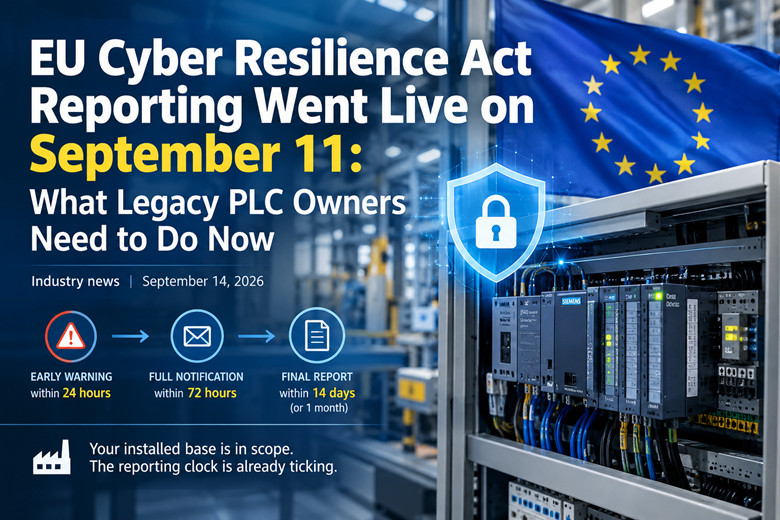
*Industry news | September 14, 2026* The date that matters to you is not 11 December 2027. It is 11 September 2026, three days ago. On that Friday, the reporting duties under the EU Cyber Resilience Act started to apply, and they apply to the equipment already bolted into your cabinets, not to the equipment you might buy next year. If a controller, HMI or drive on your floor has a data connection and someone actively exploits a vulnerability in it, the company that made it now has 24 hours to raise an early warning and 72 hours to file a full notification with an EU platform. Nobody sent you a letter about it. Your spare parts shelf and your capital plan were both built around the December 2027 date, because that is the date everyone quoted, and that date is still real for the CE marking side of things. It just is not the date that governs reporting. Those two dates now sit three months and roughly fifteen months apart, and the gap between them is where a plant gets caught out. Here is the operational version. Reporting started. Your installed base is inside it. Your patch path for most of that installed base probably does not exist. Those three sentences together are the whole story, and the rest of this piece is about what a maintenance or plant manager can actually do with them. What changed on September 11 The Cyber Resilience Act is Regulation (EU) 2024/2847. It entered into force on 10 December 2024. Article 71(2) is the article that sets out when the pieces switch on, and it does so in stages rather than all at once. Chapter IV, the part about notified bodies, has applied since 11 June 2026. Article 14, the reporting duty, applies from 11 September 2026. The main conformity regime, meaning the Annex I essential requirements, the technical documentation and the CE marking, applies from 11 December 2027. On the Friday just gone, what became live is the obligation on manufacturers to report. From 11 September 2026, a manufacturer must report actively exploited vulnerabilities and severe incidents affecting the security of products with digital elements. This is the Article 14 reporting duty. In plain terms: if a connected product the manufacturer sells is being exploited in the wild, the manufacturer has to tell the authorities, and it has to do it fast. Fast means measurable. Once the manufacturer becomes aware, it files an early warning within 24 hours, a full notification within 72 hours, and a final report no later than 14 days after a corrective measure is available for an actively exploited vulnerability, or within one month of the 72-hour notification for a severe incident. Reporting is done once, through the CRA Single Reporting Platform, or SRP, which was established by ENISA under Article 16 and was operational on 11 September 2026. The notification goes to the CSIRT of the manufacturer's main establishment and gets shared with ENISA and the other national CSIRTs. ENISA published the list of CSIRT coordinators covering all 27 member states on 4 September 2026, which tells you the plumbing was being finished right up to the deadline. There is one detail circulating that gets misread, and it matters because it separates a public-relations problem from a legal one. Commission Delegated Regulation (EU) 2026/881, adopted on 11 December 2025, lets a receiving CSIRT delay onward dissemination on cybersecurity grounds. Read that carefully. It restricts who sees a report. It does not change when it is filed. Nothing in that delegated regulation pauses the manufacturer's own filing clock. If you are talking to a vendor who suggests the clock might be paused, the clock is not paused. Then there is Article 14(8), which adds a separate duty to inform impacted users. If the manufacturer does not do that in time, the notified CSIRTs may inform users themselves where they judge it proportionate and necessary. That is the part to keep in your back pocket during a warranty conversation, because it is the regulation's own answer to the question of who eventually tells the plant. If the maker stays quiet too long, the regulator can go around them. Why legacy equipment is caught The assumption I hear most often, and I have heard it in almost those words from people who should know better, is that anything sold before December 2027 is grandfathered and therefore irrelevant to this regulation. That is half true, and the half that is false is the expensive half. Article 69(2) grandfathers products placed on the market before 11 December 2027 unless they undergo a substantial modification after that date. So an untouched machine, sitting there doing its job with the original firmware and no significant changes, is outside the CE marking and Annex I essential requirements. Fine. For an unmodified line you are not going to get dragged into a conformity project, and nobody is going to ask you to re-document a panel that was built in 2011. Article 69(3) overrides that specifically for reporting. The Article 14 duty applies to all in-scope products with digital elements placed on the market before 11 December 2027, with no age cutoff and no carve-out for old equipment. Sit with the phrase "no age cutoff" for a second. It does not say five years, it does not say ten years, and it does not say "still supported." It says all in-scope products placed on the market before that date. Now combine that with the scope rule. Products with digital elements whose intended or reasonably foreseeable use includes a direct or indirect logical or physical data connection to a device or network are in scope. Your plant runs Siemens, Rockwell, Mitsubishi and a long tail of other brands, mostly as controllers, HMIs, drives and I/O blocks. The ones that sit on Ethernet or on any fieldbus that reaches the plant network, or that anyone can plausibly connect a laptop to, tick that box. There are explicit exclusions, and they are narrow and specific: medical devices, vehicle type approval, civil aviation products, marine equipment, products developed exclusively for national security or defence, and identical spare parts. A packaging line controller is not on that list. So here is what that means for a plant running controllers and HMIs installed between 2005 and 2020. You are not the obligated party. The manufacturer is. But the equipment you own is the subject of the obligation, and it is subject to it without any age limit. A thin-client panel PC commissioned in 2008 is as much a candidate for a reported exploited vulnerability as a unit shipped last month, as far as the reporting duty is concerned. The item on your floor has not changed. What changed is that the company that made it now has a legal clock attached to what happens to it. There is a practical consequence buried in that, and it is the one I would want my own team to understand. In a reporting regime with a 24-hour clock, the manufacturer's willingness and ability to know what is happening in old equipment becomes a compliance asset. Vendors who cannot see into a decade-old build are not off the hook. They have to report what they know. But the flow of information runs through their support and security channels, and if your plant is not in that stream, you will be the last to know. The part that should worry a plant manager more than the reporting Reporting is somebody else's deadline. The patch question is yours, and it is worse. Think about the sequence. A vulnerability in an out-of-support controller gets actively exploited. The manufacturer becomes aware, and it starts a 24-hour clock and then a 72-hour clock. Under Article 14 it has to say what it knows. What it does not have to do is fix the thing. The Commission has been explicit that a manufacturer may genuinely be unable to investigate a vulnerability in a legacy product, because build environments cannot be recreated, dependencies are unavailable, or the people who knew the code have left. In that case the manufacturer must still notify, but is not required by the regulation to meet the other obligations, such as vulnerability handling. The duty is to report what is known, not to reopen a decade-old build. Read that as an operations manager and the sentence has teeth. An out-of-support controller will not get a patch. It may well get reported. So there is now a defined path where the world learns that your line is exploitable, the maker files the paperwork on time, and nothing physically changes at your plant. The report is a disclosure event, not a remedy. That reframes the support period from a nice-to-have procurement line into a security date, and it shifts where the risk sits. Under Article 13(8), a manufacturer must define a support period for vulnerability handling, at least five years or the expected in-use period if shorter, starting when the product is placed on the market, and must disclose the support period end date at the point of purchase in at least month and year format. Under Article 13(9), each security update must remain available for at least 10 years after issuance, or for the remainder of the support period, whichever is longer, and security updates must be supplied free of charge, with a narrow exception for tailor-made business products. A minimum support period of five years is a floor set by regulation, and it is short. Five years from a purchase order in 2026 lands in 2031. Five years from a 2019 order landed in 2024, which is already behind us. I have panels in this plant older than some of the people who now run them. So the stated support end date, in month and year, is now the closest thing you have to an expiry label on a control asset, and it belongs in the asset register next to the model number, not in a supplier's marketing deck. The migration argument follows from that without any engineering. If the support end date is the last date you can expect a vulnerability fix, and the reporting regime reaches back before 2027 with no age cutoff, then an end-of-support date is a security date. A dated security date is a procurement problem. It is not an IT problem, because IT does not buy the controller, does not stock the spare, and does not own the line when the migration window closes. It sits on the maintenance manager's desk, and eventually on the capital committee's desk. What the plant has to do None of this requires you to become a compliance officer. It requires four pieces of work that a manager can assign to named people, and one of them can start this week. Build an asset list of connected control equipment, with the support period end date next to each item. The word "connected" is doing real work there. Anything on the plant network, anything on a fieldbus that bridges to it, anything an integrator or a vendor laptop plausibly touches. If you have a CMMS or an asset register that already holds the tag numbers, extend it rather than starting a parallel spreadsheet, because a second list will rot. Ask suppliers and distributors for the declared support end date in writing. For anything bought from now on, treat that date as a specification alongside I/O count and price. Nobody negotiates a controller without knowing how many digital inputs it has. From this quarter, the support end date belongs in the same conversation, in months and years, in writing, on the quote if you can get it. A verbal answer is not a support statement. Put every automation vendor's security advisory channel on someone's job description. Not a shared inbox nobody reads, and not a personal email that leaves when the person does. A named role, with a backup, and a bench check that both people can log in. Vendor advisories are how you find out that a vulnerability has moved from theoretical to actively exploited, and that is the trigger point for everything in this article. Sort the equipment into what can still be patched and what cannot. That split is not a compliance exercise. It is your migration queue. Everything inside a support period goes on the maintain list. Everything outside it goes on the migration list, ordered by how much the line costs you when it stops. That is the whole triage. You do not need a risk model to draw that line; you need the support dates from step two and a view on criticality, which you already carry in your head. Fold 11 December 2027 into the capital plan rather than treating it as an IT matter. That is the date the full conformity regime applies, and it is also the deadline that has been quoted at you for two years, which is exactly why it is the wrong date to plan around alone. If your migration queue only gets funded when the 2027 date starts to bite, you will be executing migrations under time pressure with no negotiation room on lead times or price. Funding the queue a year early is cheaper than funding it in the last quarter of 2027, and the security argument is now the reason to do it rather than a slogan. There is one more thing that belongs in a manager's head, and it is about relationships rather than process. Your route to a support statement is usually the distributor or reseller who sold you the module, or the integrator who specified it. Those people have the manufacturer relationship you do not, and they can get a written answer where your general inquiry goes nowhere. This is a reason to keep a small number of parts and support relationships in decent condition rather than chasing the cheapest quote on every single transaction. When you need a support end date in writing, a documentation response or a last-time-buy allocation, you find out quickly who actually wants your business. Timetable Date | What applies 11 June 2026 | Chapter IV of the regulation, on notified bodies, applies. 11 September 2026 | Article 14 reporting duties apply. Manufacturers must report actively exploited vulnerabilities and severe incidents affecting the security of products with digital elements. Once a manufacturer becomes aware | The reporting clock runs: early warning within 24 hours, full notification within 72 hours, and a final report no later than 14 days after a corrective measure is available for an actively exploited vulnerability, or within one month of the 72-hour notification for a severe incident. 11 December 2027 | The full manufacturer conformity regime applies, including Annex I essential requirements, technical documentation and CE marking. Two notes on that table. First, the reporting row in the middle is not a one-off event. It is a standing obligation that fires each time a manufacturer becomes aware of an actively exploited vulnerability or a severe incident, which is why the clock, not the date, is the thing to keep in view. Second, the two dated rows are not the same project. The September 2026 row is about disclosure and it is already running. The December 2027 row is about conformity and it is what your capital plan has to absorb. Penalties, briefly Article 64 sets the money. For breaching the Annex I essential requirements or the Article 13 and Article 14 obligations, administrative fines run up to EUR 15 million or, for an undertaking, up to 2.5 percent of total worldwide annual turnover for the preceding financial year, whichever is higher. Other obligations carry up to EUR 10 million or 2 percent. Supplying incorrect, incomplete or misleading information to notified bodies or market surveillance authorities carries up to EUR 5 million or 1 percent. Member States set the rules on penalties, so the practical enforcement shape will vary by country. That is the manufacturer's exposure. It is not yours, and I would not invent a number for what it costs a plant, because it does not. What it does do is explain behavior. A supplier facing a potential EUR 15 million fine, or 2.5 percent of group turnover, has a hard reason to build a real vulnerability process: intake channels, triage, an ability to say something within 24 hours. It also has a hard reason to be careful about what it writes down. Expect documentation requests around supported life, update availability and known-issue status to get more serious over the next eighteen months, and expect a vague verbal answer to be replaced by a templated written one. That is a good outcome for a buyer, on balance, because a manufacturer that has to measure something tends to manage it. The buyer's job is to ask the question in a form that produces a dated answer rather than a brochure. I would not read too much else into the penalty numbers. Nobody is being fined today, and I am not aware of any enforcement wave arriving before the conformity regime starts in 2027. The reason to care now is that the September date is live and the incentive it creates reaches into how much information you get about your own plant. The spare parts angle Identical spare parts are excluded from the scope of the regulation. That exclusion is real and it is specific, and it is relevant to what a parts supplier sells. If you buy an identical replacement module to swap into a cabinet that already has that module, the spare part itself is not a product with digital elements under this regulation. Do not turn that into a compliance answer, because the controller those parts go into is not excluded. The exclusion carves out the spare part; it does not carve out the device the part sits in. A plant cannot retire its exposure by buying one more identical module for the shelf. When that controller becomes the subject of a report because a vulnerability in it is being actively exploited, the spare part exclusion does nothing for you at all. The real answer is one of two things. Either a support period that runs long enough that you never hit the wall, or a migration plan with a date on it. There is no third option that involves a purchase order and a shelf. That said, the spares side and the migration side are not in conflict, and a manager should not treat them as such. Keeping critical systems running while migration is scheduled is the whole job, and an out-of-support line usually needs stocked spares precisely because it cannot be patched. Think it through from the operations side. If a controller is end-of-support, there is no firmware fix coming, so a failure of that controller is a hardware event you have to answer with hardware. The migration may be eighteen months out in the capital plan, and the line still has to run every shift in between. That means the last-time-buy question, the stock level and the sourcing route for that controller become more important, not less, in the period between the security date passing and the migration date arriving. A spare on the shelf is not a fix for the vulnerability. It is how you survive the exposure long enough to migrate away from it, which is a different and legitimate thing. There is a further reason to keep the parts route warm, and it is not about the regulation at all. A migration program takes years to execute in a plant of any size. In that window, brownfield lines break the way brownfield lines always break, at the worst possible moment, on the shift with the least cover. The plant that has a documented parts route and a sensible stock position moves through its migration without the two problems colliding. This week's checklist 1. Start the connected asset list. Get tag numbers, manufacturer, model and a rough install year for every controller, HMI, drive and I/O block that reaches the plant network. Assign one owner and set a date to have the first pass done. The support end date column can be blank for now. 2. Send a written support period question to the top five vendors or distributors by installed base. Ask for the support period end date for each product family, in month and year, in writing. Note the date you asked and put a follow-up on the calendar. 3. Name the person who owns vendor security advisories, and the backup. Confirm both can actually access the channels for your main automation brands. If not, get the subscriptions set up this week. 4. From now on, treat the support end date as a specification on new purchases, alongside I/O count and price. Add it to the standard inquiry template so it stops being an optional question. 5. Run the first triage pass: mark everything inside its support period as maintain, everything outside as migrate, and rank the migrate list by what a stop costs the line. You now have a migration queue with a security rationale behind it. 6. Put 11 December 2027 in the capital plan as a dated line item with a budget number attached, not a note. The conformity regime starts that day and it is the deadline that funds your migration queue. 7. Note the September 2026 fact in whatever risk log or plant review you run. Reporting is live, it reaches back with no age cutoff, and it is the reason your support end dates now get read as security dates. None of this is paperwork for its own sake. It is the same set of facts a maintenance manager would want anyway, which is what the equipment is, how long it will be supported, what it costs to keep running, and when it gets replaced. The regulation just put dates on the columns. If you need a fast read on what is still serviceable and what should be heading for the migration queue, the controller and drive pages at tztechio.com/plc and tztechio.com/industrial-automation are a reasonable place to check part availability against your asset list, and the brand pages for Siemens and Allen-Bradley cover most of what sits in a European legacy panel. Start with the asset list. The rest follows from it. -------------------------------------------------------------------------------------------- 🏢 About TZ Tech TZ Tech is a leading supplier of industrial automation, electrical, instrumentation, and telecommunications components. We specialize in sourcing ready-to-ship distributor stock, allowing us to offer highly competitive pricing and short lead times. Thanks to our extensive inventory, we can even source rare and discontinued parts that are hard to find elsewhere. 🛡️ Our Quality Commitment We understand that quality is your top priority. Every component undergoes a strict screening and inspection process so you can buy with absolute confidence. For legacy or discontinued parts, we believe in complete transparency and will always provide an honest, accurate report on the product's condition. Plus, all brand-new parts come backed by a full 1-year warranty. ✉️ Get in Touch Have a project or a part you need? Send us your inquiry today! Our team is dedicated to providing a fast response within 6 hours (excluding weekends).
View More
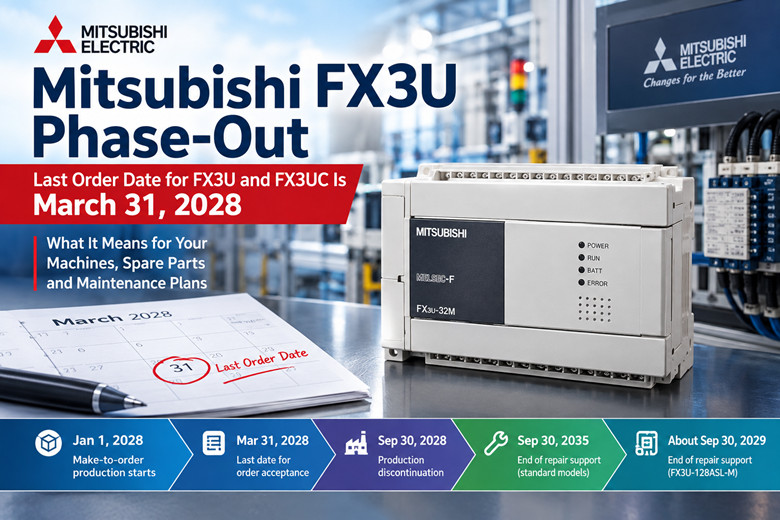
*Industry news | September 7, 2026* Mitsubishi Electric has put an end date on the MELSEC-F FX3U, the micro PLC that has run a large share of the world's small machines since it launched in 2004. In Technical Bulletin FAM-A-0116-B, "Production Discontinuation of the MELSEC-F FX3U/FX3UC Series Models and Extension Models," issued in April 2026 and updated as Version B in May 2026, Mitsubishi sets out the formal wind-down: make-to-order production begins January 1, 2028, order acceptance closes March 31, 2028, production stops September 30, 2028, and repair support continues until September 30, 2035. The official bulletin PDF is public on Mitsubishi's technical news page. The schedule matters well beyond the PLC industry's usual end-of-life notices. The FX3U is not a niche controller. Since 2004 it has been the default brain inside packaging lines, labeling machines, small water-treatment skids, HVAC panels, gate and valve controls, and OEM-built machines that ship to every market on earth, and it became the flagship of the MELSEC-F micro family. When a platform with that installed base gets a final order date, the news reaches past Mitsubishi's catalog into the spares strategy of every plant that still runs one. The practical summary for buyers and maintenance engineers: normal catalog ordering of FX3U and FX3UC products continues through 2027. From January 1, 2028, Mitsubishi builds these models only to order, and the last day a new order can be accepted is March 31, 2028. Units ordered in that window will be produced in the months that follow, and new production ends September 30, 2028. Repair support then runs seven years, to September 30, 2035, with one exception: the FX3U-128ASL-M, developed jointly with Anywire Corporation, gets only about one year of repair support after production stops. Why the FX3U phase-out is a bigger event than a typical end-of-life notice Mitsubishi's stated reason is the one that ends most long-lived electronics: the supply chain ran down. The bulletin says production parts for the target models have been discontinued one after another, making it hard to maintain production, and that the manuals for the target models will be discontinued as well. The FX3U announcement is the latest step in a broader contraction of legacy MELSEC hardware. Through 2026 Mitsubishi set a September 30, 2026 final order deadline for the high-speed Universal Q CPUs under bulletin FA-A-0418-A and moved the MELSEC-L series to make-to-order under bulletin FA-A-0466-A. The pattern: Mitsubishi is concentrating development and production on current platforms, chiefly the MELSEC iQ-F (FX5) series for the small-machine class, giving each legacy family a defined, published end rather than an open-ended availability promise. None of this makes the FX3U a bad controller or existing machines obsolete next year. It puts a clock on new supply, and the window to buy new units and stock spares for machines that will run into the 2030s is finite and published. For anyone who maintains FX3U equipment, the time to plan is now. The phase-out schedule at a glance Milestone | Date | What it means in practice Make-to-order production starts | January 1, 2028 | Mitsubishi stops building FX3U/FX3UC and related extension products for stock. Orders continue to be accepted, but production runs to order. Last date for order acceptance | March 31, 2028 | Final day Mitsubishi will accept new orders for the affected models. After this date, no new orders can be placed through normal channels. Production discontinuation | September 30, 2028 | Manufacturing ends. Orders placed before March 31 are produced in the intervening months; after this date there is no new production at all. End of repair support, standard models | September 30, 2035 | Seven years after production discontinuation. Repair requests are handled within this window, subject to repair parts availability. End of repair support, FX3U-128ASL-M | About September 30, 2029 | The AS-Link master module co-developed with Anywire Corporation gets roughly one year of repair support after production stops, about six years less than the rest of the family. The arithmetic from the date of this article makes the urgency concrete. As of September 7, 2026, roughly nineteen months of order acceptance remain: about fifteen months of normal catalog ordering through the end of 2027, followed by the three-month make-to-order window from January 1 to March 31, 2028. Orders placed by March 31 will be built in the six months between the order deadline and the September 30 production stop. For repair planning, the same arithmetic gives a nine-year repair horizon from today for standard models, ending September 30, 2035. The FX3U-128ASL-M is the outlier, with support ending around September 30, 2029, roughly three years from now; any site running that module should treat it as the first item in a spares review. The precise answer to "when is the FX3U discontinued": order acceptance ends March 31, 2028, and new production ends September 30, 2028; everything after that runs on inventory, old stock, and the repair channel. Which FX3U and FX3UC models are affected The bulletin's coverage is broad, a sign of how deep the FX3U ecosystem ran. It covers FX3U main units across their power-supply variants, FX3UC connector-style main units, the FX2N and FX3U and FX3UC extension hardware that bolted onto those CPUs, the programming and communication accessories, and the memory cassettes many sites use for program storage. FX3U main units Mitsubishi groups the affected FX3U main units by power supply type; the example model numbers below come from its own replacement guidance. Affected group | Suffix types covered | Example models named in the bulletin FX3U AC-powered main units | /ES types | FX3U-32MR/ES, FX3U-64MT/ES, FX3U-80MR/ES FX3U DC-powered main units | /DS and /DSS types | Covered by the bulletin's model lists FX3U UA1 types | UA1 variants | Covered by the bulletin's model lists The /ES AC-powered family is the one most readers will recognize, since it accounts for the majority of FX3U machines wired to AC mains. The /DS and /DSS DC-powered variants cover installations that feed the controller from a 24 V DC bus, and the UA1 types are additional voltage variants Mitsubishi sold into specific markets; all are folded into the same discontinuation. The example models show the shape of the affected range. FX3U-32MR/ES is the 32-point relay-output main unit that became the default controller for small machines; FX3U-64MT/ES is its 64-point transistor-output sibling for higher-speed applications; and FX3U-80MR/ES shows the bulletin reaching into the larger main units. Picking these three as worked examples signals that the phase-out covers the mainstream of the family, not just the edges. FX3UC main units The FX3UC is the connector-style compact version of the family, built for machines where panel space is tight and connector wiring replaces screw terminals. The bulletin covers the DC-powered FX3UC main units across their point sizes and suffix variants. Affected group | Point sizes | Suffix types covered | Example model named in the bulletin FX3UC DC-powered main units | 16, 32, 64, and 96 point | /D, /DS-T, /DSS, and /DS-TS types | FX3UC-64MT/D FX3UC machines are common in compact OEM equipment where the connector format keeps wiring tidy and replacement fast. The FX3UC-64MT/D example anchors the replacement guidance: Mitsubishi maps it directly to the FX5UC-64MT/D, preserving the connector-style form factor in the migration path. Extension units, cables, converters, and memory cassettes The affected list goes beyond main units. Because the FX3U system grew by extension, the bulletin covers the extension hardware many installations carry, and it reaches back into the FX2N catalog: FX3U installations frequently mix FX2N extension units with FX3U main units on the same DIN rail, which is why the extension list includes FX2N 32-point-class I/O units among other items. Equipment class | What is affected | Notes I/O extension units and extension models | FX2N, FX3U, and FX3UC I/O extension units and extension models | Includes FX2N 32-point-class I/O units; covers the modules used to grow systems beyond the main unit's onboard I/O Programming and communication cables | FX-422CAB-150 and related cables | The cable family used to link PCs and programming tools to FX-series PLCs Signal converters | FX-USB-AW | The USB signal converter used in PC-to-PLC programming and diagnostic setups Memory cassettes | FX3U-FLROM-64L and FX3U-FLROM-1M | Mitsubishi lists no alternative models for these cassettes The memory cassette item deserves special attention. The FX3U-FLROM-64L and FX3U-FLROM-1M are the flash memory cassettes that plug into FX3U main units for program storage and ROM operation, and the bulletin states that there are no alternative models for them, a stronger statement than a usual replacement note. Sites that use cassettes as their program backup method, or that run programs from ROM mode, will need an engineering answer rather than a purchasing one, because no direct successor exists. For maintenance teams, the practical consequence is simple. The FX-422CAB-150 cable and the FX-USB-AW converter are what an engineer reaches for when a laptop has to talk to an FX3U for programming or diagnostics, and when they leave the catalog the everyday service loop changes. Buy the spares needed before the order deadline; the last-order clock applies to cables and converters just as it does to CPUs. FX5U replacement: the bulletin's recommended migration path Mitsubishi's recommended alternatives are the MELSEC iQ-F series: FX5U, FX5UJ, and FX5UC, a recommendation it has made consistently for years. The iQ-F line is the stated successor platform for the small-machine class, and it moves engineering onto GX Works3 software rather than the GX Works2 environment that FX3U users know. The example mappings below are the bulletin's most useful guidance for engineers planning a changeover. Existing FX3U model | Direct FX5 replacement | Alternative configuration in the bulletin FX3U-32MR/ES | FX5U-32MR/ES | FX5UJ-40MR/ES FX3U-64MT/ES | FX5U-64MT/ES | FX5UJ-60MT/ES plus FX5-8EYT/ES FX3U-80MR/ES | FX5U-80MR/ES | Not listed FX3UC-64MT/D | FX5UC-64MT/D | Not listed /MS sink-triac output variants | /MT transistor units plus external relay adapter boards | FA-TH16YSR20S relay adapter, with FA-CBL10(Y)M20 accessories in some mappings Read the table the way a design engineer would. The cleanest migrations are the direct ones: an FX3U-32MR/ES becomes an FX5U-32MR/ES with the same point count, relay output type, and model-number shape. The FX5UJ alternatives are the economy track: FX5UJ is the slim, cost-oriented entry point of the iQ-F line, and the bulletin shows a 40-point FX5UJ-40MR/ES absorbing a 32-point FX3U application. For the 64-point case, it pairs a 60-point FX5UJ-60MT/ES with an FX5-8EYT/ES eight-point extension to reach the needed I/O count. The /MS mapping is the one that surprises people. The /MS sink-triac output variants were used where outputs had to switch AC loads without relay wear. In the iQ-F world, the bulletin routes those applications to /MT transistor-output units plus external relay adapter hardware, specifically the FA-TH16YSR20S relay adapter board with FA-CBL10(Y)M20 accessories in some mappings. In plain terms, the AC-switching function moves out of the PLC onto an external relay board driven by standard transistor outputs, and specifying that change means checking load currents, switching frequency, and panel space, because the external board occupies real estate the old triac outputs did not. Three engineering realities sit behind every row of the mapping table. First, the iQ-F platform programs in GX Works3, not GX Works2; ladder written for the FX3U does not load into an FX5 as a finished program, and programs that lean on FX3U-specific modules or cassette-based ROM operation need the most rework. Second, the FX5U family adds capabilities the FX3U never had, including built-in Ethernet on the FX5U main units. Third, the FX5UC keeps the connector-style form factor for FX3UC users, so the mounting philosophy survives even where the program does not. For a Mitsubishi PLC parts buyer, migration is a project with an engineering budget, not a swap order, which is why starting before the 2028 deadline matters. What the phase-out means for plants running FX3U today The FX3U installed base will not disappear in 2028. Machines built on FX3U controllers will keep running for a decade or more after production stops, because PLCs are retired when the machine is retired, not when the catalog changes. What the bulletin changes is the supply equation around those machines. Consider the timeline from the plant floor. A machine bought new in 2026 has a repair-support horizon to September 30, 2035, roughly nine years from today, and an older machine has the same horizon. The bottleneck is not the repair window; it is new supply. After March 31, 2028, the only sources of new FX3U units are distributor inventory that has not sold, and after September 30, 2028, the only sources of any FX3U hardware are old stock, the used market, and the repair channel. None of those scale to cover a plant that finds a failed CPU in 2030 with no spares on the shelf. That is the trap for the unprepared. The FX3U will not fail all at once in 2028; it will fail one machine at a time through the 2030s: a power supply after a surge, an output module after a shorted actuator, a CPU after years of heat cycling. Each failure is a trivial fix while new parts are available and a scheduling problem when they are not. The phase-out converts a routine spares question into a finite procurement window that closes March 31, 2028. For OEMs the stakes are different but just as real. Any OEM still designing new machines around the FX3U in 2026 and 2027 is committing those machines to a platform whose order book closes in under two years. A machine program launched in 2027 with a five-year production run will need FX3U hardware until 2032, four years after Mitsubishi stops building it. That math requires either a large upfront spares buy or a mid-run platform change, the most expensive kind. The bulletin is effectively a design-freeze notice for OEMs: new-machine designs should move to the iQ-F line before the window closes, while existing FX3U-based products need a documented last-buy plan. Keep running or migrate: work the decision machine by machine The phase-out does not force a single answer; it forces a decision, machine by machine. The keep-running case is strong for equipment that is mechanically sound and far from the end of its useful life: it needs a spares plan, not a new controller. The migration case is strong for machines that are already retrofit candidates, need new connectivity, or have outgrown the FX3U. Factor | Lean keep running | Lean migrate to FX5 Machine remaining life | Five or more years of sound mechanical life | Machine already near retrofit or replacement Spares position | Clean path to stock CPU, I/O, and accessories before March 31, 2028 | No budget or appetite for a last-buy stock position Program complexity | Simple ladder, well documented, easily re-created if lost | Heavy use of FX3U-specific modules, cassettes, or AS-Link hardware Connectivity needs | Standalone machine, current communications are enough | Plant now demands Ethernet, data collection, or remote access Engineering resources | No in-house GX Works3 experience and no migration budget | Staff ready to move to GX Works3 and revalidate programs FLROM cassette use | None, or program stored only as a file backup | ROM-cassette operation is part of the design, and there is no cassette alternative The keep-running economics deserve a fair hearing. Stocking a spare CPU, a spare I/O module, and the accessories a machine needs is inexpensive relative to a migration, which carries engineering time, program conversion, revalidation, panel rewiring, documentation updates, and the risk of startup problems on a machine that was running fine before. For a healthy machine with simple control requirements, the last-buy spares route is frequently the lower-cost, lower-risk answer. The catch is that the last-buy has a deadline: March 31, 2028. The migration case wins when the machine is already a retrofit candidate. If the plant is re-engineering the panel anyway, putting in an FX5U instead of buying a last FX3U costs little extra and resets the clock: the FX5 platform is current, its production is not under an end-of-life notice, and its repair horizon starts fresh. Migration also wins on capability, since FX5U main units bring built-in Ethernet and the iQ-F line is where Mitsubishi's development effort is concentrated. A plant that standardizes on iQ-F ends up with one engineering environment, GX Works3, instead of maintaining GX Works2 skills solely for an aging fleet. The wrong answer is doing nothing until 2028 and letting the calendar make the decision. A plant that waits until January 2028 to start an audit will be placing last-buy orders in the same quarter it is trying to evaluate migrations, with order books tightening and no time for a second round of purchasing. Every machine in the fleet should carry an explicit keep-running or migrate label, with a date attached, before the make-to-order period begins. The repair reality: a seven-year tail with limits Mitsubishi's repair support runs to September 30, 2035 for standard FX3U and FX3UC models, seven years after production discontinuation. That commitment is the reason the phase-out is not an immediate obsolescence event. But a repair-support window is not a guarantee that every failed board can be fixed on demand. Repairs depend on the availability of repair parts, and the bulletin's own rationale, components discontinued one after another, is the constraint that governs the repair channel as well. As the years pass, repair will get slower and less certain for the oldest modules, worth factoring into spares math rather than assuming effortless coverage for seven full years. The FX3U-128ASL-M exception is the sharpest detail in the bulletin and the easiest to miss. The module, an AS-Link master unit developed jointly with Anywire Corporation, receives only about one year of repair support after production stops, placing its cutoff around September 30, 2029. A co-developed product depends on a partner's supply and service commitments, which run on a different clock than Mitsubishi's own hardware. Any site with FX3U-128ASL-M modules in service should treat them as the highest-priority spares item in the audit: one spare bought before the order deadline costs far less than a network master failure in 2031 with no repair path and no successor on the shelf. There is also a documentation angle. The bulletin states that the manuals for the target models will be discontinued. Wiring guides, programming references, and special-function module documentation should be downloaded and archived before they disappear from Mitsubishi's documentation servers; archived manuals are cheap insurance, and the one asset in this phase-out that does not expire if you grab it now. What to do this week The bulletin rewards early action, and most of the actions are cheap today. A practical checklist for any plant or OEM running FX3U or FX3UC hardware: 1. Pull the installed-base list. Count every FX3U and FX3UC CPU, note the exact model and suffix (which determines AC or DC power, output type, and point count), and flag machines with FX2N extension units, FLROM cassettes, or an FX3U-128ASL-M. 2. Match your models against bulletin FAM-A-0116-B. The PDF is public; confirm every module you run is in scope, including extension units and accessories that are easy to forget. 3. Label every machine keep running or migrate, with an owner and a date, before the end of 2026. 4. Build the spares list for keep-running machines now: CPUs, I/O modules, power-related spares, an FX-422CAB-150 cable, an FX-USB-AW converter, and anything else the service kit needs. Price it while normal ordering is open. 5. Treat the FX3U-128ASL-M as urgent. Its repair support ends around September 30, 2029, about six years before the rest of the family, and a spare should be on order well before March 31, 2028. 6. Resolve the FLROM question. The FX3U-FLROM-64L and FX3U-FLROM-1M have no alternative models, so cassette-based program storage is an engineering task that should start now, not during a 2028 changeover. 7. Archive the manuals for every affected model before they are discontinued, and store them where the maintenance team can find them. 8. Put the dates on the calendar: normal ordering through 2027, make-to-order January 1 to March 31, 2028, production stop September 30, 2028. Set internal procurement deadlines at least a quarter ahead of each date. 9. For OEMs, freeze new-machine designs on FX5 and give existing FX3U-based products a documented last-buy plan with quantities and a date. 10. Run one migration pilot. Convert a simple machine's program to GX Works3 on an FX5U or FX5UJ and validate the bulletin's mapping against real I/O counts and panel constraints. A pilot done in 2027 makes the 2028 deadline a non-event. The bottom line for buyers Mitsubishi has given the market something it does not always get: a precise, published end date with years of warning, and a coherent replacement path in the iQ-F series. The takeaways are clean. New FX3U and FX3UC hardware remains available through normal ordering for the rest of 2026 and all of 2027. The make-to-order window from January 1 to March 31, 2028 is the final opportunity to place orders. Production ends September 30, 2028, and repair support continues to September 30, 2035, with the FX3U-128ASL-M exception ending around September 30, 2029. For plants that act this year, the phase-out is manageable: spares can be stocked, manuals archived, keep-running machines secured, and migration candidates moved to FX5U or FX5UJ replacements on an engineering schedule rather than an emergency one. For plants that wait, the same phase-out becomes a scramble of last-minute orders in a three-month window, rising reliance on old stock, and machines whose repair path narrows year by year. The FX3U earned its place by being dependable, inexpensive, and everywhere. The phase-out does not change that record; it changes the procurement rules, and the new rules have a deadline. The work starts with an audit and a calendar. The PLC spares categories and industrial automation parts sections at tztechio.com track this transition, and the Mitsubishi page is a practical starting point for locating FX3U stock and FX5 alternatives while both remain available through normal supply channels. URL Slug: mitsubishi-fx3u-fx3uc-phase-out-news ---------------------------------------------------------------------------------------------- 🏢 About TZ Tech TZ Tech is a leading supplier of industrial automation, electrical, instrumentation, and telecommunications components. We specialize in sourcing ready-to-ship distributor stock, allowing us to offer highly competitive pricing and short lead times. Thanks to our extensive inventory, we can even source rare and discontinued parts that are hard to find elsewhere. 🛡️ Our Quality Commitment We understand that quality is your top priority. Every component undergoes a strict screening and inspection process so you can buy with absolute confidence. For legacy or discontinued parts, we believe in complete transparency and will always provide an honest, accurate report on the product's condition. Plus, all brand-new parts come backed by a full 1-year warranty. ✉️ Get in Touch Have a project or a part you need? Send us your inquiry today! Our team is dedicated to providing a fast response within 6 hours (excluding weekends).
View More
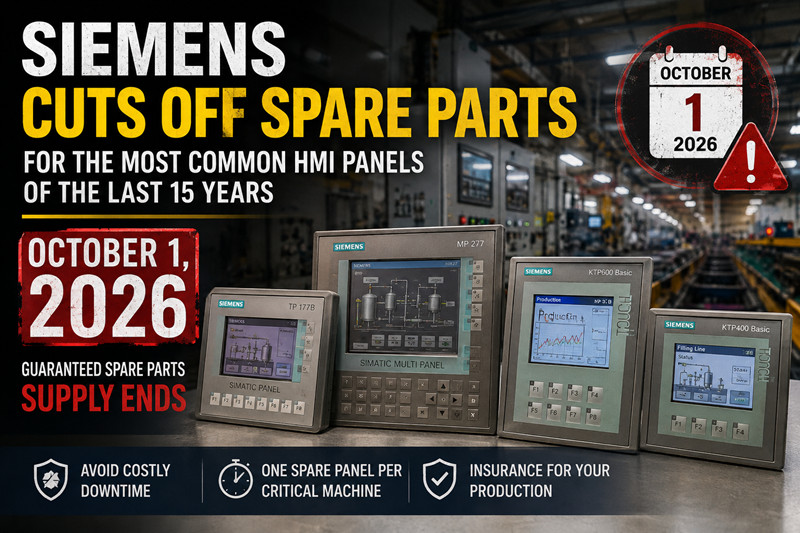
*News analysis for plant managers | August 31, 2026* October 1, 2026 is the date Siemens stops guaranteeing spare parts for the most common HMI panels of the last 15 years. The KTP400 Basic on your filling line, the TP177B on your packaging machine, the MP 277 in the control cabinet of your skid loader, the Mobile Panel 177 your setup crew carries between stations. All of them move to P.M490 on that date, and P.M490 means one thing in practice: availability becomes stock-only, and nobody has to restock it. If you have not counted these panels yet, this is the week to do it. A dead 6-inch TP177B on a running line can cost more in lost production per hour than a spare panel costs per unit. A stopped production line typically costs hundreds to thousands of dollars per hour, depending on the industry. One spare panel per critical machine is not an expense. It is insurance. Siemens published the status change on August 26, 2026 in Industry Online Support entry 109486162, titled "Status change for SIMATIC HMI products." The changes take effect on two dates: September 30, 2026 and October 1, 2026. The affected products span the KTP Basic generation, the classic x77 family, and the Mobile Panel line. Together they cover a large share of the HMIs installed on industrial machines since the mid-2000s. What changed: three milestones in plain language Siemens runs every product through lifecycle milestones. Three of them matter here. P.M400 is the phase-out announcement. Siemens tells the market that a product is entering phase-out. You can still order it and get normal support, but the clock starts running on its life. P.M410 is the type cancellation. Siemens cancels the product type and stops accepting orders. The supply chain winds down to whatever is already in it. P.M490 is the product discontinuation and the end of the spare-parts obligation. The product is no longer available, support is discontinued, and Siemens is no longer obligated to supply spare parts. Warranty claims on products already sold continue to be processed. For the panels in this article, that sequence has been running for years. The final order dates for the x77 generation and the Mobile Panels 177/277 were around October 2014. Machines built with those panels have been in service for 15 years or more. October 1, 2026 is the last step in the sequence. After that date, the guaranteed supply of spare parts ends. Two dates matter. September 30, 2026 is the type cancellation for four Multi Panel models. October 1, 2026 is the discontinuation for the KTP400/600 Basic panels, the x77 family, and the Mobile Panels, plus the phase-out announcement for two KP Basic panels. One more piece of context belongs in this picture. The Comfort generation, which was supposed to replace the x77 family, is itself in phase-out. The Comfort Panels (KP400, KTP400, KP700, TP700, KP900, TP900, KP1200, and TP1200 Comfort, plus the Comfort PRO panels TP1200, TP1500, TP1900, and TP2200) reached P.M400 on January 31, 2026. That was seven months ago. If you deferred a Comfort Panel decision, you now have two generations moving at once. The affected models: KTP400 and KTP600 Basic panels The KTP400 and KTP600 Basic panels are the entry level of the WinCC Basic generation. They are everywhere in industry: small machines, compressors, packaging ancillaries, OEM control panels. Five order numbers reach P.M490 on October 1, 2026. Model | Order number (MLFB) | Lifecycle event | Effective date KTP400 Basic mono PN | 6AV6647-0AA11-3AX0 | P.M490 | October 1, 2026 KTP400 Basic Color PN | 6AV6647-0AK11-3AX0 | P.M490 | October 1, 2026 KTP600 Basic mono PN | 6AV6647-0AB11-3AX0 | P.M490 | October 1, 2026 KTP600 Basic Color DP | 6AV6647-0AC11-3AX0 | P.M490 | October 1, 2026 KTP600 Basic Color PN | 6AV6647-0AD11-3AX0 | P.M490 | October 1, 2026 If your plant runs KTP400 or KTP600 Basic panels, check the nameplate. The order number starts with 6AV6647. Any of these five numbers means the panel loses its guaranteed spare-parts supply in about a month. The x77 family: TP177B, OP177B, TP277, OP277, MP277, MP377 The x77 family is the classic WinCC flexible generation. These are the panels mounted on machines across the Middle East, the Americas, and Europe since the mid-2000s: 6-inch, 8-inch, and 12-inch screens in key and touch versions. Six order numbers reach P.M490 on October 1, 2026. Model | Order number (MLFB) | Lifecycle event | Effective date TP177B 6" DP | 6AV6642-0BC01-1AX1 | P.M490 | October 1, 2026 OP177B 6" DP | 6AV6642-0DC01-1AX1 | P.M490 | October 1, 2026 TP 277 6" | 6AV6643-0AA01-1AX0 | P.M490 | October 1, 2026 OP 277 6" | 6AV6643-0BA01-1AX0 | P.M490 | October 1, 2026 MP 277 8" Touch | 6AV6643-0CB01-1AX2 | P.M490 | October 1, 2026 MP 377 12" Key | 6AV6644-0BA01-2AX1 | P.M490 | October 1, 2026 The TP177B deserves special attention in the audit. It is one of the most widely installed 6-inch HMIs in industrial history. A packaging line, a bottling line, a labeling machine, a small process skid: the TP177B is the face of all of them. The panel itself costs a fraction of what one hour of lost production on that line costs. That is the whole argument for buying the spare before October 1. Mobile Panels 177 and 277 The Mobile Panels are the handhelds. The 177 and 277 series belong to the same WinCC flexible generation as the x77 family. If your maintenance crew uses a handheld to jog a crane, a transfer car, or a machine tool, these order numbers matter. All of them reach P.M490 on October 1, 2026. Model | Order numbers (MLFB) | Lifecycle event | Effective date Mobile Panel 177 DP | 6AV6645-0AA01-0AX0, 6AV6645-0AB01-0AX0, 6AV6645-0AC01-0AX0 | P.M490 | October 1, 2026 Mobile Panel 177 PN | 6AV6645-0BB01-0AX0, 6AV6645-0BC01-0AX0 | P.M490 | October 1, 2026 Mobile Panel 277 | 6AV6645-0CB01-0AX0, 6AV6645-0CC01-0AX0 | P.M490 | October 1, 2026 Mobile Panel 277 10" | 6AV6645-0BE02-0AX0 | P.M490 | October 1, 2026 Handheld panels take physical abuse. They get dropped and dragged across concrete, and the cable takes the worst of the abuse. The spare case for a Mobile Panel is stronger than for a fixed panel, because the failure rate on a handheld is simply higher. If you run these, hold a spare unit per crew, and hold spare connecting cables as well. The September 30 date: type cancellation for four Multi Panels One day before the main event, four Multi Panel models hit P.M410, the type cancellation, on September 30, 2026. Model | Order number (MLFB) | Lifecycle event | Effective date MP 277 10" Touch | 6AV6643-0CD01-1AX1 | P.M410 type cancellation | September 30, 2026 MP 277 10" Touch | 6AV6643-0CD01-1AX2 | P.M410 type cancellation | September 30, 2026 MP 377 12" Touch | 6AV6644-0AA01-2AX0 | P.M410, then P.M490 | September 30 and October 1, 2026 MP 377 19" Touch | 6AV6644-0AC01-2AX1 | P.M410, then P.M490 | September 30 and October 1, 2026 For the MP 377 12" Touch and the MP 377 19" Touch, the two milestones sit on consecutive days: type cancellation on September 30, product discontinuation on October 1. For a buyer there is no practical difference. After September 30, orders go through whatever stock remains. The MP 277 10" Touch hits type cancellation on the same date with the same practical effect. The KP300 and KP400 Basic: the announcement lands October 1 Two KP Basic panels do not reach P.M490 this year. They get the P.M400 phase-out announcement on October 1, 2026, and the P.M410 type cancellation follows one year later, on October 1, 2027. Model | Order number (MLFB) | Status on October 1, 2026 | Next milestone KP300 Basic mono PN | 6AV6647-0AH11-3AX1 | P.M400 phase-out announcement | P.M410 on October 1, 2027 KP400 Basic Color PN | 6AV6647-0AJ11-3AX1 | P.M400 phase-out announcement | P.M410 on October 1, 2027 These two still have a year of guaranteed availability. Fold them into the same audit now, so the buy-or-migrate decision is made while there is no pressure on it. What P.M490 actually means for availability P.M490 is the end of the spare-parts obligation. Siemens is no longer required to supply spare parts for the product. The product is no longer available, and support is discontinued. Warranty claims on panels already sold continue to be processed. For a plant manager, translate that into supply terms. After October 1, 2026, availability is stock-only. The guaranteed supply chain is closed. The panels that remain in distributor warehouses and integrator stockrooms are the entire supply. When that stock drains, the remaining sources are the used and surplus market and specialized suppliers of discontinued automation parts, like the HMI spare parts range at tztechio.com. Suppliers in that market exist precisely for this stage of a product's life. Three consequences follow from stock-only availability. First, the date matters more than the price. A KTP600 Basic bought in September at catalog price is a bargain compared with the same panel bought from remaining stock in November, if it can be found at all. Prices on discontinued industrial electronics tend to rise as stock drains. That is not speculation; it is how the market for phase-out parts behaves. Second, stock drains unevenly. The most common models go first. The TP177B and the KTP600 Basic panels were fitted in huge numbers, so remaining stock of those exact order numbers is the first to disappear. If you run a common model, act accordingly. Third, the installed base does not disappear on October 1. The machines keep running, and the panels keep failing at their normal rate. Demand for these parts continues for years. The guaranteed supply ends on a fixed date. That gap between continuing demand and ending supply is where the market for discontinued parts lives, and it is why this date deserves action now. Do the arithmetic for one critical line. The panel on a machine fails, on average, once every several years, and it never fails at a convenient moment. A spare panel for this class of HMI typically costs a few hundred to a couple of thousand dollars, depending on the model and the market. One hour of lost production on the line costs hundreds to thousands of dollars. The comparison decides itself: the spare is cheap, the stop is not, and the stop is what you insure against. The same-day cluster: October 1 is a big day across the Siemens catalog The HMI changes do not arrive alone. October 1, 2026 carries lifecycle milestones across several Siemens product families at once. The cluster is documented in Industry Online Support entries published around August 26, 2026. Product family | Lifecycle event | Effective date | Successor or note SIMATIC HMI panels (this article) | P.M490 | October 1, 2026 | Comfort or Unified Comfort panels Central S7-400 modules | P.M410 type cancellation | October 1, 2026 | Replacement platform ET 200SP HA SIMOTION D | P.M410 type cancellation | October 1, 2026 | Migrate to SIMATIC T-CPU Selected SINUMERIK 840D sl products | Cancelled | October 1, 2026 | SINUMERIK ONE is the successor Selected S7-300 / ET 200M power supplies | Cancelled | October 1, 2026 | — M200D motor starter 3RK1 | P.M410 | October 1, 2026 | — SIMOTICS S-1FK7 servo motors | P.M400 | October 1, 2026 | Successors S-1FK2 and S-1FT2 SIMOTICS-M motors 1PM4/1PM6/1PH4/1PH6 | P.M500 end of product life | September 30, 2026 | Replacement 1PH8 For a plant manager, this cluster matters for two reasons. First, the S7-400 news. Central S7-400 modules reach type cancellation on the same day, with ET 200SP HA as the replacement platform. If your plant still runs S7-400 racks, the Siemens PLC spare parts question is live on the same date as the HMI question. Second, the cluster makes one audit efficient. The walk you do to count HMIs this week doubles as the audit for PLC modules, power supplies, motion controllers, and motors. The same walk covers all of it, and the same deadline applies. One more date belongs in the cluster. The SIMOTICS-M motors 1PM4, 1PM6, 1PH4, and 1PH6 reach P.M500, the end of product life, on September 30, 2026, with 1PH8 as the replacement. P.M500 marks the last stage of the lifecycle. If you have those motors in service, they are already at the final milestone. The audit: count the panels this week Here is the audit. It takes an afternoon, and it produces the decision list for the whole October 1 cluster. 1. Walk the plant. Every machine, every control cabinet, every operator station. Read the order number off the HMI nameplate and write it next to the machine name. The number you need starts with 6AV6. 2. Match every number against the tables in this article. Mark each panel as affected or not affected. 3. Check the spares shelf. For each affected panel, what do you actually hold? A spare panel unit, touch foils or front foils, backlight units, connecting cables, memory or transfer modules. Most plants hold less than they think. 4. Decide per panel and per machine: buy a spare, migrate the panel, or run it to failure and accept the risk. Write the decision down next to the machine's expected remaining life. 5. For every panel you keep running, place the spare order before October 1. 6. For every panel you migrate, start the conversion now, not in December. Where do you find the order number? The full MLFB is printed on the nameplate on the rear of the panel, and on most of these models it also appears on the front label. If the machine is running, read the front label first. If it is not legible, the rear nameplate carries the full number. Do not rely on the WinCC project file alone. The project names the device, but the nameplate gives you the exact order number, and the exact order number is what the spare market matches. The spare parts that matter for a panel in service go beyond the panel itself. Touch foils and front foils wear out from years of finger pressure. Backlight units dim and fail. Connecting cables break where they flex. Memory and transfer modules hold the project. A complete spare kit for one panel is the panel itself plus a front foil and a connecting cable. That kit costs a small fraction of one unplanned stop. If you need help sourcing any of it, the HMI spare parts catalog covers panels, foils, and accessories for the discontinued generations. Replacement paths in plain terms If a panel migrates, the direction of travel is clear. For the x77 family and the Mobile Panels, the successor generation is the Comfort line, for example the TP700 Comfort or the TP900 Comfort, or the newer Unified Comfort Panels. Projects convert in WinCC (TIA Portal). The conversion is not always 1:1. Older faceplates and scripts often need rework, and the rework is engineering time. Budget for it, and test the converted project on a bench before it goes near a running machine. For the KTP400/600 Basic and KP300/400 Basic panels, the choice is between the newer Basic Panels (second generation) and the Comfort line, depending on the application. A simple status display may not need the move to Comfort at all. A panel that runs recipes or trends probably does. Check the details before you pick a successor. Screen size class, number of function keys, the fieldbus interface (PROFIBUS DP versus PROFINET), the mounting cutout, and the environmental rating all matter. A 6-inch panel in a control cabinet door has a cutout you want to match, or you pay for an adapter and a door rework on top of the panel itself. Two practical notes on the migration plan. First, conversions run better when one person owns them. Assign the WinCC conversion for each machine to a named engineer. Second, do not migrate everything in one month. Stage the conversions machine by machine, and keep a spare panel for each machine until its conversion is proven. The spare is the safety net that makes staged migration safe. What to do this week The deadline is October 1, 2026, roughly a month from today. The work breaks into seven steps. 7. This week: count every HMI in the plant. Write the order number next to the machine name. You cannot decide what you have not listed. 8. This week: check the spares shelf against the list, and fill the gaps for the panels you will keep running. 9. By mid-September: make the buy-or-migrate decision for every affected panel, based on the machine's remaining life and its role in production. 10. Before October 1: place the spare orders. After the date, availability is stock-only, and prices on remaining stock tend to rise. 11. Before October 1: order touch foils, backlights, cables, and transfer modules for the panels you keep running. They fail before the panel does. 12. For migrations: start the WinCC conversion now, assign an owner per machine, and stage the cutover machine by machine. 13. Use the same audit for the rest of the October 1 cluster: central S7-400 modules, S7-300 and ET 200M power supplies, SIMOTION D controllers, selected SINUMERIK 840D sl products, M200D starters, and the SIMOTICS motors. If your plant holds obsolete or hard-to-find automation parts in inventory, industrial automation parts sourcing is the backstop for anything you miss before the deadline. The market for discontinued parts does not close on October 1. The guaranteed supply does. FAQ: the questions plant managers ask Can I still buy this panel after October 1, 2026? After P.M490, the panels are no longer available from Siemens, and the spare-parts obligation has ended. Availability is stock-only. Whatever distributors and integrators still hold is the supply, and when it is gone, the remaining sources are the used and surplus market and specialized suppliers of discontinued automation parts. If you need a panel, buy it before the date, or be prepared to pay market prices after. How long do I have? For the KTP400/600 Basic panels, the x77 family, and the Mobile Panels, the cutoff is October 1, 2026, when P.M490 takes effect. For the MP 277 10" Touch and the MP 377 12" and 19" Touch, the type cancellation lands on September 30, 2026, one day earlier. For the KP300 and KP400 Basic, the P.M400 announcement lands October 1, 2026, and the P.M410 type cancellation follows on October 1, 2027. Will my WinCC project transfer? The x77 and Mobile Panel projects convert to Comfort or Unified Comfort Panels in WinCC (TIA Portal). The conversion is not always 1:1. Older faceplates and scripts may need rework. Plan the conversion as an engineering task with a bench test before the cutover, not as a file copy. Should I buy spares or migrate? Base the decision on the machine's remaining life. A machine with years of service ahead of it justifies both: a spare panel now for continuity, and a migration plan on a schedule you control. A machine near retirement justifies a spare only, because one spare panel costs less than the migration effort. Either way, compare the cost of the spare against the cost of one unplanned stop on that line. The comparison almost always favors the spare. What happens to warranty claims after P.M490? Warranty claims continue to be processed. P.M490 ends the obligation to supply spare parts and ends support for the product. Claims on panels already sold are handled normally. What about Comfort Panels? The Comfort generation is already in phase-out. The Comfort Panels and Comfort PRO panels reached P.M400 on January 31, 2026. If your migration path for the x77 family was "move to Comfort," the window is open, but the clock is running on that generation as well. Two generations are moving at once. Is October 1, 2026 a one-off? No. The same date carries type cancellations and phase-outs across central S7-400 modules, SIMOTION D, selected SINUMERIK 840D sl products, selected S7-300 and ET 200M power supplies, M200D motor starters, and SIMOTICS servo motors. The SIMOTICS-M motors 1PM4, 1PM6, 1PH4, and 1PH6 reach end of product life one day earlier, on September 30, 2026. One plant-wide audit covers the entire cluster. October 1, 2026 is a supply date, not a machine failure date. The panels keep running after it. What changes is the guarantee behind them. Count the panels in your plant this week and decide per panel. Place the orders before the date. A stopped line costs more per hour than the spare panel costs per unit. One spare panel per critical machine is not an expense. It is insurance. URL Slug: simatic-hmi-phase-out-october-2026 -------------------------------------------------------------------------------------------- 🏢 About TZ Tech TZ Tech is a leading supplier of industrial automation, electrical, instrumentation, and telecommunications components. We specialize in sourcing ready-to-ship distributor stock, allowing us to offer highly competitive pricing and short lead times. Thanks to our extensive inventory, we can even source rare and discontinued parts that are hard to find elsewhere. 🛡️ Our Quality Commitment We understand that quality is your top priority. Every component undergoes a strict screening and inspection process so you can buy with absolute confidence. For legacy or discontinued parts, we believe in complete transparency and will always provide an honest, accurate report on the product's condition. Plus, all brand-new parts come backed by a full 1-year warranty. ✉️ Get in Touch Have a project or a part you need? Send us your inquiry today! Our team is dedicated to providing a fast response within 6 hours (excluding weekends).
View More
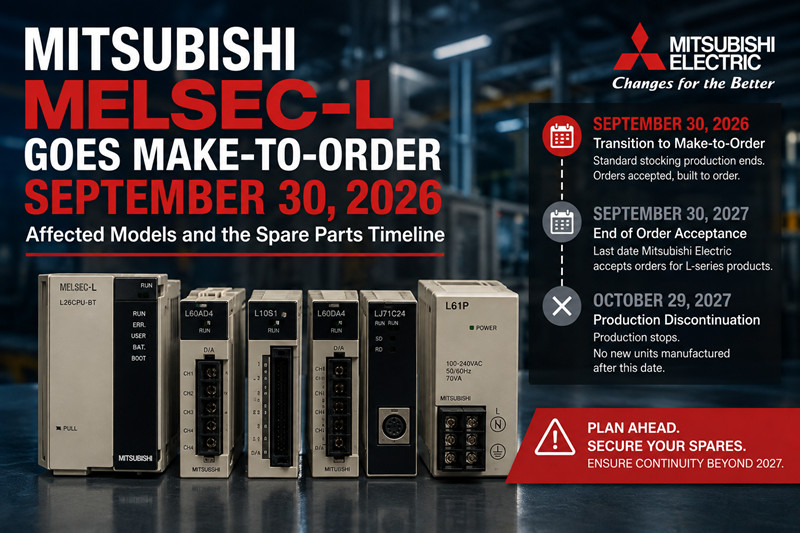
Published August 24, 2026. All dates, model numbers, and specifications in this article come from Mitsubishi Electric technical bulletin FA-A-0466-B (issue September 2025, Ver. B July 2026). Five weeks to the make-to-order cutoff September 30, 2026 is about five weeks from today. On that date, the Mitsubishi MELSEC-L series of compact PLCs moves to make-to-order status, the first formal step in a phase-out that ends with production discontinuation on October 29, 2027. The deadline comes from Mitsubishi Electric technical bulletin FA-A-0466-B, first issued in September 2025 and revised in July 2026. For maintenance teams, panel builders, OEMs, and distributors, the practical meaning is straightforward: normal off-the-shelf availability of MELSEC-L hardware ends this month. After September 30, 2026, units are built only against confirmed orders, lead times grow, and prices firm up. After October 29, 2027, no new units are produced at all, and the only sources of hardware are existing stock, surplus channels, and the used market. The same date carries a second weight for the Mitsubishi installed base. September 30, 2026 is both the final order cutoff for the MELSEC-Q series, announced in bulletin FA-A-0418-A, and the make-to-order transition for MELSEC-L. Two major PLC families reach their deadlines on the same day, which means the spares market for both families tightens at the same moment. MELSEC-L was positioned between the FX and Q families. It was widely used in small-to-mid machine control, packaging, and building systems across Asia, the Middle East, and Europe. That footprint matters here. The phase-out hits more than new designs. Every running machine, installed panel, and maintenance stockroom that still carries L-series cards is in scope. The bulletin applies to the entire product family: CPUs, power supplies, I/O, analog, positioning, network modules, and accessories all move on the same schedule. The three dates that matter Bulletin FA-A-0466-B sets out a three-step timeline. Here it is in plain form: Date | Event | What it means in practice September 30, 2026 | Transition to make-to-order | Standard stocking production ends. Orders are accepted, but units are built to order. Lead times lengthen. September 30, 2027 | End of order acceptance | Last date Mitsubishi Electric accepts orders for L-series products. October 29, 2027 | Production discontinuation | Production stops. No new units are manufactured after this date. The window between the first date and the second date is the order acceptance period: a full year in which you can still place orders, but only against a make-to-order schedule. Anyone who needs new L-series hardware for a project that will run past 2027 should treat September 30, 2027 as the real last-chance date for factory-fresh units. Why Mitsubishi Electric is ending the line The stated reason in the bulletin is concise: some component parts used in the L-series are obsolete, and continued production is difficult to maintain. That language matters. When a PLC family depends on semiconductor, connector, and passive components that are no longer manufactured, the vendor cannot sustain production no matter how strong the demand is. The calendar in the bulletin reflects a supply decision, not a demand decision. For buyers, the reason sets expectations. This is not a temporary allocation issue that will resolve itself. The component base is gone, the product line is being wound down on a fixed calendar, and the repair support window that follows is the final service horizon. Plans that assume the L-series will be available indefinitely will not survive contact with the calendar. Full list of affected models The bulletin names the entire L-series catalog. Every model in the family is affected, and the list below follows the bulletin's own grouping. Keep a copy of these tables next to your panel documentation: they are the reference list for the audit described later in this article. CPU modules Model | Notes L02CPU | CPU module L02CPU-SET | CPU set L06CPU | CPU module L06CPU-P | CPU with power supply L06CPU-P-SET | CPU set with power supply L06CPU-SET | CPU set L26CPU | CPU module L26CPU-BT | CPU with CC-Link master function L26CPU-BT-SET | CPU set with CC-Link master function L26CPU-P | CPU with power supply L26CPU-PBT | CPU with power supply and CC-Link master function L26CPU-PBT-SET | CPU set with power supply and CC-Link master function L26CPU-P-SET | CPU set with power supply L26CPU-SET | CPU set All fourteen CPU variants move on the same dates. The SET versions ship as configured packages, and the P variants integrate the power supply into the CPU unit. The BT and PBT variants carry CC-Link master functionality, which becomes a deciding factor in the migration analysis later in this article. Branch and extension modules Model | Function L6EXB | Branch module L6EXE | Extension module LC06E | Extension cable LC10E | Extension cable LC30E | Extension cable The branch and extension modules are on the no-replacement list in the bulletin, so systems built with multi-rack L-series layouts face a redesign when the time comes. Power supply modules Model | Function L61P | Power supply module L63P | Power supply module The L61P has no MX-F counterpart. The L63P has a nominal counterpart, but the wiring is incompatible, as detailed in the replacement section below. I/O modules Model | Type LX40C6 | Input module LX41C4 | Input module LX42C4 | Input module LX10 | Input module LY10R2 | Output module LY18R2A | Output module LY40NT5P | Output module LY41NT1P | Output module LY42NT1P | Output module LY40PT5P | Output module LY41PT1P | Output module LY42PT1P | Output module LH42C4NT1P | High-speed I/O module LH42C4PT1P | High-speed I/O module The LX10 AC input module is one of the models with no replacement in the bulletin. Machines that read AC signals through an LX10 need a different input strategy during migration. Analog I/O modules Model | Type L60AD4 | Analog input module L60ADVL8 | Analog input module L60ADIL8 | Analog input module L60DA4 | Analog output module L60DAVL8 | Analog output module L60DAIL8 | Analog output module L60AD2DA2 | Analog input/output module L60TCTT4 | Temperature input module L60TCRT4 | Temperature input module L60TCTT4BW | Temperature input module L60TCRT4BW | Temperature input module L60RD8 | Analog input module L60MD4-G | Analog module This is the group where the bulletin's compatibility warnings are the strictest. Every analog and temperature module in this table requires a full re-engineering effort in any migration, because the suggested FX5 replacements are fully incompatible with the L-series analog line. Positioning modules Model | Type LD75P1 | Positioning module LD75P2 | Positioning module LD75P4 | Positioning module LD75D1 | Positioning module LD75D2 | Positioning module LD75D4 | Positioning module The LD75 family connects through a 40-pin connector, and the suggested FX5 path uses screw terminals. Motion axes built on these modules need a new wiring plan before any hardware swap. High-speed counter and flexible I/O modules Model | Type LD62 | High-speed counter module LD62D | High-speed counter module LD40PD01 | Flexible I/O module Network modules Model | Type LJ61BT11 | Network module LJ71C24 | Network module LJ71C24-R2 | Network module LJ71E71-100 | Network module LJ71GF11-T2 | Network module LJ72GF15-T2 | Network module LJ72MS15 | Network module Other modules and accessories Model | Type LJ51AW12AL | AnyWireASLINK master module L6ADP-R2 | Adapter L6ADP-R4 | Adapter L6DSPU | Display unit L6EC | END cover L6EC-ET | END cover with ERR terminal L6TE-18S | Spring clamp terminal block The LJ51AW12AL stands out in this group for a different reason: it is the only model in the entire L-series catalog with a shortened repair support window, which is covered in the next section. Repair support: seven years, with one exception Repair support for the MELSEC-L series runs until October 31, 2034, seven years after the production stop, for every model except one. The exception is the LJ51AW12AL AnyWireASLINK master module. Because it was jointly developed with Anywire Corporation, its repair support ends much earlier: October 31, 2028, one year after production ends. Model group | Repair support until All MELSEC-L models except LJ51AW12AL | October 31, 2034 LJ51AW12AL (AnyWireASLINK master, joint development with Anywire Corporation) | October 31, 2028 The bulletin includes a caveat that buyers should not miss: even during the repair support window, repair may be impossible if the required parts are no longer available. Repair support is a commitment to service units, not a guarantee that every repair succeeds. For critical machinery, treat the repair window as a planning horizon, not a safety net. The practical consequence for AnyWireASLINK users is severe: the LJ51AW12AL has a one-year repair horizon after production stops, so spare modules for that specific card deserve priority on any stocking list. Replacement path 1: MELSEC MX Controller MX-F The primary migration direction for MELSEC-L CPUs in the bulletin is the MELSEC MX Controller MX-F family. The MX-F models listed as the L-series counterparts are: MXF100-8-N32, MXF100-8-P32, MXF100-X32, MXF100-Y16R, MXF100-Y32N/P, MXF100-H32N/P, MXF100-16-N32, and MXF100-16-P32. The MX-F is a newer, faster controller family, and the specification deltas are large in both directions. Some numbers improve dramatically. Others get smaller, and a few functions disappear entirely. That is the difference between a migration and a drop-in replacement. The MX-F is not a socket-compatible swap for the L-series, and the tables below show exactly where the gaps are. L02CPU to MXF100-8-N32 Feature | L02CPU | MXF100-8-N32 Max I/O points | 1024 | 512 Program capacity | 20K steps | 200K steps Instruction speed | 40 ns | 1.25 ns Memory | 80 KB | 30 MB Ports | USB mini-B + Ethernet | USB Type-C + Ethernet + CC-Link IE TSN The program capacity jump from 20K to 200K steps and the speed jump from 40 ns to 1.25 ns are the headline numbers. The I/O ceiling drops from 1024 to 512 points, which is a real constraint for larger machines. The port layout changes completely: USB mini-B and Ethernet give way to USB Type-C, Ethernet, and CC-Link IE TSN. Differential input capability is lost on the MX-F, which matters for any application that used differential inputs on the L-series. L26CPU to MXF100-8-N32 Feature | L26CPU | MXF100-8-N32 Max I/O points | 4096 | 512 Program capacity | 260K steps | 200K steps Instruction speed | 9.5 ns | 1.25 ns The L26CPU comparison shows the tradeoffs most clearly. I/O capacity drops from 4096 to 512 points. Program capacity drops from 260K to 200K steps, the rare case where the migration target has less program space than the original. Speed improves from 9.5 ns to 1.25 ns. The L26CPU-BT and L26CPU-PBT models carry CC-Link master and local station functions, and those functions are not available on the MX-F at all. If your application depends on CC-Link master capability from the CPU, the MX-F path closes that door. Modules with no replacement The bulletin is explicit that some L-series modules have no replacement in the MX-F line: L6EXB, L6EXE, LC06E, LC10E, LC30E, LX10, and L61P. For systems that use branch modules, extension modules, extension cables, AC inputs, or the L61P power supply, there is no MX-F counterpart. Those functions have to be redesigned or handled by a different family, and the affected machines should be flagged first in any spares plan. The L63P power supply caveat The L63P has a nominal counterpart in the MX-F line: the power options on the MXF100-8-N32, MXF100-8-P32, MXF100-16-N32, and MXF100-16-P32. The bulletin warns that the wiring is incompatible. The L63P uses screw terminals; the MX-F uses spring clamp terminals. Wire size changes from 0.75-2 mm² to 0.3-1.5 mm². The 5V output drops from 5.0 A to 0.72 A. A panel built around the L63P cannot reuse its wiring or its 5V budget, so the power supply swap is a panel modification, not a module exchange. Analog I/O: fully incompatible For analog I/O, the replacement direction in the bulletin points to the FX5 family: FX5-4AD, FX5-8AD, FX5-4DA, and FX5-4LC. The bulletin's position is blunt: these modules are fully incompatible with the L-series analog modules. Wiring differs, programs differ, buffer memory addresses differ, and specifications differ. Replacing an L60AD4 or an L60TCTT4 with an FX5 module is a full engineering change, not a card swap. Every analog channel has to be re-engineered, rewired, and reprogrammed, and the buffer memory addressing differences mean the PLC program itself cannot carry over. LD75 positioning: wiring change required The LD75 positioning modules map to the FX5-16ET and FX5-16ES-H, but again the wiring is incompatible. The LD75 connects through a 40-pin connector; the FX5 modules use screw terminals. Any motion axis that runs on an LD75 module needs a new wiring plan and a new program before the hardware swap can happen. Replacement path 2: MELSEC iQ-R The second migration direction is the MELSEC iQ-R platform. The bulletin notes that the R00CPU can replace L02CPU-class CPUs, with tradeoffs. The R61P is the power supply option, and the RC06B, RC12B, and RC30B cables replace the L-series extension cables. For serial communication, the RJ71C24-R2 and RJ71C24-R4 adapters are the counterparts to the LJ71C24 and LJ71C24-R2. Migration to iQ-R runs through GX Works3, and Mitsubishi Electric's reference document is the Q-to-iQ-R migration guide, L08510ENG. The guide was written for the Q-series path, and it carries over to L-series users because the two families share the same migration toolchain and much of the same program structure. The iQ-R route tends to suit sites that are already standardizing on iQ-R elsewhere in the plant. If the rest of the line runs iQ-R, moving the L-series machines to an R00CPU keeps one engineering environment and one set of spares. The MX-F route suits smaller machines where the higher program capacity and speed of the MX-F are useful, and where the I/O ceiling of 512 points is not a constraint. What plants should do now Three workstreams cover most of what needs to happen between now and September 30, 2026. Audit the installed base. Build the list of every L-series module in service, by model number and by site. The tables in this article give the full catalog, so the audit is a matter of walking the panels and matching what is inside them to the list. Pay attention to the modules with no replacement: L6EXB, L6EXE, LC06E, LC10E, LC30E, LX10, and L61P. Any machine that depends on those has no clean upgrade path, and its spares strategy is the priority. Order what you need before the transition. Until September 30, 2026, L-series hardware is still produced to stock. After that date, everything is make-to-order, lead times grow, and prices firm up. For projects already in the pipeline, place the orders now. For spares, buy the modules that are cheap to hold and hard to replace later. The order acceptance window runs to September 30, 2027, but ordering earlier means shorter lead times and better pricing. Plan the migration on a calendar. Decide, machine by machine, whether the path is MX-F, iQ-R, or a rebuild with a different family. The spec tables in this article settle the easy cases. Machines that need more than 512 I/O points, or that use CC-Link master functions, or that rely on differential inputs, will not fit the MX-F path without design changes. Analog-heavy machines face a full re-engineering job under either path, because the FX5 modules are fully incompatible and the MX-F has no direct analog counterpart. Put a migration date next to each machine and treat the repair support deadline as the backstop, not the plan. The spare parts angle For a site that buys Mitsubishi PLC spare parts, the MELSEC-L phase-out changes the buying calculus in three ways. First, timing. The make-to-order transition on September 30, 2026 is the point where lead times grow and prices firm up. Any L-series module that a site expects to need in the next five years is cheaper and faster to obtain before that date than after it. Second, the end of production. After October 29, 2027, no new L-series units exist. Every module bought from that point forward comes from surplus stock or the used market. PLC spare parts suppliers that hold L-series inventory become the only source of new-condition hardware, and that inventory does not get replenished. Third, the repair reality. The repair support window runs to October 31, 2034 for almost every model, but the bulletin states plainly that repair may be impossible if parts are unavailable. A long repair window does not create new units, and it does not guarantee that a failed module can be fixed. The only reliable protection for a critical machine is physical spares on the shelf, and that is doubly true for the LJ51AW12AL with its one-year repair horizon. The practical rule: buy the spares you need before September 30, 2026, hold the modules with no replacement path first, and treat every year of remaining service life as a year that needs hardware on hand. Compare your audit list against the Mitsubishi PLC spare parts catalog and close the gaps this quarter. FAQ When exactly does the MELSEC-L series go make-to-order? September 30, 2026. From that date, Mitsubishi Electric builds L-series units only against confirmed orders instead of producing to stock. How long can I still order new L-series units? Order acceptance runs from September 30, 2026 until September 30, 2027. That one-year window is the last chance to order factory-new hardware. When does production stop? October 29, 2027. After that date no new L-series units are manufactured, and supply comes only from stock, surplus, or the used market. How long does repair support last? Until October 31, 2034 for all models except the LJ51AW12AL. The bulletin also warns that repair may be impossible if the required parts are no longer available, so the window is not a guarantee. Why does the LJ51AW12AL have a shorter repair window? The LJ51AW12AL is an AnyWireASLINK master module developed jointly with Anywire Corporation. Its repair support ends October 31, 2028, one year after production stops. Can I swap an L26CPU for an MXF100-8-N32? Not as a drop-in. I/O capacity drops from 4096 to 512 points, program capacity drops from 260K to 200K steps, and the CC-Link master and local station functions of the L26CPU-BT and L26CPU-PBT are not available on the MX-F. Are the FX5 analog modules a direct replacement for the L60 series analog modules? No. The FX5-4AD, FX5-8AD, FX5-4DA, and FX5-4LC are fully incompatible with the L-series analog modules. Wiring, programs, buffer memory addresses, and specifications all differ. Which L-series modules have no replacement? L6EXB, L6EXE, LC06E, LC10E, LC30E, LX10, and L61P have no MX-F counterpart in the bulletin. What happens to my spares supply after October 29, 2027? Only surplus and used stock remains. Repair support continues, but it does not create new units. Sites that need L-series hardware for running machines should hold physical spares before the make-to-order date. What to do this week · Pull the L-series model list from your maintenance system and match it against the affected model tables in this article. · Flag every machine that uses L6EXB, L6EXE, LC06E, LC10E, LC30E, LX10, or L61P. Those have no replacement path and need spares first. · Check which CPUs are in the field: L02CPU, L06CPU, or L26CPU variants. The MX-F and iQ-R paths differ by CPU class. · List the analog and positioning modules in service. Every one of them means a full re-engineering job, so count them early. · Place orders for project hardware and critical spares before September 30, 2026, while units are still built to stock. · Put a migration date on each machine and a spares budget next to it. The September 30, 2027 order cutoff is the real last-chance date for new hardware. · Review the Q-series situation at the same time. The Q-series final order cutoff falls on the same day, September 30, 2026, so both families compete for the same spares market at the same moment. URL Slug: mitsubishi-melsec-l-phase-out-make-to-order-2026 -------------------------------------------------------------------------------------------- 🏢 About TZ Tech TZ Tech is a leading supplier of industrial automation, electrical, instrumentation, and telecommunications components. We specialize in sourcing ready-to-ship distributor stock, allowing us to offer highly competitive pricing and short lead times. Thanks to our extensive inventory, we can even source rare and discontinued parts that are hard to find elsewhere. 🛡️ Our Quality Commitment We understand that quality is your top priority. Every component undergoes a strict screening and inspection process so you can buy with absolute confidence. For legacy or discontinued parts, we believe in complete transparency and will always provide an honest, accurate report on the product's condition. Plus, all brand-new parts come backed by a full 1-year warranty. ✉️ Get in Touch Have a project or a part you need? Send us your inquiry today! Our team is dedicated to providing a fast response within 6 hours (excluding weekends).
View More
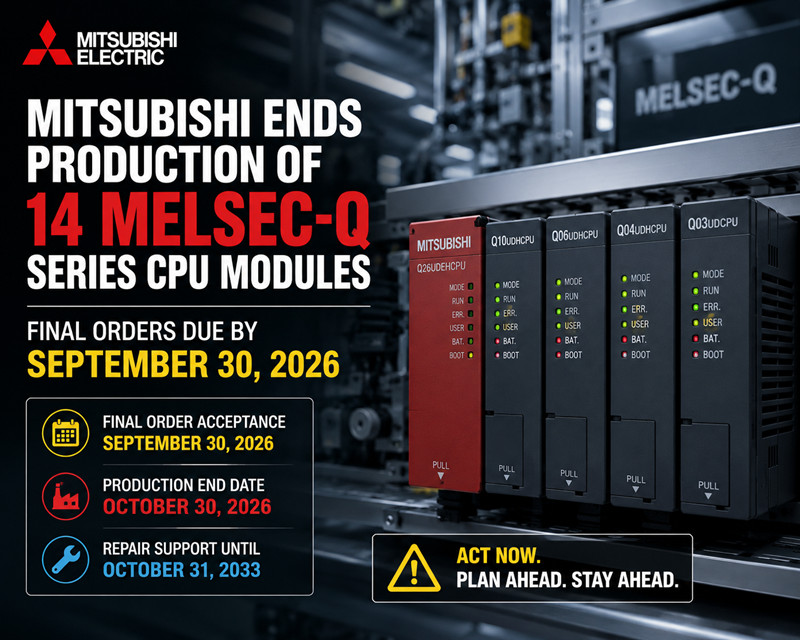
Mitsubishi Electric has announced the end of production for 14 Universal model MELSEC-Q series CPU modules, and the final order window is already open and closing. Technical bulletin FA-A-0418-A, published on the company's website, sets September 30, 2026 as the last day Mitsubishi will accept orders for these CPUs. Production stops on October 30, 2026. From today, August 17, 2026, that leaves roughly six weeks for plant managers to audit the installed base, count the spares shelf, and place any final orders for new units. For any site still running Q03UD, Q06UD, Q13UD or Q26-class CPUs, this is a procurement deadline with a hard date, not a distant announcement that can wait until after the summer. The stated reason for the discontinuation is short and familiar to anyone who has managed aging automation. Some component parts used in these products are obsolete, and Mitsubishi can no longer maintain production of them. No performance defect is cited, no safety issue, no compatibility problem. The CPUs are being retired because the supply chain underneath them is being retired. That distinction matters for planning. This is not a recall and it is not an emergency, but it is a firm cutoff. After October 30, 2026, brand-new units of these 14 models will simply not be manufactured again. Repair support is a separate timeline, and the two should not be confused. Mitsubishi will continue to repair these CPUs until October 31, 2033, which is seven years after the production stop. A CPU that is already in service today can still be sent back for repair well into the next decade. But repair support only covers units that exist. It does not create new CPUs, and it does not help a plant that needs to add capacity, replace a damaged unit it never stocked, or build a new line around a Q series CPU. The difference between "I can repair what I own" and "I can buy what I need" is the whole planning problem in one sentence. Who does this touch? In practice, the Q series is one of the most widely deployed PLC families in industrial automation, and the fourteen models in this bulletin sit in the middle of that installed base. Packaging lines, material handling systems, water treatment plants and machine tool cells across Asia, the Middle East and Europe run on these CPUs every day. A plant manager reading this announcement probably has at least one of the fourteen models in service, and probably has a spare or two on a shelf somewhere. The question is whether the list is complete, and whether the decision about the future of those lines gets made now, while new units are still orderable, or later, when they are not. The six-week window is the operational heart of this news. September 30 is the acceptance cutoff, not the delivery date. A purchase order placed in the final days of September still has to be processed, scheduled and shipped, and plants that wait until the last week are betting on logistics they do not control. The working rule for this kind of deadline is simple: treat the order cutoff as if it were the delivery deadline, and plan backward from it. Six weeks is long enough to act and too short to postpone. The 14 models and the numbers that matter The bulletin covers seven CPU classes, each available in two versions, for a total of 14 affected models. The affected range runs from the Q03 class at the entry of the group up to the Q26 class at the top. Affected models (final order date September 30, 2026) Q03UDCPU / Q03UDECPU Q04UDHCPU / Q04UDEHCPU Q06UDHCPU / Q06UDEHCPU Q10UDHCPU / Q10UDEHCPU Q13UDHCPU / Q13UDEHCPU Q20UDHCPU / Q20UDEHCPU Q26UDHCPU / Q26UDEHCPU For a maintenance manager, the useful way to read this table is to find your own CPU class in it. The Q03 and Q04 classes are the entry tier of the group and typically carry the smaller machines and standalone stations. The Q06 and Q10 classes are the mid-range workhorses, the CPUs that show up on lines with substantial I/O and some motion. The Q13, Q20 and Q26 classes sit at the top of the affected range and run the biggest programs with the fastest scan requirements. Every one of those classes is in this bulletin, which means the phase-out is not a corner of the catalog. It is the backbone of the Universal family that many plants standardized on. The bulletin itself includes the performance context, and it is worth reading those numbers carefully. The Q26UDEHCPU, the top of the affected range, runs 260K program steps with a 9.5ns basic instruction speed and 1040KB of program memory. The recommended iQ-R replacement, the R32CPU, offers 320K program steps, a 0.98ns basic instruction speed and 1280KB of program memory, and it uses an SD memory card instead of the older SRAM, Flash or ATA card. The Q13UDEHCPU, with 130K program steps, moves to 160K steps on the iQ-R side, with the same jump in instruction speed from 9.5ns down to 0.98ns. The interface changes matter for the migration planning. In the move to iQ-R, the communication interface shifts from USB (miniB), RS-232 or Ethernet to USB (miniB) and Ethernet, and the memory card shifts from SRAM, Flash or ATA to SD memory card or extended SRAM cassette. These are the details that show up in commissioning, in the wiring plan and in the stores room, and they are the reason the migration guide exists. Operationally, the numbers describe headroom, and headroom is a planning input. A faster CPU with more program memory gives a line room to grow: more logic, tighter scan times, more data collection, more future capacity without another hardware change. A plant that is near the limit of its current CPU today has a different decision to make than a plant that is using a fraction of its capacity. The bulletin's comparison figures make that difference visible before any purchase order is written. The timeline at a glance · August 17, 2026: today. Six weeks of the order window remain. · September 30, 2026: last day Mitsubishi accepts orders for the 14 CPUs. · October 30, 2026: production of the 14 CPUs ends. · October 31, 2033: repair support ends, seven years after the production stop. There is a second phase-out running in parallel, and plants should plan them together. In a separate bulletin, FA-A-0466-A, Mitsubishi has also announced the discontinuation of the MELSEC-L series. The L series moves to make-to-order on September 30, 2026. Order acceptance for L series CPUs continues until September 30, 2027, production ends October 29, 2027, and repair support runs to October 31, 2034. The affected CPUs include the L02CPU, L06CPU and L26CPU families, and Mitsubishi points to the MELSEC MX Controller MX-F, the MELSEC iQ-F (FX5) or the iQ-R as replacement paths. A plant that runs both Q series and L series controllers now has two procurement windows to manage inside the same planning period, and the two announcements share a destination: the iQ-R platform appears as a replacement path in both. What happens after October 30: the repair tail and the used market Once production ends, the market for these CPUs changes shape. Three things happen, and they happen in a predictable order. First, the remaining new stock gets consumed. Distributors and system integrators hold whatever they already bought, and that inventory becomes the last source of brand-new units. After that stock is gone, it is gone. There is no second production run announced and no indication that one is planned. The last new units will carry a premium, because the number of buyers still looking will not shrink as fast as the inventory. Second, demand shifts to the surplus and used market, and this is where the operational risk concentrates. After an official phase-out date, prices for used and surplus CPUs typically rise, and so does the risk of counterfeits and relabeled units. The shortage creates room for traders who do not test, do not document provenance, and do not stand behind the hardware. In past phase-outs across the automation industry, plants that waited have paid premium prices for untested units from unknown sources, and some have paid twice for the same CPU because the first purchase failed during commissioning. The bulletin's own dates make the arithmetic visible: seven years of repair support means the installed base is expected to keep running for years, which means demand for these CPUs will outlive supply. Third, sourcing shifts from the manufacturer to stock and surplus channels. For a plant, that changes the procurement question from "what is the price" to "what is the provenance". A tested, documented, warrantied unit from a specialist supplier is a different product from a mystery board pulled off a decommissioned line. The same part number can be a low-risk spare or a lottery ticket depending on where it comes from, and the price difference between the two tells you very little about which one you are holding. Emergency buying is the most expensive way to discover all of this. The plant that realizes in March 2027 that it needs a Q13UDHCPU for a line that has stopped will pay whatever the market asks, on whatever timeline the seller offers, with no alternative and no negotiation position. The plant that bought its spares in August 2026 pays the normal price, holds tested inventory, and keeps the leverage on its side. That asymmetry is the entire business case for acting before September 30. Repair support deserves its own paragraph, because it is easy to overestimate. Repair support until October 31, 2033 means Mitsubishi will service units that are already in service, within the normal terms of such programs. It does not mean new units, it does not mean loaner units as a right, and it does not mean the repair loop is instant. A CPU that fails in 2029 goes into a repair channel, comes back after the repair cycle, and the line waits in between. For a plant running three shifts, that waiting time is exactly what the spare on the shelf is for. The repair tail is a safety net for the hardware you own, not a supply line for the hardware you need. Three options for plants, with the operational tradeoffs Option 1: Buy the spares you need now, before September 30 The first option is also the cheapest one to execute, because it uses the normal supply chain while it still exists. The work is an audit plus an order. Walk every line and list which of the 14 CPUs are in service. Then check the stores and list which are already stocked as spares. The gap between those two lists is your shopping list, and it is usually bigger than people expect, because spares get borrowed between lines, retired units get cannibalized, and the shelf inventory in the computer rarely matches the shelf inventory in the room. For the quantity, a common working rule on critical lines is one spare CPU per critical line, plus a small common pool for the rest of the plant. Lines that run three shifts get the spare. Lines with no redundant CPU get the spare. Lines whose failure stops downstream processes get the spare. Lines with a second line of identical hardware can share from the pool. The count is a judgment call, but the principle is not: the spare exists to convert an unplanned stop into a planned swap, and the swap is only as fast as the spare is close. A CPU in a cabinet two minutes from the line is inventory. A CPU in a warehouse two countries away is a hope. The budget conversation is easier than it looks. A CPU is a modest line item compared with the cost of an unplanned stop, which typically includes lost production, overtime for the maintenance crew, expedited freight, and the downstream cost of a line that restarts late against customer commitments. Framed that way, the question is not whether the spare is affordable. The question is whether the line can afford to wait for the used market to deliver. Spares bought now come out of this year's maintenance budget, which is the budget that exists. The same CPUs bought next year come out of an emergency line that may not exist, or may come with approval chains that take longer than the line can stay down. The tradeoff is honest. Buying spares keeps you on the Q platform, which is exactly the platform being phased out. You are buying time, not a future. But time is a legitimate purchase when the alternative is a rushed migration. For a plant with a mid-life line, a stable program, and no near-term reason to change the architecture, buying several years of repair-supported operation is a rational use of the budget line. The spares are the bridge; the question of what comes after the bridge can be answered next year, on a schedule you control. Option 2: Step up to the High-speed Universal QnUDVCPU series The second option is the like-for-like step. Mitsubishi's recommended replacement within the Q family is the High-speed Universal model QCPU, the QnUDVCPU series, with examples including the Q03UDVCPU, Q04UDVCPU, Q06UDVCPU, Q13UDVCPU and Q26UDVCPU. The name is the message: same family, same form factor, same platform. Operationally, this is the lowest-risk migration on the table. The QnUDVCPU sits in the same rack, uses the same base unit, the same power supply and the same I/O modules. The project is recompiled in GX Works2 rather than rewritten. There is no rewiring of the panel, no new drawings, no change to the field wiring, and typically no change to the spare parts strategy for I/O. The commissioning window is measured in days rather than weeks, and it can often be done inside a planned shutdown without touching the process side. For a plant manager, this is the option that fits into a weekend and a change request, not a project plan. The tradeoff is that you stay on a platform whose days are numbered by the same logic that ended the current generation. The QnUDVCPU series is the replacement today; at some point it will be the phase-out notice, and the component obsolescence that ended the Q03UD through Q26UDH generation will eventually catch the generation after it. What you gain is a clean, low-risk path that buys several more years of operation with repair support, and what you defer is the eventual move to a newer architecture. For a plant that is not ready to redesign, this is the pragmatic middle path, and it pairs naturally with Option 1: stock the current CPUs for the near term, then step the critical lines up to QnUDVCPU on the normal replacement cycle instead of waiting for a failure to force the decision. Option 3: Migrate to MELSEC iQ-R The third option is the full architectural move. Mitsubishi's other recommended path is the MELSEC iQ-R series CPU, the RnCPU family, with examples including the R04CPU, R08CPU, R16CPU and R32CPU. This is a genuine migration rather than a swap. The iQ-R platform means a new base unit, a new power supply, a new rack, and a different memory system built around SD memory cards and the extended SRAM cassette instead of the older SRAM, Flash or ATA cards. The performance numbers from the bulletin show why plants make this move: the R32CPU takes the Q26UDEHCPU's 260K program steps to 320K, its 1040KB of program memory to 1280KB, and its 9.5ns basic instruction speed down to 0.98ns. That is not incremental improvement; that is a different class of headroom, and it is the headroom the next decade of program growth will need. The engineering effort is real and should be budgeted as such. Mitsubishi publishes the MELSEC-Q Series to MELSEC iQ-R Series Migration Guide, reference L08510ENG, which is the working document for porting programs. Porting is not retyping; it is a review of every program block against a new platform, with new communication interfaces, from USB (miniB), RS-232 or Ethernet to USB (miniB) and Ethernet. The commissioning window is the biggest hidden cost. A migration touches the rack, the wiring plan, the program, the documentation and the training of the maintenance crew, and it should be scheduled against the shutdown calendar, not squeezed into one. Budget the engineering time, not just the hardware, because the hardware line item is the smaller number on that spreadsheet. The payoff is the longest runway. The iQ-R platform is the current generation, it is the destination Mitsubishi points to in both the Q and L phase-outs, and it carries the performance headroom the comparison numbers illustrate. For plants under pressure to strengthen OT security, there is a secondary argument worth one sentence: legacy Q series CPUs predate modern OT security expectations, and a phase-out milestone like this one gives a defensible reason to move to a current platform. The security case is a bonus on top of the supply case, not a replacement for it. The tradeoff is cost and risk concentrated in one window. Hardware, engineering hours, commissioning time and the possibility of process issues after cutover all land in the same period. The mitigation is sequencing: migrate one line first, run it in production, and use it as the template for the rest of the plant. Plants that treat iQ-R as a project rather than a purchase get the benefits. Plants that treat it as a purchase get a surprise, usually in the form of a commissioning overrun on a line that was never going to be available long enough. What this means for the installed base and the spare parts market The MELSEC-Q series is one of the most widely deployed PLC families in industrial automation, and a large share of that installed base runs exactly the CPU classes in this bulletin. The Q03UD, Q06UD, Q13UD and Q26-class CPUs are not rare hardware; they are the workhorses of a generation of production lines, and they are still running production today in packaging, material handling, water treatment and machine tool applications across Asia, the Middle East and Europe. Some of those lines were designed around the Q series a decade or more ago, and the control architecture has not changed since, because it did not need to. This bulletin changes that arithmetic for every one of them. The order cutoff does not reduce demand; it reduces supply. Demand stays wherever the installed base stays, and the installed base does not disappear on October 30. It keeps running, it keeps breaking, and it keeps needing CPUs. The result is a market where the manufacturer exits and the stock and surplus channels take over. For buyers, that means the quality of the supplier matters more than the price list. For a site sourcing Mitsubishi PLC spare parts, the practical checklist is provenance, testing, warranty and delivery time, in that order. A unit with documentation and a test record is worth more than a cheaper unit with a story. For plants that stocked early, the phase-out is a non-event. Their spares are on the shelf, their lines are covered, and they can watch the used market from the sidelines. For plants that did not, the phase-out shows up later as an emergency buy at premium prices, with the counterfeit risk layered on top. The difference between those two outcomes is a purchase order placed before September 30. The same logic applies to the wider PLC spare parts shelf: a plant that reviews its critical spares against this bulletin will find that the review pays for itself on the first line that would have stopped. The L series ripple should be part of the same plan. The MELSEC-L phase-out in bulletin FA-A-0466-A runs on a slightly longer clock, with order acceptance until September 30, 2027, but the make-to-order transition begins on September 30, 2026, the same day the Q order window closes. Plants that standardize on one platform across machines should look at the two announcements together, because the replacement paths overlap: the MELSEC MX Controller MX-F, the MELSEC iQ-F (FX5) and the iQ-R appear in the L series guidance, and the iQ-R appears in both bulletins. A plant that consolidates on iQ-R solves both phase-outs with one architecture, while a plant that buys Q spares and L spares separately is managing two supply chains that are both winding down. The bottom line The September 30, 2026 order cutoff for the 14 MELSEC-Q series CPUs is a date with consequences that compound. Miss it and the options narrow: new units disappear, the used market takes over, prices and counterfeit risk rise, and the only remaining certainty is the repair tail, which runs to October 31, 2033, but only for CPUs that already exist. Nothing about this announcement requires a panic, and everything about it requires a decision. The plants that lose on phase-outs are never the ones that heard the news late. They are the ones that heard it on time and treated it as next quarter's problem. The action list is short enough to fit on one page. Audit the plant and find every one of the 14 affected models, in service and in stores. Decide which lines get spares and how many, using the one-spare-per-critical-line rule as the starting point and the three-shift and no-redundancy lines as the priority. Place the order before September 30, and treat the cutoff as the delivery date, not the order date. Choose the replacement path for the medium term: QnUDVCPU for the low-risk step, iQ-R for the architectural move, and keep bulletin FA-A-0418-A and the L08510ENG migration guide in the project file either way. Six weeks is enough. It is enough to audit, enough to decide, enough to order. What it is not enough for is the alternative: discovering the problem in March 2027, on a stopped line, with a budget approval in one hand and a used-market quote in the other. The plants that treat this announcement as a procurement event will not notice the phase-out at all. The plants that treat it as a rumor will notice it exactly once, on the day the line stops. URL Slug: mitsubishi-q-series-phase-out-deadline-2026 -------------------------------------------------------------------------------------------- 🏢 About TZ Tech TZ Tech is a leading supplier of industrial automation, electrical, instrumentation, and telecommunications components. We specialize in sourcing ready-to-ship distributor stock, allowing us to offer highly competitive pricing and short lead times. Thanks to our extensive inventory, we can even source rare and discontinued parts that are hard to find elsewhere. 🛡️ Our Quality Commitment We understand that quality is your top priority. Every component undergoes a strict screening and inspection process so you can buy with absolute confidence. For legacy or discontinued parts, we believe in complete transparency and will always provide an honest, accurate report on the product's condition. Plus, all brand-new parts come backed by a full 1-year warranty. ✉️ Get in Touch Have a project or a part you need? Send us your inquiry today! Our team is dedicated to providing a fast response within 6 hours (excluding weekends).
View More
Siemens has published a firm end date for the first-generation SIMATIC S7-1200. In an advance notice dated June 30, 2026 (Siemens Industry Online Support entry ID 109996314), the company confirmed that the S7-1200 G1 will be officially declared phased out on November 1, 2026, and that G1 units will remain orderable as new parts only through September 30, 2027. At the same time, the successor platform, the SIMATIC S7-1200 G2, has reached delivery release (entry ID 109973175). For the maintenance engineers and procurement teams who keep G1-based machines running across packaging plants, water and wastewater facilities, and HVAC systems, those two dates are the most consequential product lifecycle information Siemens has published in years. The full timeline, the G2's pricing and capabilities, and a practical spare parts plan for the transition follow. The announcement, in three numbers Advance notice 109996314 is short, but three figures in it define the remaining commercial life of every G1 CPU, I/O module, signal board, and power supply in your plant: · November 1, 2026. The G1 is officially declared phased out. This is the formal end-of-life declaration, the date from which Siemens treats the platform as a legacy product in its systems. · September 30, 2027. The last date on which a G1 can be ordered as a new part. Between November 2026 and this date, the G1 remains fully orderable through normal channels. · Approximately nine years of spare parts supply after the order cutoff. Siemens' planning horizon for G1 spare parts runs to roughly 2036. Two details in that notice deserve close attention. First, the phase-out declaration is not the last order date. Siemens has structured the transition with a window of nearly one year after the declaration during which brand-new G1 hardware can still be purchased. Second, the spare parts commitment is long. Nine years of planned spares supply takes the platform well past the point where most of today's G1 machines will have been retired or migrated on their own schedules. Why this matters: the G1 installed base The S7-1200, launched in 2009, has been one of the most widely deployed compact PLCs of the last 15 years. It became the default controller for small and mid-sized machines across three of the most common plant environments in industrial maintenance: packaging lines, where it runs labelers, cartoners, and wrappers; water and wastewater treatment, where it sequences pumps, valves, and chemical dosing; and HVAC, where it coordinates air handling units, chillers, and building utilities. OEMs built it into equipment shipped to every region, and its combination of integrated Ethernet, a compact footprint, and TIA Portal engineering made it the entry point to Siemens automation for an entire generation of engineers. The geography of that installed base matters for the spare parts market. In the Middle East, the S7-1200 shows up in desalination plants, pumping stations, and oil and gas auxiliary systems, where equipment is specified for decades of service in harsh conditions. In the Americas, it is embedded in food and beverage packaging lines and in HVAC plant equipment that runs continuously. In Europe, it drives wastewater treatment trains and machine tools that must meet strict documentation and safety requirements. In every one of those regions, the maintenance organization inherits the phase-out decision whether or not it participated in the original purchase. The engineers who commissioned these machines in 2012, 2015, or 2019 are often the same people who will be asked to keep them running in 2030. That installed base is the reason a phase-out notice for a compact PLC is a real event rather than a paperwork formality. Industrial machines have service lives measured in decades, and most G1-controlled equipment will keep running on G1 hardware long after the last new CPU leaves a Siemens warehouse. A calendar date passing does not re-engineer a packaging line. Re-engineering happens when the line is rebuilt, the process changes, or a failed component can no longer be sourced at a reasonable price. That last scenario is the one to plan around. A single failed CPU in 2028 is an ordinary maintenance event. A single failed CPU in 2028 with no spare on the shelf, no new stock available from distributors, and a machine that cannot run without it is an unplanned rebuild with production downtime measured in weeks. What you buy and store before September 30, 2027 closes the gap between those two outcomes. The G1 phase-out timeline at a glance Date | Milestone | What it means in practice June 30, 2026 | Advance notice published (entry 109996314) | Siemens formally opens the G1 phase-out procedure; the planning window starts Now | S7-1200 G2 in delivery release (entry 109973175) | The successor platform is available to order; new designs should target G2 November 1, 2026 | G1 declared phased out | End-of-life status takes effect; G1 remains orderable as a new part September 30, 2027 | Last order date for new G1 | Final day to buy brand-new G1 CPUs and modules through normal channels October 1, 2027 | Spare-parts-only phase begins | No new G1 sales; supply is limited to spare parts and repair support Through ~2036 | Planned G1 spare parts supply | Siemens' published planning horizon: about nine years of spares after the 2027 cutoff Maintenance managers should put this table in front of anyone who budgets capital or spare parts spend. The date that matters for buying decisions is not November 2026, which only changes the product's official status. It is September 2027, which closes the door on new G1 hardware entirely. Reading the table correctly matters, because Siemens' phase-out nomenclature is easy to misread. The November 2026 declaration is a status change in Siemens' product lifecycle systems; it triggers catalog updates, pricing adjustments, and the formal transition to end-of-life handling. The September 2027 cutoff is the commercial event with real consequences for buyers. Between those dates, G1 orders are processed normally. After the cutoff, new-manufacture G1 units disappear from the supply chain, and the market shifts to the stock that distributors and specialist traders accumulated beforehand. That is the mechanism by which a well-documented phase-out still produces a tightening spare parts market: the official supply does not vanish overnight, but the pool of new units available to late buyers shrinks every month. What the S7-1200 G2 brings The G2 is not a cosmetic refresh of the G1. Siemens is positioning it as the successor across the compact controller range, and the delivery release note (entry 109973175) confirms it is shipping now through normal distribution. The engineering environment stays consistent: the G2 integrates in TIA Portal, so teams that already work in Siemens' toolchain do not need to learn a new one. Performance, scalability, and data Siemens cites improved performance and scalability, flexible machine safety, efficient motion control, and increased data transparency as the G2's headline advantages. For a plant engineer, that means a controller family with a wider performance span, more flexible safety functions, lighter motion-control engineering, and machine data that higher-level systems can read more readily. Pricing: a concrete benchmark Distributor listings in the United States put the SIMATIC S7-1200 G2 CPU 1214C DC/DC/DC, order number 6ES7214-1AH50-0XB0, at a list price of $395. That figure is a useful benchmark for budgeting a migration: the mid-range CPU of the new family is priced competitively for the compact PLC segment. Procurement teams should treat list price as a starting point, since actual quotes vary by region, volume, and distributor terms. The CPU price is a planning anchor, but a complete migration budget also includes the I/O and power supply hardware for the new cabinet and the engineering time for the project conversion. The free migration tool removes the software license cost from that equation, which for a multi-machine fleet is a meaningful line item that simply disappears. Fail-safe capability in the CPU line G2 CPUs include failsafe variants. The CPU 1214FC DC/DC/DC, order number 6ES7214-1AF50-0XB0, is the fail-safe counterpart to the standard 1214C, which means machine safety functions can be implemented on the controller itself rather than through a separate safety arrangement. A new fail-safe I/O module Siemens has also introduced the SM 1226 F-DI 4/F-DQ 2 (order number 6ES7226-6ME50-0XB0), a fail-safe module that combines fail-safe digital inputs and fail-safe digital outputs in a single unit. At 30 mm wide, the module is compact, and Siemens states that it reduces DIN rail space by roughly 60 percent compared with a comparable G1 fail-safe configuration. For panel builders and maintenance teams working in crowded cabinets, that reduction is a concrete, measurable benefit of moving safety I/O to the G2 platform. Cybersecurity by design The G2 adheres to IEC 62443-4-2, the international standard for security capabilities of industrial automation components. For plants operating under OT security programs or facing vendor security questionnaires, that adherence matters: a controller family that addresses component-level security requirements is easier to justify to corporate IT and security stakeholders than one that predates the standard. A free migration tool Siemens provides a free S7-1200 G2 migration tool (support entry ID 109986503) to help move existing projects to the new platform. The existence of an official, free migration path matters for planning: it removes a common barrier to upgrading, which is the cost and risk of re-engineering the application from scratch. Migration is still a project with its own testing and validation, but the tooling cost is zero. The practical workflow is to run the tool per project, review the report it generates for items that need manual attention, and validate the migrated program on the target G2 hardware before touching production. Siemens documents the tool's scope and known limitations in the support entry, and the migration report doubles as an engineering worklist. For plants that run standardized machine programs across multiple lines, one validated migration can be reused as the template for the rest of the fleet, which is where the real time savings appear. What G1 owners should do now No plant needs to panic-migrate a healthy fleet. The announcement calls for deliberate buying and planning decisions in the next 13 months, while new G1 hardware is still available. Five actions cover the essentials. 1. Stock critical G1 spares before September 30, 2027 Every G1 installation should have a defined set of critical spares on the shelf before the order cutoff. The minimum list is the components whose failure stops a machine: the CPU itself, the power supply, and every I/O module type in the machine's configuration. For plants with multiple identical machines, spare modules can be shared across the fleet, but the spares need to exist before October 2027, because after that date the only supply is whatever remains in distributor and specialist stock. 2. Buy the long-lead and unusual items early Common modules will remain available in specialist channels for years, because the spare parts commitment runs to roughly 2036 and the aftermarket will carry the platform. Less common items are the real risk: signal boards, communication modules, and older I/O variants that were configured on machines a decade ago. These are the modules that disappear from stock first when a platform enters its spare-parts-only phase. If a machine uses a module that is not a current catalog item, that module should sit near the top of the stocking list. 3. Treat the 2027 cutoff as a migration planning deadline, not a migration deadline Nothing in the Siemens announcement forces a plant to migrate in 2026 or 2027. The G1 will remain supportable through roughly 2036, and many plants will legitimately run G1 for years. But the September 2027 cutoff is the natural deadline for a different decision: which lines migrate to G2, and which lines stay on G1 with stocked spares. Lines that migrate should be scheduled while G1 spares are still cheap and plentiful, so that the same budget cycle can cover both the migration and the remaining G1 spares. Lines that stay on G1 need their spares purchased before the cutoff, full stop. 4. Use the free migration tool on one pilot project The free G2 migration tool (entry 109986503) changes the economics of evaluating a migration. A plant can take one representative machine, migrate its project, and run it through validation at zero tooling cost. That pilot produces the two things every migration decision needs: a real estimate of engineering effort and a documented list of differences between the G1 and G2 environments. With those in hand, the rest of the fleet can be scheduled deliberately rather than in response to failures. 5. Audit the installed base before ordering None of this works without an accurate inventory. Before any purchase order is placed, walk the plant and record what is actually in each cabinet: CPU order numbers, firmware versions, I/O module types, signal boards, and communication modules. Plants are routinely surprised by what a decade of small modifications leaves behind, including module variants that were never documented and spare parts that were already consumed and never replaced. The audit output is a stocking list ranked by failure criticality, and it is also the input the migration tool needs when a line is scheduled for conversion. The audit is unglamorous work, but it is the difference between buying the right spares in 2027 and discovering in 2028 that the one module nobody stocked is the one module that failed. Why tztechio.com still sells G1 modules The spare parts angle of this announcement is straightforward: demand for G1 modules does not end when Siemens stops selling them as new. It rises. Plants that did not stock before the cutoff will be looking for G1 CPUs, power supplies, and I/O modules for years afterward, because their machines still run on G1, and the planned spare parts supply, however generous, does not put a spare in every cabinet. That is why tztechio.com continues to carry first-generation S7-1200 modules alongside the newer platform. The Siemens section of the store lists G1 CPUs, I/O modules, signal boards, and power supplies, and the broader PLC category covers the rest of the automation spares market. The practical guidance for procurement is to compare what a plant holds in stock against its critical module list, and to place orders for the gaps before the September 2027 cutoff, while new G1 stock can still be bought at normal prices. After the cutoff, the same modules will trade in a thinner market where availability, not list price, is the deciding factor. For plants that are migrating, the same storefront covers the transition: it adds G2 CPUs and modules to the Siemens inventory as they reach distribution, alongside the G1 spares that will keep legacy lines running. Running both generations through one procurement channel simplifies the transition period, which is exactly the period most plants are entering now. Frequently asked questions Q: When is the S7-1200 G1 officially phased out? A: Siemens declared in advance notice 109996314 that the G1 will be officially declared phased out on November 1, 2026. The phase-out declaration is the formal end-of-life status; it does not stop sales by itself. Q: Can I still buy a new G1 CPU after November 1, 2026? A: Yes. The G1 remains orderable as a new part until September 30, 2027. The November 2026 date changes the product's official status, and the September 2027 date is the last order date for new G1 hardware. Q: How long will spare parts for the G1 be available? A: Siemens plans spare parts supply for approximately nine additional years after the September 30, 2027 order cutoff, which puts the planning horizon at roughly 2036. Q: What does the S7-1200 G2 cost? A: As a benchmark, US distributor listings show the G2 CPU 1214C DC/DC/DC (order no. 6ES7214-1AH50-0XB0) at a list price of $395. Failsafe variants such as the CPU 1214FC DC/DC/DC (order no. 6ES7214-1AF50-0XB0) are available as well. Actual quotes vary by region and distributor terms. Q: Is there a tool to migrate S7-1200 G1 projects to G2? A: Yes. Siemens provides a free S7-1200 G2 migration tool, documented in support entry ID 109986503. It works within the TIA Portal environment. Q: What is the SM 1226 F-DI 4/F-DQ 2? A: It is a new G2 fail-safe I/O module (order no. 6ES7226-6ME50-0XB0) that combines fail-safe digital inputs and fail-safe digital outputs in one 30 mm-wide module. Siemens states it reduces DIN rail space by roughly 60 percent compared with a comparable G1 fail-safe configuration. Q: Does the G2 meet modern cybersecurity requirements? A: The G2 adheres to IEC 62443-4-2, the international standard for security capabilities of industrial automation components, and integrates in TIA Portal. Q: Where can I buy G1 spare parts after the phase-out? A: Specialist automation parts suppliers such as tztechio.com continue to stock first-generation S7-1200 modules. The Siemens spare parts section and the PLC category cover G1 CPUs, I/O, and power supplies. Q: Should we migrate our G1 machines now, or keep them running? A: That is a per-plant decision, and the Siemens timeline leaves room for both answers. A machine that is running reliably, has stocked spares, and is not under pressure for new connectivity or security features can legitimately stay on G1 for years, supported by the spare parts supply that runs to roughly 2036. A machine that is being rebuilt, that needs cybersecurity features the G1 platform cannot provide, or that must exchange more data with higher-level systems is a candidate for G2 migration. The discipline is to decide deliberately, machine by machine, before September 30, 2027, rather than to let the cutoff force the decision later. Sources · Siemens Industry Online Support, advance notice 109996314 (June 30, 2026): S7-1200 G1 phase-out declaration, last order date September 30, 2027, and approximately nine years of planned spare parts supply. · Siemens Industry Online Support, delivery release note 109973175: S7-1200 G2 in delivery release. · Siemens Industry Online Support, support entry 109986503: free S7-1200 G2 migration tool. -------------------------------------------------------------------------------------------------------------------------------------------------------------------- 🏢 About TZ Tech TZ Tech is a leading supplier of industrial automation, electrical, instrumentation, and telecommunications components. We specialize in sourcing ready-to-ship distributor stock, allowing us to offer highly competitive pricing and short lead times. Thanks to our extensive inventory, we can even source rare and discontinued parts that are hard to find elsewhere. 🛡️ Our Quality Commitment We understand that quality is your top priority. Every component undergoes a strict screening and inspection process so you can buy with absolute confidence. For legacy or discontinued parts, we believe in complete transparency and will always provide an honest, accurate report on the product's condition. Plus, all brand-new parts come backed by a full 1-year warranty. ✉️ Get in Touch Have a project or a part you need? Send us your inquiry today! Our team is dedicated to providing a fast response within 6 hours (excluding weekends).
View More
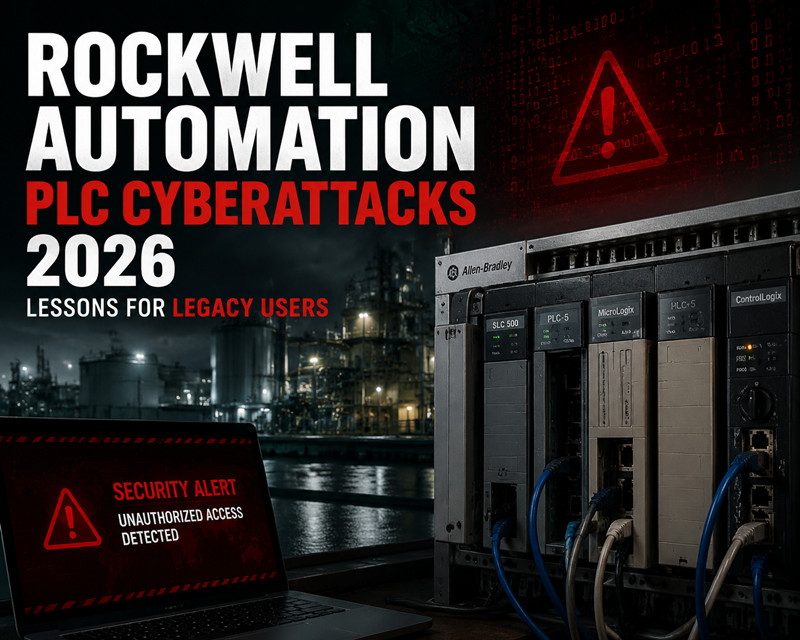
The largest operational technology (OT) security incident of 2026 unfolded over six weeks this spring. Between March and mid-April, Iranian hackers systematically targeted nearly 4,000 internet exposed Rockwell Automation and Allen-Bradley PLCs across US critical infrastructure. The campaign prompted a joint federal advisory from CISA, the FBI, NSA, DOE, EPA, and US Cyber Command on April 7, followed by a Censys exposure report on April 10. Engineers running legacy Rockwell systems (SLC 500, PLC-5, older MicroLogix) should pay attention. This attack was years in the making. What Happened: A Timeline of the 2026 Campaign March 2026. Iranian threat activity against US critical infrastructure escalated sharply. Attackers aligned with two principal groups, the IRGC-linked CyberAv3ngers and the MOIS-linked Handala, began systematic reconnaissance of internet facing industrial control devices. Their target was Rockwell Automation PLCs exposed on port 44818 via EtherNet/IP. April 7. CISA, the FBI, NSA, DOE, EPA, and US Cyber Command issued a joint advisory confirming attackers had extracted project files from compromised devices, manipulated HMI and SCADA displays, and deployed wiper malware. At least one water facility was forced to manual operation after losing PLC control. April 10. Censys published exposure data showing 5,219 global hosts responding as Rockwell or Allen-Bradley devices reachable via EtherNet/IP, approximately 3,900 inside the United States. The vast majority were simply connected to the public internet with default settings. The attackers were not exploiting zero-days. They used Shodan and Censys to find Rockwell-branded PLCs on the public internet, then attempted default credentials and direct EtherNet/IP command exploitation. Which Devices Were Targeted Any Rockwell Automation or Allen-Bradley PLC with Ethernet connectivity exposed to the public internet was a viable target. Affected models included ControlLogix (1756 series, the flagship widely deployed in critical infrastructure), CompactLogix (1769, 5370, 5380 series, common in mid-size manufacturing and utilities), MicroLogix (1100, 1400 series, older and widely used in smaller facilities and remote sites), SLC 500 with Ethernet (designed in the 1990s with no meaningful security features), and PLC-5 with Ethernet (a 1980s design still running in oil and gas, water, and heavy industry). The attackers did not need advanced capabilities. EtherNet/IP implements minimal authentication by design, and many sites had never changed default passwords, disabled unused CIP services, or added a firewall between their PLCs and the carrier network. Why This Matters for Legacy PLC Users The 2026 Rockwell campaign exposes a structural vulnerability deferred for two decades. Hundreds, possibly thousands, of SLC 500 and MicroLogix systems remain in active service across American water plants, energy sites, and factories. These controllers were designed before internet-connected PLCs were imagined. They have no cryptographic authentication, no secure boot, no role-based access control, and often no firmware patching mechanism. You cannot patch a PLC-5. There is no update that retrofits encryption onto a SLC 500's serial-to-Ethernet bridge. The devices are what they are. This creates a hard deadline. The EU's NIS2 Directive requires compliance by October 2026, with substantial fines, and explicitly covers OT systems. While the US lacks a single equivalent regulation, sector-specific mandates from TSA, DOE, and EPA are moving in the same direction. Facilities running internet exposed legacy PLCs are increasingly in regulatory violation, and that was true before Iranian APT groups started fingerprinting their controllers. The April 7 joint advisory makes clear that federal agencies now consider these devices an active national security vector. What to Do If You're Running Legacy Rockwell PLCs Step 1: Audit every PLC on your network. Use Shodan, Censys, or OT asset discovery tools (Dragos, Nozomi, Claroty) to identify every Rockwell device on your public IP ranges. In the Censys scan, most exposed devices were not intentionally exposed. They sat behind misconfigured firewalls or were connected for remote troubleshooting and never disconnected. Step 2: Remove PLCs from the public internet. Place every Rockwell PLC reachable on port 44818 behind a properly configured firewall. For remote access, use a cellular modem with VPN, not a direct Ethernet drop. Air-gap critical controllers where possible. Step 3: Upgrade where feasible. Newer CompactLogix 5380 and 5480 series controllers offer trusted-slot authentication, CIP security extensions, and firmware integrity verification. Step 4: For truly legacy platforms such as SLC 500 and PLC-5, accept that you cannot patch them. You have three options. Network segmentation with unidirectional gateways uses data diode or unidirectional gateway appliances to allow monitoring traffic out while preventing any inbound commands from reaching the controller. Migration to a current platform uses Rockwell's migration programs for SLC 500 to CompactLogix and PLC-5 to ControlLogix, which are mature but require downtime planning. Hardening in place is possible if migration is not immediate: change all default passwords, disable unused EtherNet/IP services, restrict access via ACLs, and monitor EtherNet/IP traffic for anomalous commands. None of these are perfect. But any is better than having an Iranian APT group extract your project files and overwrite controller firmware at 2 AM on a Saturday. The Spare Parts Angle As facilities scramble to secure or migrate aging Rockwell systems, demand is increasing for spare ControlLogix and CompactLogix modules (1756, 1769 series) for swap-in replacements of potentially compromised units, Ethernet security appliances (bump in the wire devices that add authentication and traffic inspection without controller firmware changes), legacy-to-current migration kits (adapters, chassis, and power supplies for SLC 500 to CompactLogix swaps), and hard to find Allen-Bradley modules for facilities maintaining legacy spares during multi-year migrations. TZTechio's inventory, from current 5380-series CompactLogix to legacy 1746 and 1771 I/O, covers this range. When a water plant needs a 1756-L73 by Wednesday, availability matters. Wider Context: OT Attacks Are Accelerating The 2026 Rockwell campaign did not happen in isolation. It is the latest in a series of OT incidents that have escalated since 2023. The Unitronics attacks (2023-2024) were Iranian-linked attacks on Israeli-made Unitronics PLCs in US water utilities using the same playbook of Shodan scans, default credentials, and taking control. The Stryker 80,000-device wipe (March 2026) happened weeks before the Rockwell campaign and wiped 80,000 endpoints from medical device infrastructure. It was not an OT incident, but it proved that safety critical fleets are in the crosshairs. The NIS2 deadline (October 2026) has EU member states scrambling to meet requirements for mandatory incident reporting, supply chain security, and OT risk management. US regulatory push will follow in 2027. Attackers have learned that industrial control systems are the weak point of critical infrastructure. The 2026 Rockwell campaign proves you do not need nation-state resources to compromise most PLCs. You just need a Shodan query and the willingness to try default passwords. For anyone responsible for a legacy Rockwell system, the time for planning is over. Audit your controllers. Disconnect them from the internet. If you cannot protect them, migrate them, before someone else does it for you. --- *Sources: CISA/FBI/NSA/DOE/EPA/US Cyber Command Joint Advisory, April 7, 2026; Censys Research Report, April 10, 2026; BleepingComputer; CNN; Defense One. This article is for informational purposes and does not constitute cybersecurity or compliance advice. Consult qualified professionals for your specific environment.*
View More

CHICAGO — June 23, 2026 — Schneider Electric took the stage at Automate 2026 today to announce "Industrial Automation Modernization as a Service," a new offering that pairs EcoStruxure Automation Expert (EAE) software with HPE SimpliVity hybrid cloud infrastructure. The service is built around a simple premise: let plants running legacy PLC and DCS systems modernize incrementally — without forklift upgrades or full rip-and-replace projects. For the thousands of facilities still operating Modicon Quantum, Premium, and M340 controllers, the core question is whether this changes anything about the hardware they depend on today. What the Service Delivers The architecture combines Schneider's IEC 61499-based EcoStruxure Automation Expert with HPE's hyperconverged SimpliVity platform. Automation logic runs as software-defined workloads rather than being locked to specific programmable logic controller hardware. Both companies are members of the UniversalAutomation.org consortium, and they are positioning the service as a path toward runtime portability across hardware layers. Schneider's announcement included several performance targets for the new model: · 50% faster time to market for new production lines · 60% faster commissioning through templated, repeatable deployment patterns · Up to 40% energy reduction via optimized compute allocation · Unified cloud cybersecurity governance across distributed sites · CapEx-to-OpEx conversion — plants pay for automation as an operational service rather than a capital equipment purchase The service supports multiple deployment models — on-site, private cloud, and distributed edge architectures — giving plant operators flexibility in how they phase in the new technology. How It Works Alongside Existing Systems Schneider is not requiring that existing PLCs be removed. The Modernization-as-a-Service model runs alongside current automation infrastructure, coexisting with existing Modicon Quantum, Premium, and M340 racks while plant operators transition specific functions to the new software-defined environment at their own pace. A facility can, for example, keep its Modicon Quantum rack with a 140 CPU 53414 processor handling core sequence control while migrating data aggregation, analytics, or higher-level coordination logic to the EAE/HPE platform. The same principle applies to Modicon Premium systems using TSX P57 processors and M340 controllers — the new architecture complements rather than replaces them in the short to medium term. Schneider's press materials, reported by Automation World and distributed via PRNewswire, describe the service as built for "the reality of brownfield automation" — acknowledging that most industrial sites cannot afford production downtime for a full system swap. Spare Parts Implications For maintenance and procurement teams, the practical effect of this announcement is clearer than the press materials may suggest. Short Term: Demand Holds Steady — and May Increase In the near term, the availability of Modernization-as-a-Service does not reduce the need for replacement parts. If anything, the opposite is true. An incremental migration strategy means legacy Schneider hardware stays in production longer than it would under a full rip-and-replace plan. Each year a Quantum or Premium system remains operational creates ongoing demand for: · Replacement processors (140 CPU 53414 for Quantum racks, TSX P57 for Premium) · Communication modules such as the 140 NOE 77101 Ethernet module · Power supplies, backplanes, and I/O modules · Racks and cabling for expansion Plant operators pursuing phased modernization typically maintain larger spare parts inventories during the transition period, not smaller ones. A controller that might have been decommissioned in a single weekend under a full replacement project now stays online for months or years as functions migrate one by one. Long Term: A Gradual Shift Toward Software-Defined Automation Over a five-to-ten-year horizon, the broader trend points toward decoupling automation logic from specific hardware SKUs. The IEC 61499 standard that underpins EAE allows control code to run on diverse hardware platforms — standard servers, edge appliances, or even cloud instances — rather than being tied to a specific vendor's processor module. For the spare parts market, this means demand for legacy PLC modules will eventually taper — but the taper is measured in years, not quarters. The installed base of Modicon Quantum systems alone has been in production since the 1990s and is not going away overnight. Many of these systems run in capital-intensive industries such as oil and gas, water treatment, and power generation, where control system replacement cycles routinely span a decade or more. Three Product Families in Scope The announcement has direct relevance to users of three Schneider PLC families: Modicon Quantum: This long-running platform includes the 140 CPU 53414 processor and the widely deployed 140 NOE 77101 Ethernet communication module. Quantum racks remain common in process industries, and the incremental modernization path means these parts will continue to be specified for maintenance and sparing. Modicon Premium (TSX): The TSX P57 processor family, still operational in thousands of installations globally, is another candidate for gradual migration. Premium systems often run critical processes where downtime is measured in millions of dollars per hour — a strong incentive for cautious, phased transitions. Modicon M340: A mid-range platform popular in hybrid manufacturing, M340 installations are newer on average but still benefit from the same incremental approach. These systems may be among the first to see partial migration as operators gain confidence with the new architecture. Industry Context The Schneider-HPE partnership signals a broader industry shift toward treating automation as an IT-managed service rather than a standalone OT deployment. By embedding EAE on HPE SimpliVity, the companies are betting that plant operators will want the same consumption-based pricing and infrastructure flexibility they get from enterprise cloud services. Schneider's membership in UniversalAutomation.org alongside HPE is central to the strategy. The organization promotes a common runtime environment based on IEC 61499, allowing automation applications to move between hardware platforms from different vendors. This is the foundation that makes Modernization-as-a-Service technically feasible — and it represents a longer-term move toward portable, vendor-independent industrial control software. Schneider Electric announced the service is available immediately for new deployments, with phased migration support for existing sites rolling out through the remainder of 2026. Coverage from Automation World and the company's own press release provided the details. What It Means for Parts Availability Modernization-as-a-Service does not make legacy PLC parts obsolete. For the industrial automation spare parts market, the practical effect is a longer, more gradual transition that sustains demand for replacement modules, processors, and communication cards for years to come. The cautious pace of brownfield automation — where production uptime takes priority over architectural purity — means Modicon Quantum, Premium, and M340 components will remain in active use and active demand well into the next decade. ------------------------------------------------------------------------------------------------------------------- 🏢 About TZ Tech TZ Tech is a leading supplier of industrial automation, electrical, instrumentation, and telecommunications components. We specialize in sourcing ready-to-ship distributor stock, allowing us to offer highly competitive pricing and short lead times. Thanks to our extensive inventory, we can even source rare and discontinued parts that are hard to find elsewhere. 🛡️ Our Quality Commitment We understand that quality is your top priority. Every component undergoes a strict screening and inspection process so you can buy with absolute confidence. For legacy or discontinued parts, we believe in complete transparency and will always provide an honest, accurate report on the product's condition. Plus, all brand-new parts come backed by a full 1-year warranty. ✉️ Get in Touch Have a project or a part you need? Send us your inquiry today! Our team is dedicated to providing a fast response within 6 hours (excluding weekends).
View More
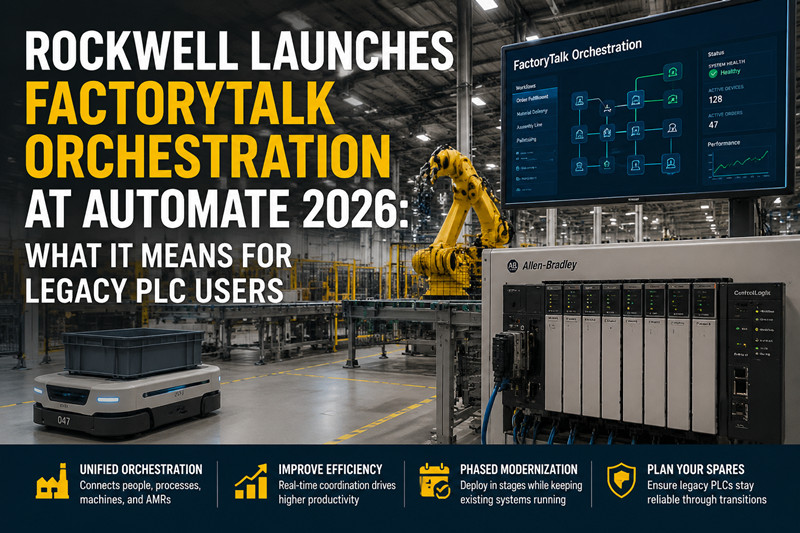
CHICAGO — Rockwell Automation took the wraps off FactoryTalk Orchestration at Automate 2026, a new software platform designed to coordinate production workflows, material movement, autonomous mobile robots (AMRs), and automated systems across plant floors. The launch, which drew coverage from Automation World and other trade media, signals a strategic push into the orchestration layer that sits between enterprise planning systems and the controllers that run the machinery. For the thousands of plants still running legacy Rockwell platforms — ControlLogix 1756-L6x and L7x controllers, SLC 500 systems, and even older PLC-5s — the announcement carries implications that reach well beyond the show floor at Chicago's McCormick Place (June 22–26). What FactoryTalk Orchestration Does FactoryTalk Orchestration is not a controller replacement. It is a middleware layer that connects enterprise systems such as MES and ERP directly to production equipment and AMRs using real-time data streams. The platform can dispatch an AMR to deliver raw materials to a specific work cell the moment a upstream process signals completion, adjust conveyor routing based on order priority, or synchronize multiple robotic stations for mixed-model production — all without manual intervention. Rockwell demonstrated internal deployments during the show that showed measurable material handling efficiency improvements. In one case study presented on-site, a parts distribution center using FactoryTalk Orchestration reduced wait times at transfer points by roughly 30 percent by dynamically routing AMRs based on real-time production queue status rather than fixed schedules. The platform is part of a broader industry push toward what automation suppliers now call "orchestrated automation" — the idea that discrete islands of automation (a robotic arm here, a conveyor there, an AGV in another zone) need to be choreographed as a single system. Automation World reported from the event that Rockwell positioned FactoryTalk Orchestration as the "digital conductor" for the smart manufacturing floor (Automation World, June 26, 2026). Martech Edge also covered the launch, noting that the offering fills a gap Rockwell had acknowledged for years — a unified orchestration layer between Level 3 (plant operations) and Level 2 (control) in the ISA-95 model (Martech Edge, June 23, 2026). Launch Context: Automate 2026 Automate 2026 drew more than 25,000 attendees across five days in Chicago, with Rockwell using the event to showcase both new hardware and software. The introduction of FactoryTalk Orchestration was among the week's most heavily attended product demonstrations. The launch follows Rockwell's 11th annual State of Smart Manufacturing Report, published earlier in 2026, which found that more than 80 percent of manufacturers surveyed planned to increase or maintain their automation technology investments through the year. The report pointed specifically to integration complexity as a top barrier — the exact problem FactoryTalk Orchestration aims to solve. Rockwell's booth at Automate featured a live production line simulation where FactoryTalk Orchestration coordinated a CompactLogix 5380-controlled filling station, an AMR making delivery runs from a virtual warehouse, and a palletizing robot — all driven by order data from a simulated ERP system. The demonstration was designed to show that orchestration is already deployable with current-generation hardware. The Legacy PLC Angle: What It Means for Older Systems Here is where the launch story intersects with the reality of the installed base. For plants running older ControlLogix 1756-L6x or L7x controllers, the orchestration story is twofold. First, FactoryTalk Orchestration supports backward compatibility with modern ControlLogix 5580 and CompactLogix 5380 controllers — but older L6x/L7x controllers may need a firmware upgrade or eventual replacement to participate fully in orchestrated workflows. The orchestration layer communicates most effectively with controllers running Studio 5000 Logix Designer v34 or later, which excludes many L6x and early L7x installations still active in the field. Second, the surge in automation investment driven by these orchestration projects means more legacy systems will be retired and need spare parts to keep remaining lines running during transitions. Plants that adopt FactoryTalk Orchestration incrementally — adding orchestrated work cells one at a time while leaving other lines on legacy control — will need to maintain parallel spares inventories across two generations of equipment. The same dynamic applies to plants running SLC 500 or PLC-5 platforms. These systems have no direct integration path to FactoryTalk Orchestration. Plants that want to connect them into an orchestrated workflow will need to bridge through protocol gateways or, more commonly, plan for a full Rockwell Automation controller migration. Each migration wave creates a spike in demand for replacement modules, power supplies, and backplanes to keep non-migrated lines healthy through multi-year transition programs. Spare Parts Strategy in the Orchestration Era Industry consultants who spoke with trade media at Automate 2026 emphasized that orchestration projects tend to follow a phased deployment pattern: one cell, one line, or one building at a time. That phased approach means legacy equipment stays in production longer than it would under a rip-and-replace modernization. The result is a prolonged tail of spare parts demand for platforms that Rockwell is no longer actively developing. For maintenance and procurement teams, the practical takeaway is straightforward. The decision to adopt FactoryTalk Orchestration should include a spares assessment for the legacy controllers that will be bridged, not replaced, during the first deployment phases. If a ControlLogix L7x rack is supporting a non-orchestrated line while engineering teams build out the orchestrated zone next door, that older rack needs to stay operational — and serviced — for the duration. Sourcing options for discontinued Rockwell and Allen-Bradley components become more important as the installed base of SLC 500 and PLC-5 systems continues to age. The orchestration trend extends the useful life of these older systems by enabling plants to modernize selectively rather than wholesale. Market Impact and What Comes Next Rockwell has not disclosed pricing for FactoryTalk Orchestration, but the platform is expected to ship broadly in the second half of 2026. The automation industry will be watching adoption rates closely, particularly in automotive, food and beverage, and warehouse logistics — sectors where mixed-fleet AMR coordination and dynamic production scheduling deliver immediate ROI. The broader story from Automate 2026 is that orchestration is no longer a future concept. Rockwell, Siemens, and other major automation suppliers are all building or acquiring orchestration capabilities. For plants running older Rockwell controllers, the question is whether their legacy systems are ready to participate — or whether the transition is the right time to re-evaluate the spares strategy that will carry them through it. ------------------------------------------------------------------------------------------------------------------ 🏢 About TZ Tech TZ Tech is a leading supplier of industrial automation, electrical, instrumentation, and telecommunications components. We specialize in sourcing ready-to-ship distributor stock, allowing us to offer highly competitive pricing and short lead times. Thanks to our extensive inventory, we can even source rare and discontinued parts that are hard to find elsewhere. 🛡️ Our Quality Commitment We understand that quality is your top priority. Every component undergoes a strict screening and inspection process so you can buy with absolute confidence. For legacy or discontinued parts, we believe in complete transparency and will always provide an honest, accurate report on the product's condition. Plus, all brand-new parts come backed by a full 1-year warranty. ✉️ Get in Touch Have a project or a part you need? Send us your inquiry today! Our team is dedicated to providing a fast response within 6 hours (excluding weekends).
View More

Please read on, stay posted, subscribe, and we welcome you to tell us what you think.


Sitemap | Blog | XML | Privacy Policy
In addition, with your permission, we want to place cookies to make your visit anointeraction with slOC more personal. For this we use analytical and advertisingcookies. With these cookies we and third parties can track and collect yourinternet behawior inside and outside super-instrument.com. With this we and third parties adapt super-instrument.com and advertisementsto your interest. By clicking Accept you agree to this. If you decline, we only usethe necessary cookies and you unfortunately will not receive any personalizedcontent. Please visit our Cookie policy for more information or to change yourconsent in the future.
Accept and continue Decline cookies