
ControlLogix vs CompactLogix: Which One Does Your Plant Actually Need?

Let's be honest: most of the ControlLogix racks I see in the field don't need to be ControlLogix. A 1756-L73 running a machine with thirty I/O points is a $6,000 processor doing a $1,200 job. I've opened cabinets like that three times this year. The panel is twice the size it needs to be, the spares cost three times as much, and the electrician needs a step stool to reach the processor.
Nobody wants to admit they overspecified. The integrator wrote "for future expansion" into the spec and the future never showed up. Meanwhile the CompactLogix brick in the next cabinet runs an identical machine, costs a fraction to keep spares for, and hasn't faulted in four years.
But don't read this as a "small PLC good, big PLC bad" rant. I've also seen a 1769-L36ERM coordinating three motion axes and a VFD network off one backplane, a brick stretched way past its limits. That failure mode costs just as much, in a different currency.
Here's what most people miss. The two families share the same programming environment, the same instruction set, the same Studio 5000 software, and none of the same hardware. They aren't "big version, small version" of each other; they're two architectures that speak the same language, and treating them as interchangeable is how you end up with a gold-plated cabinet or a brick in way over its head. Let's be straight about this: what follows is what each platform is built to do, what it costs to own over ten years, and how to pick the one that won't embarrass you in front of your maintenance crew. I've spent more than twenty years in this trade, and here's everything I know without the sales brochure.
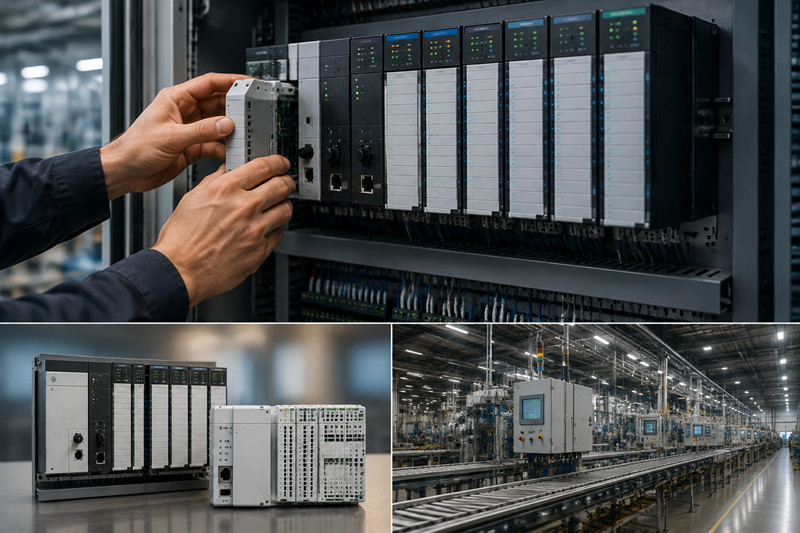
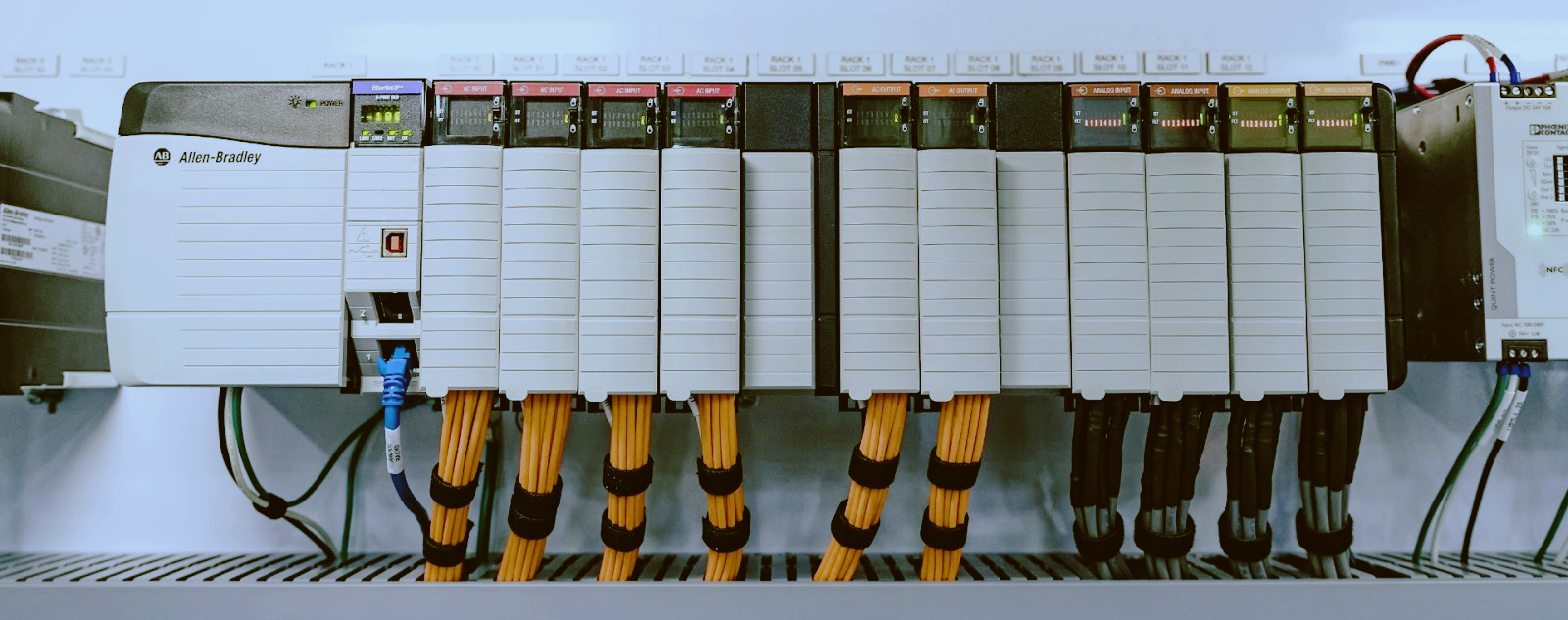
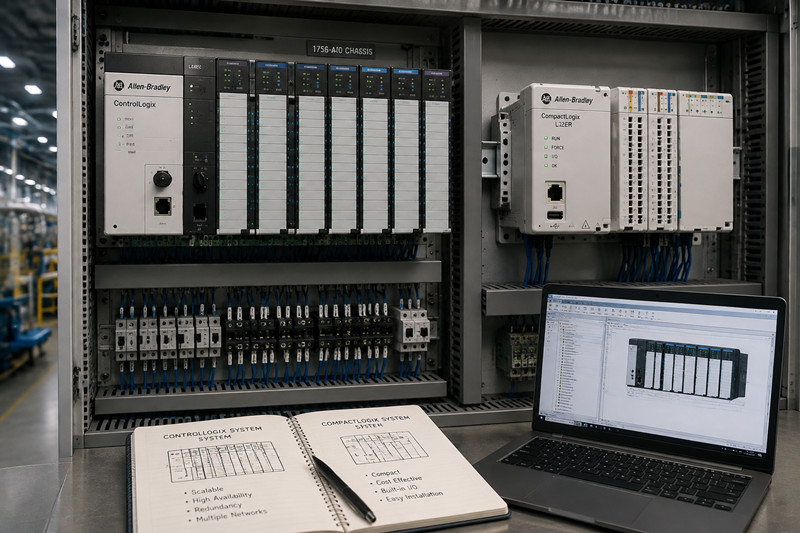
ControlLogix is a modular, chassis-based system. You buy a rack, called a chassis, and slot cards into it. The processor is one card, the power supply bolts to the side, and every I/O, comms, and motion card plugs into the backplane. The chassis comes in five standard sizes: the 1756-A4 with four slots, the 1756-A7 with seven, the 1756-A10 with ten, the 1756-A13 with thirteen, and the 1756-A17 with seventeen.
CompactLogix is a brick. Processor, power supply, and a chunk of I/O live in one molded housing. You bolt it to the back panel and hang expansion modules off the side on a short serial bus. No backplane, no card cage, no swappable comms cards. What you see is what you get, decided at purchase time.
That one architectural difference drives how you size, repair, expand, and stock spares. Allen-Bradley parts don't cross over at all: a 1756-IB16 input card will not fit a CompactLogix system, and a 1769-IQ16 will not fit a ControlLogix rack. If you run both, you're stocking two separate spare-parts bins, and that's a real, recurring cost.
ControlLogix exists for one reason: it's what you pick when the system is too big, too fast, or too critical for anything smaller.
Because every module rides the backplane, ControlLogix scales in a way CompactLogix can't touch. Need more I/O? Add another chassis and connect it with a 1756-EN2T or 1756-EN2TR EtherNet/IP module, and the processors treat remote racks as if they were local. The 1756-EN2TR adds a second RJ45 port and CIP Sync. Legacy plants still run ControlNet with the 1756-CNB and DeviceNet with the 1756-DNB, so one rack can hold a plant's older networks together. A brick can't do that.
Need more memory? The 1756-L82E carries 5 MB of user memory and the 1756-L85E carries 20 MB, enough for a batch recipe table, an alarm database, and a historian buffer in one controller. Need redundancy? That's hardware, not software trickery, and it's the headline below.
The I/O modules are built for industrial abuse. A 1756-IB16 gives you sixteen 24 VDC inputs with isolation and per-point diagnostics, and the 1756-OB16 does the same on outputs. When a field device starts dying, the diagnostics tell you which channel is going before the machine faults. On a CompactLogix you find out when the machine stops.
Power comes from the 1756-PA72, a 120/240 VAC supply rated for 6 amps of backplane current, or the 1756-PB72, its 24 VDC twin, sized against the total current draw of every card. Get that wrong and you get brownouts at the worst moment, usually 3 a.m. during a batch run.
Nobody wants to admit this, but redundancy is the single biggest reason plants buy ControlLogix. The 1756-RM2 redundancy module, one per chassis, pairs two processors so that when the primary faults, the standby takes over with bumpless transfer of program and data. That's high-availability, DCS-style thinking bolted onto a PLC, and CompactLogix has nothing like it. There is no redundant CompactLogix, and there won't be one. If your application can't tolerate a processor swap, you're buying ControlLogix, full stop.
Redundancy isn't free. You buy two of everything, plus sync cables, configuration time, and annual failover testing. A system that's never failover-tested is just an expensive way to have two broken processors.
ControlLogix is where Allen-Bradley motion lives. The 1756-M02AE, 1756-M03SE, and 1756-M08SEE SERCOS modules, and the newer motion over EtherNet/IP, run multi-axis coordinated applications a CompactLogix L36ERM has no headroom for.
Then there's the process world. ControlLogix with PlantPAx is Allen-Bradley's answer to a DCS, and it's a legit one. The 1756-IF8 and 1756-IF16 analog inputs, the 1756-OF8 and 1756-OF4 outputs, PID with auto-tune, alarm management, batch sequencing, all run in the same chassis as your discrete logic.
Now the part the sales reps skip. ControlLogix is expensive. A current 1756-L82E lists in the $6,000 to $9,000 range, and the 1756-L85E sits north of that. Add a chassis, a 1756-PA72, a pair of 1756-EN2TR modules, and I/O, and a modest ten-slot rack is a $25,000 to $40,000 cabinet before a single field wire is pulled. A hot-spare processor is another $7,000 to $10,000 of inventory that does nothing until something dies.
The footprint is real too. A 1756-A13 chassis with a processor, two comms cards, and nine I/O cards needs ventilation, a deeper enclosure, a power budget a brick doesn't. I've seen plants put one into a panel sized for a CompactLogix and then wonder why the temperature alarm goes off every summer.
And one more thing: the L6x generation is done. The 1756-L61, 1756-L63, and their siblings hit their last-time-buy windows in 2024 and 2025, and those windows are closed. New L6x processors don't exist; today's stock is secondary market for a platform Allen-Bradley has stopped supporting. The 1756-L7x and 1756-L8x families remain current, but every year you keep an L63 in production you're betting the plant on a part that gets harder to find. PLC spares for L6x systems are drying up, and I've watched the price of a used 1756-L63 nearly double in eighteen months. Plan the migration before the market plans it for you.
Now the platform that actually runs most of the machines on this planet.
The 1769 line has been around for over two decades and it's still the workhorse. Processors run from the 1769-L16ER, a tiny brick with 512 KB of memory perfect for a single machine, up through the 1769-L18ER, the 1769-L24ER-QBFC1B with embedded 24 VDC I/O, two analog inputs, two analog outputs and a counter, the 1769-L30ER, the 1769-L33ER, and the 1769-L36ERM, which adds two integrated motion axes. The L33ER is probably the most common PLC on factory floors in the Americas and the Middle East right now: a 2 MB controller with built-in EtherNet/IP, enough for a decent-sized machine, at a fraction of ControlLogix cost. Want more headroom? The 1769-L37ERM and 1769-L38ERM exist, but you're still on the same serial bus and two-axis motion limit.
I/O hangs off the side of the brick on the 1769 bus. The 1769-IQ16 gives you sixteen 24 VDC inputs, the 1769-OW16 sixteen relay outputs, the 1769-IF4 four analog inputs, and the rest of the family covers AC inputs and thermocouple modules. Power comes from the 1769-PA4, rated 4 amps at 120/240 VAC, or the 1769-PA2 at 2 amps, bolted to the brick's left end. Everything is DIN-rail or panel mounted. No rack, no card cage, no backplane current math. On comms, the "ER" processors carry EtherNet/IP natively, and a 1769-SDN scanner adds a DeviceNet master for legacy field devices. Not the network zoo a ControlLogix rack can host, but plenty for a machine cell.
The newer 5069 CompactLogix is the same idea with modern internals. The 5069-L306ER, 5069-L330ER, and 5069-L340ER bricks run faster processors with more memory, and modules like the 5069-IBS16 and 5069-OB16 talk over a faster local bus. The 5069-L340ER is genuinely capable: 3.2 MB of memory, dual EtherNet/IP ports, and enough speed to blur the line with entry-level ControlLogix.
Here's the catch nobody mentions at the sales meeting: 1769 and 5069 are not compatible. A 5069 brick will not take 1769 expansion modules, and a 1769 brick will not take 5069 modules. Form factor, bus, and mounting all changed. If your supplier nudges you to "upgrade" to 5069, you're not upgrading, you're replacing everything in the cabinet.
The brick does exactly what its name says: everything a machine needs in one box that mounts in minutes. The 1769-L24ER-QBFC1B has embedded I/O, so a small machine needs exactly one part, a 24 VDC supply, and a network cable. Spares are cheap enough that plants stock a complete spare brick: when the processor dies, you swap the whole unit in fifteen minutes instead of rebuilding a rack.
Cost per point is the big one. A 1769-L33ER with a couple of 1769-IQ16 and 1769-OW16 modules runs maybe a third of what an equivalent ControlLogix slot count costs, and the panel space is a third too. For standalone machines, skids, packaging lines, material handling, pump stations, and anything under roughly 100 I/O points, CompactLogix is the right engineering answer, not just the cheap one.
The programming story is identical. Techs who know Studio 5000 move between a 1769-L30ER and a 1756-L85E without retraining; tags, routines, AOIs, the whole toolkit is the same. That's the single biggest reason CompactLogix adoption is so high: the people who maintain it already know it.
CompactLogix has hard ceilings, and you need to know where they are before you pick it, not after. The expansion bus is serial, so the more modules you hang off a brick, the slower the I/O update. Load a 1769-L33ER with eight or nine modules and a fast program and you get scan times a ControlLogix rack eats for breakfast. There's no redundancy, no hot-swap, no ControlNet, no DeviceNet without an add-on scanner, and motion tops out at two axes on the L36ERM. If your machine has six servo axes with coordinated moves, the brick is the wrong tool, and no amount of clever programming fixes that.
There's also the repair model. A brick is one sealed unit. When the embedded I/O on a 1769-L24ER-QBFC1B dies, the whole brick dies; when a 1756-IB16 in a rack dies, you pull one card, swap in the spare, and you're back in ten minutes. The brick trades repairability for price, and most of the time that's a fair trade.
And the 5069 migration trap deserves repeating. If you're on 1769 today and someone tells you the 5069 is "the same thing but newer," check your wallet. The industrial automation market is full of plants that bought 5069 bricks expecting to reuse 1769 I/O and ended up buying both. PLC spares strategy: pick a generation and stock for it.
Feature | CompactLogix 1769 / 5069 | ControlLogix 1756
Architecture | Brick with side-mounted expansion bus | Modular chassis with parallel backplane
Processor examples | 1769-L16ER through L38ERM; 5069-L306ER, L330ER, L340ER | 1756-L61/L63 (end-of-life), L73, L82E, L85E
User memory | 512 KB to 3.2 MB | Up to 20 MB on the 1756-L85E
I/O expansion | Embedded I/O plus local expansion only | Local racks plus distributed remote racks
I/O module examples | 1769-IQ16, OW16, IF4; 5069-IBS16, OB16 | 1756-IB16, OB16, IF8, OF8
Comms | EtherNet/IP standard; DeviceNet via 1769-SDN; no ControlNet | EtherNet/IP, ControlNet, DeviceNet via modules (EN2T/EN2TR, CNB, DNB)
Redundancy | None | Yes, 1756-RM2 processor pairs
Motion | Up to 2 integrated axes (L36ERM) | Multi-axis SERCOS and EtherNet/IP motion
Process / DCS apps | Limited | Full PlantPAx support
Footprint | Small, panel or DIN rail | Large, needs rack and ventilation
Cost per point | Low | High
Spares strategy | Cheap, stock a whole spare brick | Expensive, stock cards and processors
Current status | 1769 and 5069 both current | L7x/L8x current; L6x end-of-life since 2024-2025
...the machine is standalone. A packaging line, a CNC loader, a palletizer, a pump skid, a small water treatment unit. Under 100 I/O points, no redundancy, no coordinated multi-axis motion, one or two EtherNet/IP connections to a VFD or an HMI. The 1769-L33ER handles this class of work all day, and the spare brick in stores costs less than one ControlLogix processor.
I've seen too many projects where a CompactLogix would have done the job and the plant bought ControlLogix because the machine builder's standard spec said so. If you're the plant, push back. Ask for the cost-per-point justification. Most of the time there isn't one.
...the application is redundant, process-heavy, motion-heavy, or spread out. A fired heater with burner management, a batch reactor skid, a pipeline station with remote I/O in three buildings, a printing line with eight servo axes. When a processor fault costs more per hour than the whole control system costs per year, you buy ControlLogix and you don't apologize for it. That's the oil and gas, power, and water world in the Middle East and the process plants of Europe and the Americas, which run ControlLogix for a reason.
Process applications especially: PlantPAx, the 1756-IF8 and 1756-IF16 analog modules, and the redundant 1756-RM2 pairs are the stack Allen-Bradley sells into DCS replacements. If you're migrating an old pneumatic or hybrid control system, ControlLogix with PlantPAx is the platform the whole ecosystem, including historians and alarm management software, is built around.
...you're in the middle. A machine with 100 to 300 I/O points, no redundancy, light motion. A 5069-L340ER can run that machine, and so can a 1756-L72 or 1756-L73. The honest answer is that both work; the decision comes down to what your crew already stocks, what your other plants standardize on, and the ten-year cost. If every other line in the plant runs CompactLogix, the techs have spares and know-how, so match the fleet. If the plant already runs a redundant ControlLogix infrastructure, adding one more rack is cheaper than starting a second spare-parts bin. Standardization beats optimization almost every time.
List prices, and let's be clear these are approximate and negotiable, though the shape of the numbers is stable.
A CompactLogix processor runs roughly $1,500 to $4,000 depending on model, the 1769-L16ER at the bottom and the 5069-L340ER at the top. Add a power supply and a handful of I/O modules and a working small system lands around $3,000 to $8,000.
A ControlLogix processor runs roughly $4,000 to $12,000, the 1756-L85E at the top and the 1756-L71 or 1756-L73 in the middle. Add a chassis, a 1756-PA72 or 1756-PB72, comms modules, and I/O, and a real system starts around $15,000. Redundancy doubles the processor cost and stacks the 1756-RM2 modules on top.
Now do the ten-year math. CompactLogix spares are cheap enough to stock a complete spare brick. ControlLogix spares are expensive enough that most plants stock one processor and a couple of I/O cards and pray. The L6x situation makes it worse: Allen-Bradley parts for the 1756-L61 and 1756-L63 are secondary-market only, and the price reflects it. I've seen used L63 processors listed for more than a new L73. That's the end-of-life tax, and it only goes up.
Cost per point is the other lens. A CompactLogix system with 50 points of discrete I/O works out to roughly $80 to $150 per point all-in; the same 50 points on ControlLogix runs $250 to $400 per point before the rack and power supply. You're paying a premium for capability you may never use. That's fine when you need it. It's theft when you don't.
Print this out and go through it in order; don't skip to model numbers until you've answered the architecture questions.
· Does the application require redundant processors? If yes, ControlLogix with 1756-RM2. There is no CompactLogix answer. Stop here.
· Is this a process application with PID, alarm management, batch, or PlantPAx integration? If yes, ControlLogix. PlantPAx on CompactLogix is fighting the platform.
· Does the machine need more than two coordinated servo axes? If yes, ControlLogix. The 1769-L36ERM stops at two.
· Is the I/O spread across multiple locations, remote racks, or more than about 100 to 150 points? If yes, ControlLogix with distributed chassis, or a hard look at whether the 5069's faster bus can carry it.
· Is the machine standalone, under 100 I/O, no redundancy, one or two network connections? If yes, CompactLogix, and don't let anyone upsell you.
· What does your maintenance crew already stock and know? Match the fleet if there's a fleet standard. Standardization beats optimization.
· What is the ten-year cost, including spares and the L6x end-of-life tax if you're on legacy hardware? Run the numbers, don't guess.
If you answer mostly "yes" to the first four, you're buying ControlLogix and it's the right call. If you answer mostly "yes" to the fifth and sixth, you're buying CompactLogix and you'll sleep fine.
Can I mix 1769 and 5069 modules in one system?
No. Different form factors, different buses, different mounting. A 5069-L340ER will not accept a 1769-IQ16, and a 1769-L33ER will not accept a 5069-IBS16. Migrating from 1769 to 5069 means replacing the I/O, not just the processor. The only thing that transfers is your program logic and tags, and even then expect to rebuild the I/O tree.
Is ControlLogix worth it for a 50-I/O machine?
Almost never. Fifty points of discrete I/O on a 1756-L73 means a chassis, a power supply, two comms cards, four or five I/O cards, and a $6,000 processor doing maybe 10% of its capacity. A 1769-L24ER-QBFC1B with embedded I/O runs the same machine for a fraction of the money and panel space. Exceptions: redundancy requirements, process applications, or a plant standard that says everything is ControlLogix.
Can CompactLogix do redundancy?
No. There is no redundant CompactLogix configuration, no equivalent of the 1756-RM2, and no software trick that changes that. If you need bumpless processor failover, you need ControlLogix. Some plants run two bricks with a handshake and let the second take over a shared network, but that's a shadow system with a switchover gap, not redundancy, and it's not appropriate for anything safety-critical.
Which platform has better spare-parts availability in 2026?
For current hardware, both are fine, but CompactLogix is the easier position to defend. Bricks are cheap enough that you stock a complete spare, and 1769 and 5069 modules are still in production. On the ControlLogix side, current L7x and L8x parts are available, but the L6x generation is the problem: the last-time-buy windows closed in 2024 and 2025, new parts don't exist, and everything you find is secondary market. If you're running 1756-L61 or 1756-L63 processors, parts availability is your top risk and the migration should already be planned. Check lead times before you commit; the market shifts.
Can I reuse my 1756 modules if I downsize to CompactLogix?
No. 1756 modules are chassis cards and physically cannot mount in a CompactLogix system, 1769 or 5069. The reverse is equally true. Downsizing means selling or scrapping the 1756 cards and buying new I/O. I've seen plants try to keep a 1756-EN2T "for the network" and then discover it's a chassis card. The only things that carry over are your program, your tag database, and your scars.
URL Slug: controllogix-vs-compactlogix-guide
------------------------------------------------------------------------------------------------------------------
🏢 About TZ Tech
TZ Tech is a leading supplier of industrial automation, electrical, instrumentation, and telecommunications components. We specialize in sourcing ready-to-ship distributor stock, allowing us to offer highly competitive pricing and short lead times. Thanks to our extensive inventory, we can even source rare and discontinued parts that are hard to find elsewhere.
🛡️ Our Quality Commitment
We understand that quality is your top priority. Every component undergoes a strict screening and inspection process so you can buy with absolute confidence. For legacy or discontinued parts, we believe in complete transparency and will always provide an honest, accurate report on the product's condition. Plus, all brand-new parts come backed by a full 1-year warranty.
✉️ Get in Touch
Have a project or a part you need? Send us your inquiry today! Our team is dedicated to providing a fast response within 6 hours (excluding weekends).

Please read on, stay posted, subscribe, and we welcome you to tell us what you think.


Sitemap | Blog | XML | Privacy Policy
In addition, with your permission, we want to place cookies to make your visit anointeraction with slOC more personal. For this we use analytical and advertisingcookies. With these cookies we and third parties can track and collect yourinternet behawior inside and outside super-instrument.com. With this we and third parties adapt super-instrument.com and advertisementsto your interest. By clicking Accept you agree to this. If you decline, we only usethe necessary cookies and you unfortunately will not receive any personalizedcontent. Please visit our Cookie policy for more information or to change yourconsent in the future.
Accept and continue Decline cookies