
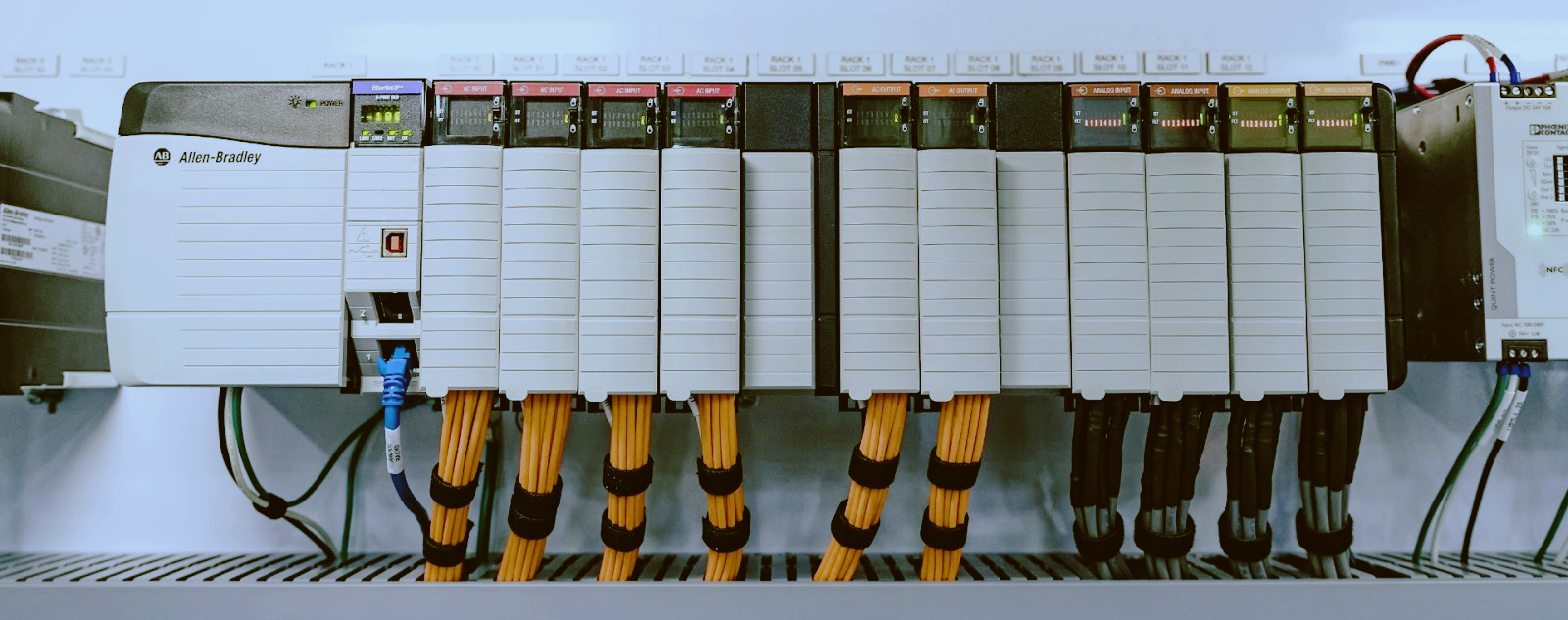
Allen-Bradley 1771 I/O Modules: What's Obsolete, What's Still Supported, What Replaces It
The 1771 I/O family is the classic Allen-Bradley chassis I/O for the PLC-5 era (1785 processors) and 1771 racks. Rockwell introduced it in the 1980s. It ran the bulk of North American and Middle East process and machine control for three decades. It is not compatible with SLC 500 (that is the 1746 family). It is not directly compatible with ControlLogix (1756). Moving to either platform requires a migration, not a swap.
As of 2026, most of the 1771 line sits in Active Mature or Life Cycle status. Many modules are End of Life. New production is limited to a shrinking list of catalog numbers. The installed base keeps running on surplus, remanufactured, and aftermarket stock. Plants in the Middle East, Americas, and Europe still operate thousands of 1771 racks. This reference lists the catalog numbers, typical lifecycle status, and the practical replacement path for each module family.
Rockwell uses four lifecycle statuses:
Status | Meaning
Active | In production, fully supported
Active Mature | In production, support ongoing, no new features
Life Cycle | Production limited or by order, support phased
End of Life | Discontinued, no repair, no support
Statuses shift over time. The tables below show typical status as of 2026. Always verify each catalog number on the Rockwell Product Lifecycle page before you commit a bill of materials.
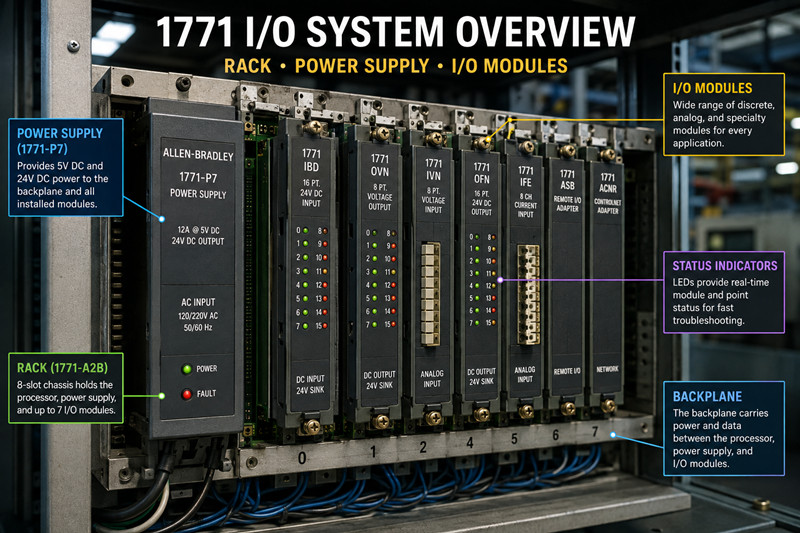
The 1771 rack is a backplane chassis. The processor, power supply, and I/O modules all plug into the same backplane. Rack size determines how many modules the system can hold.
Catalog | Slots | Notes
1771-A1B | 4 | Smallest chassis, used for small remote I/O drops
1771-A2B | 8 | Most common size
1771-A3B | 12 | Medium plants and machine lines
1771-A4B | 16 | Largest, for dense I/O panels
Slot count includes the processor slot. A PLC-5/15 in an 8-slot rack leaves seven slots for I/O. Racks are passive hardware. They rarely fail. The backplane connectors wear with repeated module insertion, so handle card removal carefully.
Rack status: Active Mature. Chassis production continues in low volume. The 1771-A2B remains the most requested rack for spare and expansion use.
The 1771 power supply mounts on the left side of the rack. It converts line power to the 5V DC and 24V DC buses the backplane uses.
Catalog | Output | Notes
1771-P7 | 12A at 5V DC, plus 24V DC | Standard supply for most racks
1771-P4S | 4A at 5V DC | Small systems
1771-P6S | 6A at 5V DC | Medium systems
Power supply sizing: sum the current draw of every module in the rack, then add 20% headroom. Under-sized supplies cause brownouts and intermittent faults that look like processor problems. Input voltage versions exist for 120V/60Hz (Americas) and 230V/50Hz (Middle East, Europe) mains. Check the nameplate before ordering. A 120V unit on a 230V line fails immediately.
Capacitors age. A 1771-P7 from 1995 delivers less current than it did new. Remanufactured supplies get recapped and load-tested. That is the recommended buy for critical spares.
Discrete inputs read dry contacts, pushbuttons, limit switches, and proximity sensors. The 1771 family covers DC, AC, and TTL signal levels.
Catalog | Points | Signal | Notes
1771-IBD | 16 | 24V DC | Workhorse module, Active Mature
1771-IAD | 8 | 120V AC | Americas plants
1771-IBN | 16 | 24V DC, isolated | Per-point isolation
1771-IGD | 8 | 5V TTL | Logic-level interfaces
1771-IAC | 8 | 120V AC, isolated | Isolated AC inputs
1771-IA | 8 | 120V AC | Original AC input
1771-IB | 8 | 24V DC | Original DC input
The 1771-IBD is the most common 24V DC input module in the entire family. It is still produced and still supported. Surplus demand stays high because it is the default choice for new drops on existing PLC-5 systems. The 1771-IAD and 1771-IAC handle 120V AC circuits directly. This suits the Americas, where 120V/60Hz control circuits are standard. In 230V/50Hz markets, engineers either use 24V DC sensors or step down through control transformers. The 1771-IGD is rare. It reads 5V TTL logic levels from old test equipment and specialty devices. The 1771-IB is the 8-point predecessor of the IBD. Both fit the same slot, but new designs should use the IBD if panel space allows.
All input modules report field status through indicator LEDs. Sinking and sourcing versions exist across the catalog; match the module to the sensor common. Mixed sinking and sourcing on one module is not possible, so check the wiring diagram before ordering replacements.
Discrete outputs drive contactors, solenoid valves, pilot lights, and motor starters.
Catalog | Points | Signal | Notes
1771-OBD | 16 | 24V DC | Workhorse module, Active Mature
1771-OAD | 8 | 120V AC | Americas plants
1771-OBN | 16 | 24V DC, isolated | Per-point isolation
1771-ODD | 8 | 24V DC, isolated | Isolated DC output
1771-OD16 | 16 | 24V DC | High-density DC output
1771-OA | 8 | 120V AC | Original AC output
1771-OB | 8 | 24V DC | Original DC output
The 1771-OBD is the family standard for 24V DC outputs. It is Active Mature and remains in production. The 1771-OAD and 1771-OA switch 120V AC loads directly. Verify the load current per point and the total per module; AC solenoids draw inrush current several times the holding current. The 1771-OD16 gives 16 points in one slot for dense panels. The isolated versions, 1771-OBN and 1771-ODD, keep each point electrically separate. Use them when outputs drive loads from different power sources or when a single shorted load must not take down the group.
Output modules fail more often than input modules. They switch real current and absorb inductive kickback from coils. Fused output modules protect the card but not the triac or transistor. A blown fuse on a 1771-OBD is a five-minute fix; a blown output driver is a module replacement.
Analog modules handle 4-20 mA, 0-10V, thermocouple, RTD, and mV signals. These are the modules most affected by obsolescence.
Catalog | Points | Function | Notes
1771-IFE | 4 | Analog input | Revisions /A, /B, /C
1771-OFE1 | 4 | Analog output | Isolated outputs
1771-OFE2 | 4 | Analog output | 4-20 mA focus
1771-OFE3 | 4 | Analog output | Voltage focus
1771-IXHR | 8 | Thermocouple/mV input | High-resolution
1771-IR | 4 | RTD input | Resistance temperature
1771-NIV | 8 | Isolated mV input |
1771-NIS | 4 | Isolated analog input |
1771-NOC | 4 | Isolated analog output |
The 1771-IFE is the most common analog input module in the 1771 family. It reads four channels of 4-20 mA or 0-10V. Revisions /A, /B, and /C exist. The /C revision adds features and is the preferred spare. The 1771-OFE1, OFE2, and OFE3 cover analog output. The OFE2 is configured for current loops, the OFE3 for voltage. The 1771-IXHR reads eight thermocouple or mV channels with cold-junction compensation. Type J, K, T, E thermocouples are supported. The 1771-IR reads RTDs. Both the IXHR and the IR are End of Life. Thermocouple and RTD inputs on existing systems should migrate to the 1756-IT6 or 1756-IR6I when the rack converts. The 1771-N series (NIV, NIS, NOC) is isolated analog I/O for noisy environments. Production stopped years ago. These modules now come from surplus and remanufactured stock.
Analog accuracy depends on the module revision. The 1771-IFE /A is 12-bit; later revisions improve linearity. Calibration drifts with age. A remanufactured analog module is recalibrated and certified. Budget for calibration whenever you buy used analog cards.
Specialty modules handle remote I/O, networks, and data transfer. They are the backbone of distributed 1771 systems.
Catalog | Function | Notes
1771-ASB | Remote I/O adapter | Still widely stocked, Active Mature
1771-SDN | DeviceNet scanner | End of Life
1771-SCN | ControlNet scanner | Life Cycle
1771-DCM | Direct communication module | End of Life
1771-OWN | Word/byte transfer module | End of Life
1771-PM | PLC-2/3 processor adapter | End of Life
The 1771-ASB turns a 1771 rack into a remote I/O drop. A PLC-5 or a 1756 bridge with a remote I/O port talks to it over twinaxial cable. It is the single most important module in distributed 1771 plants. It is Active Mature and still produced. It is also the most failure-prone item in the system, because it carries the communication traffic for the whole rack. One failed ASB takes down every module behind it. The 1771-SDN scanned DeviceNet devices from a PLC-5. DeviceNet itself is in decline, and the SDN is End of Life. The 1771-SCN did the same for ControlNet. The 1771-DCM connected a PLC-5 to another processor for peer-to-peer messaging. The 1771-OWN transferred blocks of data between processors. Both are long discontinued. The 1771-PM let PLC-2 and PLC-3 processors use 1771 I/O. It is obsolete; surviving units are collector items for legacy plants.
Communication modules carry firmware. Verify the firmware revision matches the processor and network before installation. A mismatched ASB firmware revision is a common cause of remote rack faults that appear as wiring problems.
Typical status as of 2026. Verify on the Rockwell Product Lifecycle page before ordering.
Catalog | Typical status | Notes
1771-A1B / A2B / A3B / A4B | Active Mature | Chassis remain in production
1771-P7 / P4S / P6S | Active Mature | Supplies still produced
1771-IBD | Active Mature | Still produced, high demand
1771-IAD | Life Cycle | Production limited
1771-IBN | Life Cycle | Production limited
1771-IGD | End of Life | Surplus only
1771-IAC | Life Cycle |
1771-IA / 1771-IB | End of Life | Surplus only
1771-OBD | Active Mature | Still produced, high demand
1771-OAD | Life Cycle |
1771-OBN | Life Cycle |
1771-ODD | End of Life |
1771-OD16 | Life Cycle |
1771-OA / 1771-OB | End of Life | Surplus only
1771-IFE | Life Cycle | Revisions /A /B /C
1771-OFE1 / OFE2 / OFE3 | Life Cycle |
1771-IXHR | End of Life | Surplus only
1771-IR | End of Life | Surplus only
1771-NIV / NIS / NOC | End of Life | Surplus only
1771-ASB | Active Mature | Still produced, widely stocked
1771-SDN | End of Life |
1771-SCN | Life Cycle |
1771-DCM | End of Life |
1771-OWN | End of Life |
1771-PM | End of Life |
The pattern is clear. Discrete DC modules (IBD, OBD) and the ASB stay in production. AC modules and analog modules are sliding to Life Cycle and End of Life. Specialty and data-transfer modules are mostly gone. Buyers increasingly rely on surplus and remanufactured stock for anything outside the Active Mature list.
Three paths exist for 1771 systems.
Path one: keep the PLC-5 and buy remanufactured 1771 modules. This is the cheapest path for existing systems. A remanufactured 1771-IBD costs a fraction of a full migration and installs in minutes. No logic changes, no rewiring, no downtime beyond the swap. This path works until the processor itself fails or the plant needs new functionality.
Path two: replace the rack with ControlLogix. The standard migration maps 1771 modules to 1756 equivalents:
1771 module | 1756 replacement | Notes
1771-IBD | 1756-IB16 | 16-point 24V DC input
1771-OBD | 1756-OB16D | 16-point 24V DC output
1771-IFE | 1756-IF8 | 8-channel analog input
1771-OFE1/2/3 | 1756-OF8 | 8-channel analog output
1771-ASB (remote rack) | 1756 rack + 1756-EN2T | EtherNet/IP
The 1756-EN2T puts the new rack on EtherNet/IP. Field wiring does not transfer. Terminal blocks and marshalling need review. The 1771 modules bolt into a 1771 rack; the 1756 modules snap into a 1756 chassis. Panel layouts change. The migration is a project, not a swap. PLC-5 ladder logic converts to ControlLogix tag-based logic with Rockwell conversion tools, then needs manual review. Schedule the cutover for a shutdown window.
Path three: keep the 1771 racks and bridge them to a modern controller. A 1771 rack with a 1771-ASB runs as a remote I/O drop. A ControlLogix chassis with a remote I/O bridge module (the 1756-era bridge on the remote I/O network) or a 1785-series bridge talks to it. This preserves the field wiring and the 1771 modules while moving control to a current processor. It is a middle path for plants that cannot rewire but cannot keep the PLC-5.
Voltage is a migration input, not an output. 120V/60Hz plants keep their control transformers; 230V/50Hz plants keep theirs. The 1756 DC modules still need 24V DC field power, so the panel power distribution usually survives the migration.
Plants running PLC-5 and 1771 hardware should hold a defined spare kit. These five items cover most failures:
Catalog | Why stock it
1771-IBD | Most common input, high failure exposure
1771-OBD | Most common output, fails from load switching
1771-IFE | Analog input, End of Life pressure
1771-ASB | Single point of failure for the whole remote rack
1771-P7 | Aging capacitors, every rack needs one
Stock depth: one spare per ten installed for IBD and OBD. One ASB per five remote racks. One P7 per site minimum, two for multi-rack sites. One IFE per site. Add one 1771-IAD or 1771-OAD per site if the plant runs 120V AC I/O. Rotate spares through the maintenance cycle so stored modules stay verified.
The 1771-ASB deserves special attention. It is the communication heart of every remote drop. It handles the traffic for all modules behind it, runs hot, and sits on a network that takes lightning hits in many regions. A single ASB failure stops a whole machine or process area. It is Active Mature today, but that status will not last forever. Plants should secure ASB spares now, while production and surplus both exist.
Store modules in anti-static bags in a dry cabinet. Electrostatic damage is invisible and kills modules at random intervals after installation. Label each spare with its test date and the system it belongs to.
Can 1771 modules work in a ControlLogix rack?
No. The 1771 family uses the 1771 backplane; ControlLogix uses the 1756 backplane. The cards are physically and electrically different. There is no adapter that mounts a 1771 card in a 1756 chassis. Migration to 1756-IB16, 1756-OB16D, 1756-IF8, and 1756-OF8 is the standard path.
Is the 1771-ASB still made?
Yes. As of 2026 the 1771-ASB is Active Mature and still in production. It remains the most stocked 1771 communication module. That status can change, so plants that depend on remote 1771 racks should buy spares while supply is available.
What is the difference between 1771 and 1746?
1771 is the chassis I/O for PLC-5 processors and 1771 racks. 1746 is the I/O for SLC 500 processors. Different backplanes, different mounting, different wiring. A 1771 module cannot go into an SLC 500 chassis and a 1746 module cannot go into a 1771 rack. They are separate product lines that share the Allen-Bradley brand.
How do I check the lifecycle status of a 1771 module?
Open the Rockwell Product Lifecycle page and search the catalog number. The page shows the current status: Active, Active Mature, Life Cycle, or End of Life, plus the last order date and last repair date. Statuses change without notice, so check before every significant purchase.
What replaces the 1771-IFE?
The 1756-IF8 is the standard ControlLogix replacement. It gives eight analog input channels versus four on the IFE. For plants staying on PLC-5, a remanufactured 1771-IFE is the practical replacement. The /C revision is preferred for spares.
Is 1771 hardware worth repairing?
For modules in production, Rockwell repair is available. For End of Life modules, Rockwell repair stops. Remanufactured modules from specialized suppliers cover the gap. A remanufactured 1771-IFE costs less than a migration and restores the system to spec. For the ASB, repair or replacement is almost always cheaper than the downtime it prevents.
Can I mix 120V and 24V modules in one rack?
Yes. Racks mix AC and DC modules freely. The backplane supplies logic power; field power comes from the module terminals. Keep AC and DC field wiring in separate ducts and observe the isolation ratings in the installation manual.
How long will 1771 spare parts be available?
Surplus stock will last years, but specific catalog numbers dry up at different rates. The 1771-IGD and 1771-PM are already scarce. The 1771-IBD and 1771-ASB remain available. Buy the End of Life items your plant uses now, while they are still findable. See the Allen-Bradley spare parts section for current availability.
Run this list on every scheduled shutdown.
· Inspect the 1771-P7: check output voltage under load, look for bulged capacitors, listen for hum.
· Clean rack backplane contacts with the proper contact cleaner. Do not use abrasive tools.
· Verify the 1771-ASB status LEDs: run, fault, and communication indicators in the correct state.
· Check remote rack communication counts in the processor. Rising error counts mean cable or ASB trouble.
· Tighten field wiring on 1771-OBD and 1771-OAD outputs. Loose terminals cause heat and intermittent trips.
· Replace blown module fuses with the exact rating. Never bridge a fuse.
· Test spare modules on a bench rack before they go into storage.
· Record module serial numbers and firmware revisions in the maintenance log.
· Verify the 120V/60Hz or 230V/50Hz supply matches the module nameplate before re-energizing.
· Rotate stocked spares through service so nothing sits dead for years.
The 1771 market in 2026 is a surplus and remanufactured market. Rockwell still makes the core items (IBD, OBD, ASB, P7, racks). Everything else comes from stock that is shrinking. Buy from suppliers that test and certify modules, publish the revision, and back the sale with a warranty. A used module without a test report is a gamble; a remanufactured module with a load test is a spare part.
Plants in the Middle East, Americas, and Europe all face the same problem: the PLC-5 installed base is large, and the production line is closing down around it. The practical answer for most sites is a defined spare kit plus a migration plan on the calendar. Stock the PLC spare parts that keep production running today, and sequence the ControlLogix migration for the next major shutdown. Between those two actions, the 1771 family keeps earning its keep.
For a full catalog of 1771 modules, including End of Life and remanufactured items, browse the Allen-Bradley spare parts listing. Compare revisions, check test certifications, and confirm compatibility with your rack before ordering.
URL Slug: allen-bradley-1771-io-reference
--------------------------------------------------------------------------------------------
🏢 About TZ Tech
TZ Tech is a leading supplier of industrial automation, electrical, instrumentation, and telecommunications components. We specialize in sourcing ready-to-ship distributor stock, allowing us to offer highly competitive pricing and short lead times. Thanks to our extensive inventory, we can even source rare and discontinued parts that are hard to find elsewhere.
🛡️ Our Quality Commitment
We understand that quality is your top priority. Every component undergoes a strict screening and inspection process so you can buy with absolute confidence. For legacy or discontinued parts, we believe in complete transparency and will always provide an honest, accurate report on the product's condition. Plus, all brand-new parts come backed by a full 1-year warranty.
✉️ Get in Touch
Have a project or a part you need? Send us your inquiry today! Our team is dedicated to providing a fast response within 6 hours (excluding weekends)


Please read on, stay posted, subscribe, and we welcome you to tell us what you think.


Sitemap | Blog | XML | Privacy Policy
In addition, with your permission, we want to place cookies to make your visit anointeraction with slOC more personal. For this we use analytical and advertisingcookies. With these cookies we and third parties can track and collect yourinternet behawior inside and outside super-instrument.com. With this we and third parties adapt super-instrument.com and advertisementsto your interest. By clicking Accept you agree to this. If you decline, we only usethe necessary cookies and you unfortunately will not receive any personalizedcontent. Please visit our Cookie policy for more information or to change yourconsent in the future.
Accept and continue Decline cookies