
Fuji Electric MICREX PLC: Migration Options for End-of-Life Systems
Fuji Electric has been a dominant force in industrial automation across Japan and Southeast Asia for decades, with its MICREX PLC family installed in thousands of factories handling food processing, material handling, and water treatment. But the landscape has shifted. Fuji Electric has consolidated its programmable controller lineup around the SPH5000 and SPH3000M platforms, and the older generations — the MICREX-SX SPH200/300/500 series, the MICREX-NX family, and early SPH1000 systems — have all reached or are approaching end-of-life.
If you are maintaining a line built around one of these legacy controllers, you face a familiar industrial dilemma: keep sourcing replacement parts on the used market, or commit to a migration project. Neither path is risk-free. The right answer depends on your specific hardware revision, I/O count, tolerance for downtime, and long-term production plan.
Here are the five questions that come up most often when engineers realize their Fuji MICREX system is no longer fully supported. The answers are model-specific and grounded in what's actually available in 2026.
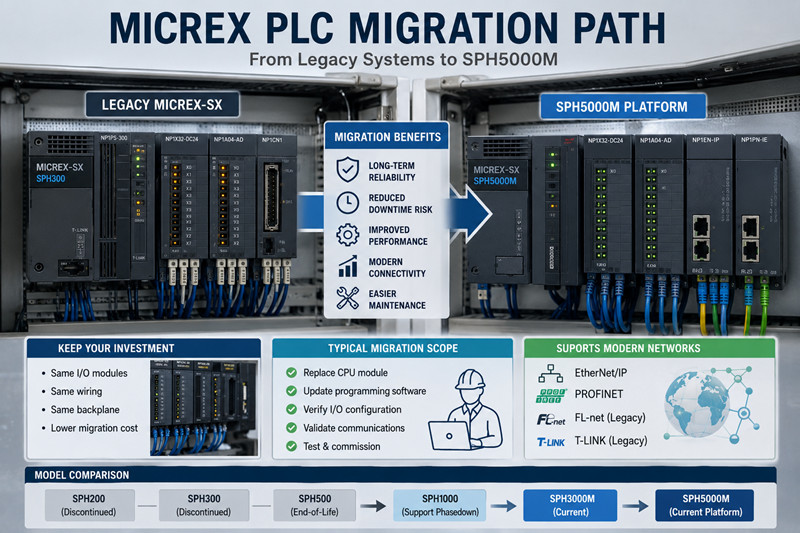
Fuji Electric has published formal end-of-life notices for several MICREX families. Here is the current status as of mid-2026:
MICREX-SX SPH200 Series (Discontinued — No Factory Support)
The SPH200 was Fuji's entry-level modular PLC in the MICREX-SX lineup. CPU models like the NP1FH-200 and NP1PH-200 were discontinued more than a decade ago. Fuji stopped accepting repair orders for these CPUs in 2019. If you have an SPH200 on your line, you are already running on whatever spare stock exists in the channel.
MICREX-SX SPH300 Series (Discontinued — Support Ended)
The SPH300 (CPU models NP1FH-300, NP1PH-300, NP1PS-300) was the mid-range workhorse of the MICREX-SX family. Formally discontinued in 2020, the five-year post-discontinuation support window has now closed in all regions. In Japan and parts of SE Asia, depot repair for emergency cases may still be available through authorized distributors with old stock of spare CPU boards, but wait times have stretched from weeks to months.
MICREX-NX Series (Obsolete — No Support)
The MICREX-NX family predates the MICREX-SX line and uses a completely different backplane and I/O form factor. Models like the NX-32, NX-64, and NX-128 CPU units have been out of production since the early 2000s. Spare parts are only available through third-party brokers or surplus dealers.
MICREX-SX SPH500 Series (End-of-Life Active)
The SPH500 (CPU models NP1PH-500, NP1PS-500) shares the same backplane form factor as the SPH1000 and SPH3000M, but Fuji is phasing it out in favor of the SPH5000M. Factory support is expected to end completely by 2028. Fuji still manufactures replacement CPU modules for warranty contracts, but new-unit pricing has increased 30-40% since 2023 as production volumes dropped.
MICREX-SX SPH1000 Series (Support Phasedown)
The SPH1000 (CPU models NP1PS-1000, NP1PH-1000) bridges the gap between old MICREX-SX and the current SPH5000 architecture. Fuji still sells these CPUs, but lead times for factory orders have stretched to 12-16 weeks. Fuji recommends the SPH5000M as the direct replacement for new projects.
Key takeaway: If your CPU is an SPH200 or SPH300, you are past the point of factory support. SPH500 and SPH1000 users have a narrowing migration window — roughly 12 to 24 months depending on your region.
---
This is the single most common question from engineers managing Fuji lines. Short answer: it depends on the CPU generation.
Physical Compatibility — I/O Modules
The good news: Fuji Electric maintained the same backplane form factor across the SPH200, SPH300, SPH500, SPH1000, SPH3000M, and SPH5000M families. Your existing I/O modules — digital input modules like NP1X32-DC24, analog modules like NP1A04-AD, and specialty modules like NP1CN1 (T-LINK), NP1CN2 (FL-net), and NP1CN3 (PROFIBUS) — can be taken out of the old rack and plugged directly into a new SPH5000M rack. The I/O bus protocol is electrically compatible across these generations, making a CPU-only swap physically possible.
CPU and Firmware — Not a Direct Swap
The catch is the CPU module and programming environment. An SPH5000M CPU (model NP1PS-5000M or NP1PH-5000M) will not run SX-Programmer project files compiled for an SPH200 or SPH300 without significant rework. The instruction set expanded between generations. Memory maps for T-LINK and FL-net communication areas changed. Interrupt handling and task scheduling that worked on the SPH300 may behave differently on the SPH5000M.
What this means in practice: you can keep your field wiring, I/O rack, power supplies, and base modules. You will need to rewrite the application logic in Standard SX-Programmer or the newer NP (Nano Programming) environment and revalidate it.
Practical Drop-In Path
The most straightforward migration path is SPH1000 → SPH5000M. If you have an SPH1000 running Standard SX-Programmer projects compiled under V6.x or later, the conversion involves recompiling the project, checking communication configuration, and swapping the CPU module. For SPH200/300 users on older SX-Programmer V3.x/V4.x projects, expect a full program rewrite.
---
Software compatibility is often the make-or-break factor in any MICREX migration. Using the wrong software version can corrupt project files or fail to communicate with the CPU entirely.
SX-Programmer (Legacy — SPH200/300/500)
The original SX-Programmer, typically V3.x through V5.x, is the only software that can compile and download logic to SPH200 and SPH300 CPUs. It runs on Windows XP through Windows 7 (32-bit). It does not install correctly on Windows 10 or 11 without a virtual machine. Communication uses the SX bus protocol over RS-232C or USB-to-serial adapters with the NP1W-CN1 cable. If you need to maintain an SPH200 or SPH300 line, keep a dedicated Windows 7 PC with SX-Programmer V5.2 or later.
Standard SX-Programmer (Transition — SPH1000/SPH3000M)
Standard SX-Programmer V6.x and V7.x supports the SPH1000, SPH3000M, and early SPH5000M firmware revisions. It runs on Windows 7 and Windows 10 (64-bit) and uses a different project file format (.sxp vs. the older .sxc). Projects created in V3.x/V4.x must be manually re-created — there is no automatic conversion utility. This version also introduced device configuration files for EtherNet/IP and PROFINET modules. If your legacy system used T-LINK or FL-net, expect to reconfigure communication parameters from scratch.
NP (Nano Programming) Software (Current — SPH5000M)
Fuji Electric's current programming environment, NP software, supports the SPH5000M and SPH3000M with the latest firmware. It runs on Windows 10 and Windows 11 (64-bit) and provides structured text (ST), ladder diagram (LD), and function block diagram (FBD) editors. NP software does not support SPH200, SPH300, or SPH500 CPUs at all — connecting to these older CPUs will fail at the communication handshake. NP projects are not backward-compatible with Standard SX-Programmer.
Legacy CPU | Required Software | Migration Path
SPH200/300 | SX-Programmer V3-V5 | Full rewrite in Standard SX-Programmer or NP
SPH500 | SX-Programmer V5+ | Standard SX-Programmer V6/V7 → export to NP
SPH1000 | Standard SX-Programmer V6/V7 | Recompile in NP + revalidate
SPH5000M | NP software (current) | Current platform — no migration needed
---
Cost is where the numbers get real — and rarely as clean as the vendor brochures suggest.
Sourcing Used Parts — The Short-Term Path
A used SPH300 CPU (NP1PH-300) on the surplus market ranges from $150 to $400 depending on condition and revision. A used SPH500 CPU runs $350 to $700. I/O modules are cheaper: $30 to $80 for digital inputs, $80 to $200 for analog modules.
The math looks attractive for a single CPU swap. The risk is buying a component with unknown runtime hours, stored in uncontrolled conditions, with no warranty beyond "tested on power-up." We have seen buyers receive CPUs with corroded battery contacts, expired firmware revisions, or modules that passed a bench test but failed after three weeks of production vibration. If your line runs 24/7 and downtime costs $5,000+ per hour, one unexpected failure of a used CPU wipes out any apparent savings.
Migration — The Long-Term Path
A full migration from an SPH300 to an SPH5000M typically costs $8,000 to $18,000 per cabinet in hardware (CPU, memory card, power supply, communication modules). Labor for programming, panel rework, and commissioning adds $5,000 to $12,000 per cabinet depending on program complexity.
For a 256-I/O-point food processing skid running an SPH500, budget $15,000 to $20,000 for a full migration. For a 512-point water treatment line with multiple SPH300 CPUs on T-LINK, expect $25,000 to $40,000.
The Breakeven Calculation
The breakeven point comes when you have replaced a critical CPU more than once. Buy a used SPH300 for $350, it runs 14 months, fails, and you buy another for $400 plus $150 emergency shipping — you are at $900 with no guarantee the third unit lasts longer. At that point, the migration cost looks like an investment in reliability.
For plants running MICREX-NX systems, used parts are the only option since Fuji no longer manufactures compatible components. Migration requires replacing the entire backplane and I/O infrastructure, pushing costs to $30,000+ per cabinet.
Regional Factors
In Japan and SE Asia, used Fuji MICREX parts are 15-25% cheaper than in North America or Europe, reflecting the larger installed base. In the Middle East — particularly UAE, Saudi Arabia, and Qatar food processing plants — Fuji spare parts command a 30-40% premium because most must be imported from Japan or Singapore with 4-6 week lead times.
---
When factory support runs out, the secondary market becomes essential. Here is where engineers actually source Fuji MICREX spare parts in 2026.
Specialized Automation Parts Suppliers
For a broad inventory of Fuji MICREX CPUs, I/O modules, power supplies, and communication modules, your best source is a dedicated industrial automation parts supplier like TZ Techio, which stocks new-old-stock and tested used components across the SPH200, SPH300, SPH500, SPH1000, and SPH3000M families. These suppliers typically test each module before listing and offer a 30-day warranty.
Japanese Surplus Brokers
Companies like Nippon Avionics and Marubun, along with regional surplus houses in Osaka and Nagoya, are primary clearinghouses for decommissioned Fuji equipment. Pricing is competitive if you buy direct, but requires Japanese-language capability and a freight forwarder. Expect minimum order quantities of 3-5 units for CPUs.
Auction Platforms
Yahoo! Japan Auctions and Mercari Japan are the deepest markets for used Fuji MICREX parts, but they require a proxy buying service (Buyee, FromJapan). We estimate 60-70% of all used Fuji PLC parts change hands through Japanese domestic channels before appearing in international listings. By the time a module hits eBay or Alibaba, it has typically been marked up 50-100%.
What to Stockpile
If you plan to keep a legacy MICREX system running another 3-5 years, prioritize:
1. CPU module — the most failure-prone and hardest to source over time
2. Battery backup module (CR123A-based) — ages on the shelf and fails silently
3. Communication modules (T-LINK NP1CN1, FL-net NP1CN2) — no substitutes available
4. Power supply module — electrolytic capacitors age regardless of runtime
---
Use this table to evaluate your specific situation. No single answer fits every plant.
Factor | Migrate to SPH5000M | Source Used Parts
Current CPU | SPH500 or newer | SPH200/300 or MICREX-NX
I/O count | 128+ points | Under 128 points
Line criticality | 24/7 uptime required | Non-critical or backup line
Support window | Need warranty, factory support | Can tolerate unplanned downtime
Budget horizon | 5+ year ROI on reliability | 12-18 month horizon
Geography | North America, Europe, Middle East | Japan, SE Asia (good parts availability)
Software status | Have Standard SX-Programmer V6+ | Running legacy SX-Programmer V3-V5
Spare CPU cost | N/A (new) | Under $300 each
Risk tolerance | Low — cannot absorb random failure | High — can swap and recover
For plants running SPH200 or SPH300 CPUs with fewer than 128 I/O points on non-critical lines, sourcing used parts is defensible for the next 18-24 months. Stockpile two spare CPUs, a handful of I/O modules, and backup batteries. Monitor the surplus market quarterly — SPH300 CPU prices have been climbing 8-12% per year as supply contracts.
For every other scenario — particularly SPH500 or SPH1000 users in North America, the Middle East, or Europe — the migration math favors the SPH5000M. The window for an orderly, planned migration is narrowing. If you need to locate specific Fuji MICREX spare parts or compare pricing on new-old-stock modules, browse the PLC category at TZ Techio or explore the broader industrial automation inventory. A reliable supply chain for legacy hardware — or a clear migration path to current platforms — is the difference between a scheduled upgrade and an emergency shutdown.
-----------------------------------------------------------------------------------------------------------------
🏢 About TZ Tech
TZ Tech is a leading supplier of industrial automation, electrical, instrumentation, and telecommunications components. We specialize in sourcing ready-to-ship distributor stock, allowing us to offer highly competitive pricing and short lead times. Thanks to our extensive inventory, we can even source rare and discontinued parts that are hard to find elsewhere.
🛡️ Our Quality Commitment
We understand that quality is your top priority. Every component undergoes a strict screening and inspection process so you can buy with absolute confidence. For legacy or discontinued parts, we believe in complete transparency and will always provide an honest, accurate report on the product's condition. Plus, all brand-new parts come backed by a full 1-year warranty.
✉️ Get in Touch
Have a project or a part you need? Send us your inquiry today! Our team is dedicated to providing a fast response within 6 hours (excluding weekends).


Please read on, stay posted, subscribe, and we welcome you to tell us what you think.


Sitemap | Blog | XML | Privacy Policy
In addition, with your permission, we want to place cookies to make your visit anointeraction with slOC more personal. For this we use analytical and advertisingcookies. With these cookies we and third parties can track and collect yourinternet behawior inside and outside super-instrument.com. With this we and third parties adapt super-instrument.com and advertisementsto your interest. By clicking Accept you agree to this. If you decline, we only usethe necessary cookies and you unfortunately will not receive any personalizedcontent. Please visit our Cookie policy for more information or to change yourconsent in the future.
Accept and continue Decline cookies