Industrial Sensor Types & Selection: Proximity, Photoelectric, Pressure & More
Sensors are the eyes and ears of industrial automation. Without sensors, a PLC cannot know whether a product is in position, if a tank is full, or if a motor is overheating. Choosing the right sensor for each application is critical: the wrong sensor leads to production downtime, false triggers, or safety hazards.
This guide covers the most common industrial sensor types — proximity sensors, photoelectric sensors, pressure sensors, and temperature sensors — their working principles, key specifications, and a brand comparison of Bently Nevada, Honeywell, Pepperl+Fuchs, and Keyence.
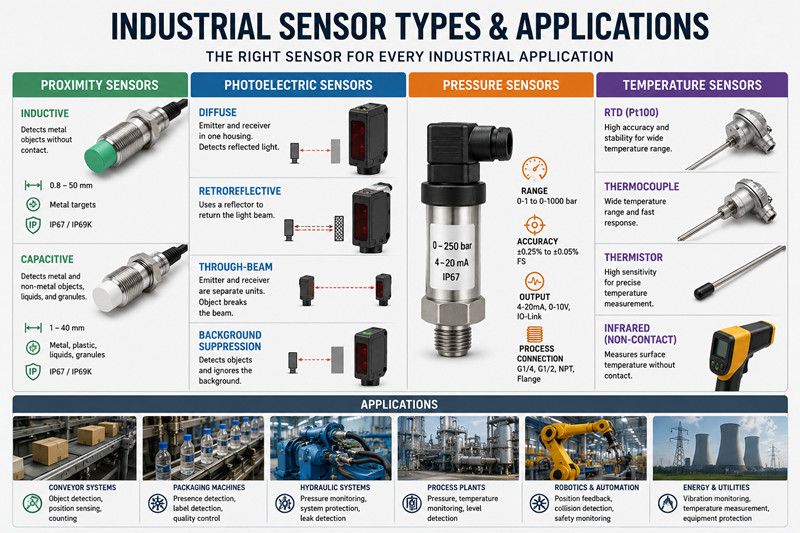
Proximity sensors detect the presence or absence of an object without physical contact. They are the workhorse of factory automation, used for position detection, counting, and process control.
Inductive sensors detect metal objects by generating an electromagnetic field. When a metal target enters the field, eddy currents reduce the oscillation amplitude, triggering a switch output.
Key specifications:
· Sensing distance: 0.8mm - 50mm (varies by target size and sensor model)
· Target: Ferrous and non-ferrous metals (steel, aluminum, brass)
· Output: PNP (sourcing) or NPN (sinking), NO or NC
· Protection: IP67 standard, IP69K for pressure wash
Capacitive sensors detect both metallic and non-metallic targets (plastics, liquids, granules) by measuring changes in capacitance between the sensor electrode and the target.
Key specifications:
· Sensing distance: 1mm - 40mm
· Target: Metals, plastics, wood, paper, glass, liquids
· Can detect levels inside non-metallic containers
· More sensitive to environmental factors (humidity, dust)
· Reed switches: Contact-based, activated by permanent magnet. Simple and inexpensive.
· Hall effect sensors: Solid-state, detect magnetic field changes. No contact wear, longer life.
Photoelectric sensors use a light beam (typically infrared or red LED) to detect objects. They offer longer sensing distances than inductive/capacitive sensors and can detect transparent objects, labels, and color differences.
Emitter and receiver in one housing. Light is reflected off the target back to the receiver. Range: 50mm - 3m. Best for: detecting presence of any object in close range.
Emitter and receiver in one housing. Reflector placed opposite. Object blocks the reflected beam. Range: up to 15m. Best for: long-range detection, detecting clear/transparent objects.
Emitter and receiver are separate units. Object breaks the beam. Range: up to 60m. Best for: maximum accuracy, counting, detecting small objects.
Advanced diffuse sensors with built-in distance measurement. Ignores background objects. Best for: detecting objects against a conveyor or machine frame.
Key specifications:
· Light source: Red LED (visible), Infrared LED, Laser (precision)
· Response time: 0.1ms - 50ms (laser: <0.1ms)
· Output: PNP/NPN, Digital or Analog
· Protection: IP67 / IP69K for food industry
Pressure sensors measure the force per unit area exerted by a fluid (liquid or gas). They are essential for hydraulic systems, pneumatic controls, process monitoring, and safety systems.
· Gauge pressure: Relative to atmospheric pressure (0 bar = atmospheric). Most common.
· Absolute pressure: Relative to perfect vacuum. Used for barometric measurement.
· Differential pressure: Difference between two pressure points. Used for filter monitoring, flow measurement.
· Sealed gauge: Pre-set reference at 1 atm (sea level). Used in aircraft and aerospace.
· Strain gauge / Piezoresistive: Metal diaphragm with bonded strain gauge. Good for high pressure (up to 1000 bar).
· Thin-film: Strain gauge integrated onto diaphragm. Excellent long-term stability. Most common for industrial use.
· Capacitive: Ceramic or metal diaphragm changes capacitance. Excellent for low pressure and vacuum.
· Piezoelectric: Generates charge when stressed. For dynamic pressure measurement (hydraulic hammer, pulsating systems).
Key specifications:
· Pressure range: 0-1 bar to 0-1000 bar (gauge or absolute)
· Output: 4-20mA (current loop, industry standard), 0-10V, IO-Link
· Accuracy: ±0.25% to ±0.05% of full scale
· Process connection: G1/4, G1/2, NPT, flange
Uses platinum resistance (typically Pt100). Accuracy: ±0.1°C to ±0.5°C. Range: -200°C to +600°C. Best for: precision measurement, wide temperature range.
Two dissimilar metals joined at a junction. Generates voltage proportional to temperature. Range: -270°C to +2300°C. Best for: extremely high temperatures, fast response.
Semiconductor material with temperature-dependent resistance. Range: -100°C to +300°C. Best for: low-cost, high sensitivity applications.
Measures emitted infrared radiation. Range: -40°C to +3000°C. Best for: moving objects, hazardous areas, inaccessible measurement points.
|
Feature |
Bently Nevada |
Honeywell |
Pepperl+Fuchs |
Keyence |
|
Specialty |
Vibration & machinery monitoring |
Pressure, temperature, flow |
Inductive, photoelectric, vision |
Photoelectric, vision, laser |
|
Key Product |
3300 XL 8mm Proximitor |
PX2 Series pressure sensors |
NJ series vision sensors |
IV3 series vision sensors |
|
Strength |
Oil & gas turbine monitoring |
Aerospace & industrial process |
Intrinsically safe sensors |
High-speed inspection |
|
Price Level |
$$$ (premium) |
$$-$$$ |
$$ |
$$-$$$ |
|
Best For |
Turbines, compressors, pumps |
Process automation |
Factory automation |
Quality inspection |
|
Global Support |
Excellent (Baker Hughes) |
Excellent |
Good |
Good |
· Bently Nevada (Baker Hughes): The gold standard for vibration and machinery protection in oil & gas, power generation, and heavy industry. The 3300 XL series is the most deployed proximity sensor in rotating equipment worldwide.
· Honeywell: Broad portfolio covering pressure, temperature, flow, and force. PX2 series pressure sensors are industry standard for hydraulic systems. Excellent for process automation and building management.
· Pepperl+Fuchs: Germany's sensor specialist. World leader in intrinsically safe and explosion-proof sensors for chemical, pharmaceutical, and oil & gas. Exceptional build quality for factory automation.
· Keyence: Japan's inspection technology leader. Best-in-class vision sensors and laser profile meters. IV3 series delivers high-speed, accurate inspection for packaging and electronics assembly.
Inductive sensors only detect metals (use capacitive or photoelectric for non-metals). Measure the actual gap — use sensors with 1.5-2× the required sensing distance for margin.
PNP (sourcing) is standard in Europe and Asia. NPN (sinking) is common in Japan and Allen Bradley systems. Check your PLC input card compatibility. Consider analog output (4-20mA, 0-10V) for process monitoring.
IP67/IP69K rating for washdown. Explosion-proof (ATEX/IECEx) for hazardous areas. Temperature extremes require sensors rated beyond operating range. Chemical exposure requires compatible wetted materials.
High-speed counting or rapid part detection (<1ms): Use laser photoelectric or Hall effect sensors. Standard detection (10-50ms): LED photoelectric or inductive sensors.
Traditional: Discrete I/O (PNP/NPN). Modern: IO-Link (easy configuration, diagnostic data), PROFINET, EtherNet/IP. Choose sensors compatible with your PLC ecosystem.
Selecting the right sensor requires matching the detection principle to the target material, environment, and performance requirements. For rotating equipment protection, Bently Nevada is the undisputed leader. For process automation and pressure measurement, Honeywell offers the broadest portfolio. Pepperl+Fuchs excels in hazardous-area sensors. Keyence dominates in high-speed inspection and vision-based quality control.
Q: What is the difference between PNP and NPN sensors?
A: PNP sensors source current (current flows from sensor to load). NPN sensors sink current (current flows from load to sensor). Choose based on your PLC input card type: PNP input cards require PNP sensors, NPN input cards require NPN sensors.
Q: Can inductive sensors detect non-metallic objects?
A: No. Inductive sensors only detect conductive or ferromagnetic metals. For non-metals (plastics, wood, liquids), use capacitive sensors, photoelectric sensors, or ultrasonic sensors.
Q: What does IP67 mean?
A: IP (Ingress Protection) rating: First digit = solid particle protection (6 = dust-tight). Second digit = liquid protection (7 = immersion up to 1m for 30 minutes). IP69K adds high-pressure, high-temperature washdown protection.
Q: What is IO-Link?
A: IO-Link is a standardized point-to-point communication protocol (IEC 61131-9) for smart sensors. It enables remote configuration, diagnostic data readout, and easy sensor replacement without re-wiring. Increasingly standard in modern automation.
Q: How do I choose between a proximity sensor and a photoelectric sensor?
A: Use proximity sensors when: target is metal, short sensing distance (<50mm), dirty environment, high switching frequency. Use photoelectric sensors when: non-metallic target, longer distance required, transparent object detection, color discrimination needed.
· Bently Nevada 3300 XL 8mm Proximitor Sensor
· Industry-standard vibration sensor for rotating equipment protection. 8mm sensing distance, IP67, -40°C to +180°C operating range.
· Honeywell PX2 Series Pressure Transducer
· Heavy-duty pressure sensor for hydraulic systems. 0-250 bar range, 4-20mA output, IP67, G1/2 process connection.
· Pepperl+Fuchs NBB10-30GM50-E2 Inductive Sensor
· Standard inductive proximity sensor. 10mm sensing distance, PNP NO output, IP67, M30 threaded body.
· Keyence IV3 Series Vision Sensor
· High-speed vision inspection sensor for quality control. Detects presence, color, shape, and dimensions at 1000 inspections/sec.
· Pepperl+Fuchs Capacitive level sensor for detecting liquids and granules in tanks and hoppers. Adjustable sensitivity, IP68 rated.
-------------------------------------------------------------------------------------------------------------------------
TZ Tech is a professional supplier for industrial automation and electrical parts, as well as some instrumentation, telecommunication parts. We mostly sell the ready stock of distributor, with competitive price and short lead time. Even discontinued parts we may also can supply as we have a large inventory here.
We understand what you concern, so we will ensure the quality. We strictly screen the components you require, so you don’t need worry about any quality issues with the goods you receive. For specialized parts that have long since been discontinued, we will sincerely inform you the actual condition of the goods. All brand new parts we will support 1 year warranty.
If you need any related parts, please feel free to send an inquiry. Our staff will support quick response within 6 hours. (except weekend here)

Please read on, stay posted, subscribe, and we welcome you to tell us what you think.


Sitemap | Blog | XML | Privacy Policy
In addition, with your permission, we want to place cookies to make your visit anointeraction with slOC more personal. For this we use analytical and advertisingcookies. With these cookies we and third parties can track and collect yourinternet behawior inside and outside super-instrument.com. With this we and third parties adapt super-instrument.com and advertisementsto your interest. By clicking Accept you agree to this. If you decline, we only usethe necessary cookies and you unfortunately will not receive any personalizedcontent. Please visit our Cookie policy for more information or to change yourconsent in the future.
Accept and continue Decline cookies