Mitsubishi Ends Production of 14 MELSEC-Q Series CPU Modules: Final Orders Due by September 30, 2026
August 21, 2026
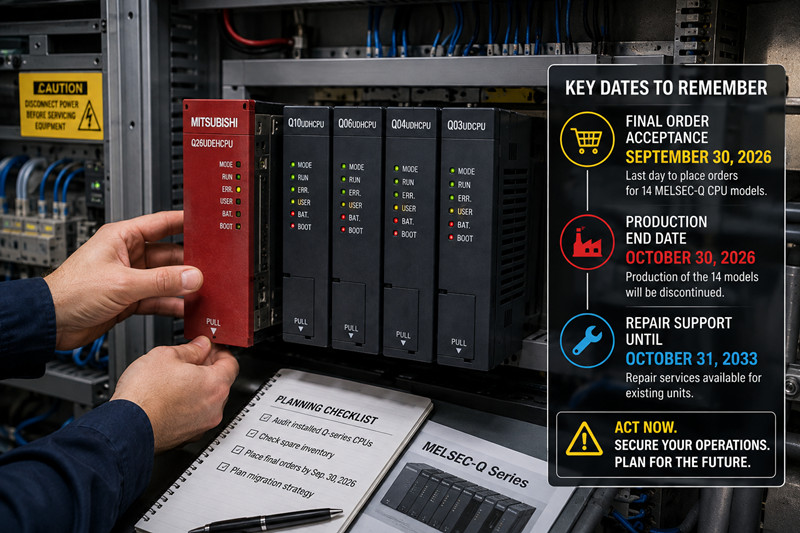
Mitsubishi Electric has announced the end of production for 14 Universal model MELSEC-Q series CPU modules, and the final order window is already open and closing. Technical bulletin FA-A-0418-A, published on the company's website, sets September 30, 2026 as the last day Mitsubishi will accept orders for these CPUs. Production stops on October 30, 2026. From today, August 17, 2026, that leaves roughly six weeks for plant managers to audit the installed base, count the spares shelf, and place any final orders for new units. For any site still running Q03UD, Q06UD, Q13UD or Q26-class CPUs, this is a procurement deadline with a hard date, not a distant announcement that can wait until after the summer.
The stated reason for the discontinuation is short and familiar to anyone who has managed aging automation. Some component parts used in these products are obsolete, and Mitsubishi can no longer maintain production of them. No performance defect is cited, no safety issue, no compatibility problem. The CPUs are being retired because the supply chain underneath them is being retired. That distinction matters for planning. This is not a recall and it is not an emergency, but it is a firm cutoff. After October 30, 2026, brand-new units of these 14 models will simply not be manufactured again.
Repair support is a separate timeline, and the two should not be confused. Mitsubishi will continue to repair these CPUs until October 31, 2033, which is seven years after the production stop. A CPU that is already in service today can still be sent back for repair well into the next decade. But repair support only covers units that exist. It does not create new CPUs, and it does not help a plant that needs to add capacity, replace a damaged unit it never stocked, or build a new line around a Q series CPU. The difference between "I can repair what I own" and "I can buy what I need" is the whole planning problem in one sentence.
Who does this touch? In practice, the Q series is one of the most widely deployed PLC families in industrial automation, and the fourteen models in this bulletin sit in the middle of that installed base. Packaging lines, material handling systems, water treatment plants and machine tool cells across Asia, the Middle East and Europe run on these CPUs every day. A plant manager reading this announcement probably has at least one of the fourteen models in service, and probably has a spare or two on a shelf somewhere. The question is whether the list is complete, and whether the decision about the future of those lines gets made now, while new units are still orderable, or later, when they are not.
The six-week window is the operational heart of this news. September 30 is the acceptance cutoff, not the delivery date. A purchase order placed in the final days of September still has to be processed, scheduled and shipped, and plants that wait until the last week are betting on logistics they do not control. The working rule for this kind of deadline is simple: treat the order cutoff as if it were the delivery deadline, and plan backward from it. Six weeks is long enough to act and too short to postpone.
The bulletin covers seven CPU classes, each available in two versions, for a total of 14 affected models. The affected range runs from the Q03 class at the entry of the group up to the Q26 class at the top.
Affected models (final order date September 30, 2026)
Q03UDCPU / Q03UDECPU
Q04UDHCPU / Q04UDEHCPU
Q06UDHCPU / Q06UDEHCPU
Q10UDHCPU / Q10UDEHCPU
Q13UDHCPU / Q13UDEHCPU
Q20UDHCPU / Q20UDEHCPU
Q26UDHCPU / Q26UDEHCPU
For a maintenance manager, the useful way to read this table is to find your own CPU class in it. The Q03 and Q04 classes are the entry tier of the group and typically carry the smaller machines and standalone stations. The Q06 and Q10 classes are the mid-range workhorses, the CPUs that show up on lines with substantial I/O and some motion. The Q13, Q20 and Q26 classes sit at the top of the affected range and run the biggest programs with the fastest scan requirements. Every one of those classes is in this bulletin, which means the phase-out is not a corner of the catalog. It is the backbone of the Universal family that many plants standardized on.
The bulletin itself includes the performance context, and it is worth reading those numbers carefully. The Q26UDEHCPU, the top of the affected range, runs 260K program steps with a 9.5ns basic instruction speed and 1040KB of program memory. The recommended iQ-R replacement, the R32CPU, offers 320K program steps, a 0.98ns basic instruction speed and 1280KB of program memory, and it uses an SD memory card instead of the older SRAM, Flash or ATA card. The Q13UDEHCPU, with 130K program steps, moves to 160K steps on the iQ-R side, with the same jump in instruction speed from 9.5ns down to 0.98ns.
The interface changes matter for the migration planning. In the move to iQ-R, the communication interface shifts from USB (miniB), RS-232 or Ethernet to USB (miniB) and Ethernet, and the memory card shifts from SRAM, Flash or ATA to SD memory card or extended SRAM cassette. These are the details that show up in commissioning, in the wiring plan and in the stores room, and they are the reason the migration guide exists.
Operationally, the numbers describe headroom, and headroom is a planning input. A faster CPU with more program memory gives a line room to grow: more logic, tighter scan times, more data collection, more future capacity without another hardware change. A plant that is near the limit of its current CPU today has a different decision to make than a plant that is using a fraction of its capacity. The bulletin's comparison figures make that difference visible before any purchase order is written.
· August 17, 2026: today. Six weeks of the order window remain.
· September 30, 2026: last day Mitsubishi accepts orders for the 14 CPUs.
· October 30, 2026: production of the 14 CPUs ends.
· October 31, 2033: repair support ends, seven years after the production stop.
There is a second phase-out running in parallel, and plants should plan them together. In a separate bulletin, FA-A-0466-A, Mitsubishi has also announced the discontinuation of the MELSEC-L series. The L series moves to make-to-order on September 30, 2026. Order acceptance for L series CPUs continues until September 30, 2027, production ends October 29, 2027, and repair support runs to October 31, 2034. The affected CPUs include the L02CPU, L06CPU and L26CPU families, and Mitsubishi points to the MELSEC MX Controller MX-F, the MELSEC iQ-F (FX5) or the iQ-R as replacement paths. A plant that runs both Q series and L series controllers now has two procurement windows to manage inside the same planning period, and the two announcements share a destination: the iQ-R platform appears as a replacement path in both.
Once production ends, the market for these CPUs changes shape. Three things happen, and they happen in a predictable order.
First, the remaining new stock gets consumed. Distributors and system integrators hold whatever they already bought, and that inventory becomes the last source of brand-new units. After that stock is gone, it is gone. There is no second production run announced and no indication that one is planned. The last new units will carry a premium, because the number of buyers still looking will not shrink as fast as the inventory.
Second, demand shifts to the surplus and used market, and this is where the operational risk concentrates. After an official phase-out date, prices for used and surplus CPUs typically rise, and so does the risk of counterfeits and relabeled units. The shortage creates room for traders who do not test, do not document provenance, and do not stand behind the hardware. In past phase-outs across the automation industry, plants that waited have paid premium prices for untested units from unknown sources, and some have paid twice for the same CPU because the first purchase failed during commissioning. The bulletin's own dates make the arithmetic visible: seven years of repair support means the installed base is expected to keep running for years, which means demand for these CPUs will outlive supply.
Third, sourcing shifts from the manufacturer to stock and surplus channels. For a plant, that changes the procurement question from "what is the price" to "what is the provenance". A tested, documented, warrantied unit from a specialist supplier is a different product from a mystery board pulled off a decommissioned line. The same part number can be a low-risk spare or a lottery ticket depending on where it comes from, and the price difference between the two tells you very little about which one you are holding.
Emergency buying is the most expensive way to discover all of this. The plant that realizes in March 2027 that it needs a Q13UDHCPU for a line that has stopped will pay whatever the market asks, on whatever timeline the seller offers, with no alternative and no negotiation position. The plant that bought its spares in August 2026 pays the normal price, holds tested inventory, and keeps the leverage on its side. That asymmetry is the entire business case for acting before September 30.
Repair support deserves its own paragraph, because it is easy to overestimate. Repair support until October 31, 2033 means Mitsubishi will service units that are already in service, within the normal terms of such programs. It does not mean new units, it does not mean loaner units as a right, and it does not mean the repair loop is instant. A CPU that fails in 2029 goes into a repair channel, comes back after the repair cycle, and the line waits in between. For a plant running three shifts, that waiting time is exactly what the spare on the shelf is for. The repair tail is a safety net for the hardware you own, not a supply line for the hardware you need.
The first option is also the cheapest one to execute, because it uses the normal supply chain while it still exists. The work is an audit plus an order. Walk every line and list which of the 14 CPUs are in service. Then check the stores and list which are already stocked as spares. The gap between those two lists is your shopping list, and it is usually bigger than people expect, because spares get borrowed between lines, retired units get cannibalized, and the shelf inventory in the computer rarely matches the shelf inventory in the room.
For the quantity, a common working rule on critical lines is one spare CPU per critical line, plus a small common pool for the rest of the plant. Lines that run three shifts get the spare. Lines with no redundant CPU get the spare. Lines whose failure stops downstream processes get the spare. Lines with a second line of identical hardware can share from the pool. The count is a judgment call, but the principle is not: the spare exists to convert an unplanned stop into a planned swap, and the swap is only as fast as the spare is close. A CPU in a cabinet two minutes from the line is inventory. A CPU in a warehouse two countries away is a hope.
The budget conversation is easier than it looks. A CPU is a modest line item compared with the cost of an unplanned stop, which typically includes lost production, overtime for the maintenance crew, expedited freight, and the downstream cost of a line that restarts late against customer commitments. Framed that way, the question is not whether the spare is affordable. The question is whether the line can afford to wait for the used market to deliver. Spares bought now come out of this year's maintenance budget, which is the budget that exists. The same CPUs bought next year come out of an emergency line that may not exist, or may come with approval chains that take longer than the line can stay down.
The tradeoff is honest. Buying spares keeps you on the Q platform, which is exactly the platform being phased out. You are buying time, not a future. But time is a legitimate purchase when the alternative is a rushed migration. For a plant with a mid-life line, a stable program, and no near-term reason to change the architecture, buying several years of repair-supported operation is a rational use of the budget line. The spares are the bridge; the question of what comes after the bridge can be answered next year, on a schedule you control.
The second option is the like-for-like step. Mitsubishi's recommended replacement within the Q family is the High-speed Universal model QCPU, the QnUDVCPU series, with examples including the Q03UDVCPU, Q04UDVCPU, Q06UDVCPU, Q13UDVCPU and Q26UDVCPU. The name is the message: same family, same form factor, same platform.
Operationally, this is the lowest-risk migration on the table. The QnUDVCPU sits in the same rack, uses the same base unit, the same power supply and the same I/O modules. The project is recompiled in GX Works2 rather than rewritten. There is no rewiring of the panel, no new drawings, no change to the field wiring, and typically no change to the spare parts strategy for I/O. The commissioning window is measured in days rather than weeks, and it can often be done inside a planned shutdown without touching the process side. For a plant manager, this is the option that fits into a weekend and a change request, not a project plan.
The tradeoff is that you stay on a platform whose days are numbered by the same logic that ended the current generation. The QnUDVCPU series is the replacement today; at some point it will be the phase-out notice, and the component obsolescence that ended the Q03UD through Q26UDH generation will eventually catch the generation after it. What you gain is a clean, low-risk path that buys several more years of operation with repair support, and what you defer is the eventual move to a newer architecture. For a plant that is not ready to redesign, this is the pragmatic middle path, and it pairs naturally with Option 1: stock the current CPUs for the near term, then step the critical lines up to QnUDVCPU on the normal replacement cycle instead of waiting for a failure to force the decision.
The third option is the full architectural move. Mitsubishi's other recommended path is the MELSEC iQ-R series CPU, the RnCPU family, with examples including the R04CPU, R08CPU, R16CPU and R32CPU. This is a genuine migration rather than a swap. The iQ-R platform means a new base unit, a new power supply, a new rack, and a different memory system built around SD memory cards and the extended SRAM cassette instead of the older SRAM, Flash or ATA cards. The performance numbers from the bulletin show why plants make this move: the R32CPU takes the Q26UDEHCPU's 260K program steps to 320K, its 1040KB of program memory to 1280KB, and its 9.5ns basic instruction speed down to 0.98ns. That is not incremental improvement; that is a different class of headroom, and it is the headroom the next decade of program growth will need.
The engineering effort is real and should be budgeted as such. Mitsubishi publishes the MELSEC-Q Series to MELSEC iQ-R Series Migration Guide, reference L08510ENG, which is the working document for porting programs. Porting is not retyping; it is a review of every program block against a new platform, with new communication interfaces, from USB (miniB), RS-232 or Ethernet to USB (miniB) and Ethernet. The commissioning window is the biggest hidden cost. A migration touches the rack, the wiring plan, the program, the documentation and the training of the maintenance crew, and it should be scheduled against the shutdown calendar, not squeezed into one. Budget the engineering time, not just the hardware, because the hardware line item is the smaller number on that spreadsheet.
The payoff is the longest runway. The iQ-R platform is the current generation, it is the destination Mitsubishi points to in both the Q and L phase-outs, and it carries the performance headroom the comparison numbers illustrate. For plants under pressure to strengthen OT security, there is a secondary argument worth one sentence: legacy Q series CPUs predate modern OT security expectations, and a phase-out milestone like this one gives a defensible reason to move to a current platform. The security case is a bonus on top of the supply case, not a replacement for it.
The tradeoff is cost and risk concentrated in one window. Hardware, engineering hours, commissioning time and the possibility of process issues after cutover all land in the same period. The mitigation is sequencing: migrate one line first, run it in production, and use it as the template for the rest of the plant. Plants that treat iQ-R as a project rather than a purchase get the benefits. Plants that treat it as a purchase get a surprise, usually in the form of a commissioning overrun on a line that was never going to be available long enough.
The MELSEC-Q series is one of the most widely deployed PLC families in industrial automation, and a large share of that installed base runs exactly the CPU classes in this bulletin. The Q03UD, Q06UD, Q13UD and Q26-class CPUs are not rare hardware; they are the workhorses of a generation of production lines, and they are still running production today in packaging, material handling, water treatment and machine tool applications across Asia, the Middle East and Europe. Some of those lines were designed around the Q series a decade or more ago, and the control architecture has not changed since, because it did not need to. This bulletin changes that arithmetic for every one of them.
The order cutoff does not reduce demand; it reduces supply. Demand stays wherever the installed base stays, and the installed base does not disappear on October 30. It keeps running, it keeps breaking, and it keeps needing CPUs. The result is a market where the manufacturer exits and the stock and surplus channels take over. For buyers, that means the quality of the supplier matters more than the price list. For a site sourcing Mitsubishi PLC spare parts, the practical checklist is provenance, testing, warranty and delivery time, in that order. A unit with documentation and a test record is worth more than a cheaper unit with a story.
For plants that stocked early, the phase-out is a non-event. Their spares are on the shelf, their lines are covered, and they can watch the used market from the sidelines. For plants that did not, the phase-out shows up later as an emergency buy at premium prices, with the counterfeit risk layered on top. The difference between those two outcomes is a purchase order placed before September 30. The same logic applies to the wider PLC spare parts shelf: a plant that reviews its critical spares against this bulletin will find that the review pays for itself on the first line that would have stopped.
The L series ripple should be part of the same plan. The MELSEC-L phase-out in bulletin FA-A-0466-A runs on a slightly longer clock, with order acceptance until September 30, 2027, but the make-to-order transition begins on September 30, 2026, the same day the Q order window closes. Plants that standardize on one platform across machines should look at the two announcements together, because the replacement paths overlap: the MELSEC MX Controller MX-F, the MELSEC iQ-F (FX5) and the iQ-R appear in the L series guidance, and the iQ-R appears in both bulletins. A plant that consolidates on iQ-R solves both phase-outs with one architecture, while a plant that buys Q spares and L spares separately is managing two supply chains that are both winding down.
The September 30, 2026 order cutoff for the 14 MELSEC-Q series CPUs is a date with consequences that compound. Miss it and the options narrow: new units disappear, the used market takes over, prices and counterfeit risk rise, and the only remaining certainty is the repair tail, which runs to October 31, 2033, but only for CPUs that already exist. Nothing about this announcement requires a panic, and everything about it requires a decision. The plants that lose on phase-outs are never the ones that heard the news late. They are the ones that heard it on time and treated it as next quarter's problem.
The action list is short enough to fit on one page. Audit the plant and find every one of the 14 affected models, in service and in stores. Decide which lines get spares and how many, using the one-spare-per-critical-line rule as the starting point and the three-shift and no-redundancy lines as the priority. Place the order before September 30, and treat the cutoff as the delivery date, not the order date. Choose the replacement path for the medium term: QnUDVCPU for the low-risk step, iQ-R for the architectural move, and keep bulletin FA-A-0418-A and the L08510ENG migration guide in the project file either way.
Six weeks is enough. It is enough to audit, enough to decide, enough to order. What it is not enough for is the alternative: discovering the problem in March 2027, on a stopped line, with a budget approval in one hand and a used-market quote in the other. The plants that treat this announcement as a procurement event will not notice the phase-out at all. The plants that treat it as a rumor will notice it exactly once, on the day the line stops.
URL Slug: mitsubishi-q-series-phase-out-deadline-2026
--------------------------------------------------------------------------------------------
🏢 About TZ Tech
TZ Tech is a leading supplier of industrial automation, electrical, instrumentation, and telecommunications components. We specialize in sourcing ready-to-ship distributor stock, allowing us to offer highly competitive pricing and short lead times. Thanks to our extensive inventory, we can even source rare and discontinued parts that are hard to find elsewhere.
🛡️ Our Quality Commitment
We understand that quality is your top priority. Every component undergoes a strict screening and inspection process so you can buy with absolute confidence. For legacy or discontinued parts, we believe in complete transparency and will always provide an honest, accurate report on the product's condition. Plus, all brand-new parts come backed by a full 1-year warranty.
✉️ Get in Touch
Have a project or a part you need? Send us your inquiry today! Our team is dedicated to providing a fast response within 6 hours (excluding weekends).


Please read on, stay posted, subscribe, and we welcome you to tell us what you think.


Sitemap | Blog | XML | Privacy Policy
In addition, with your permission, we want to place cookies to make your visit anointeraction with slOC more personal. For this we use analytical and advertisingcookies. With these cookies we and third parties can track and collect yourinternet behawior inside and outside super-instrument.com. With this we and third parties adapt super-instrument.com and advertisementsto your interest. By clicking Accept you agree to this. If you decline, we only usethe necessary cookies and you unfortunately will not receive any personalizedcontent. Please visit our Cookie policy for more information or to change yourconsent in the future.
Accept and continue Decline cookies