Mitsubishi MELSEC-L Goes Make-to-Order September 30, 2026: Affected Models and the Spare Parts Timeline
August 31, 2026
Published August 24, 2026. All dates, model numbers, and specifications in this article come from Mitsubishi Electric technical bulletin FA-A-0466-B (issue September 2025, Ver. B July 2026).
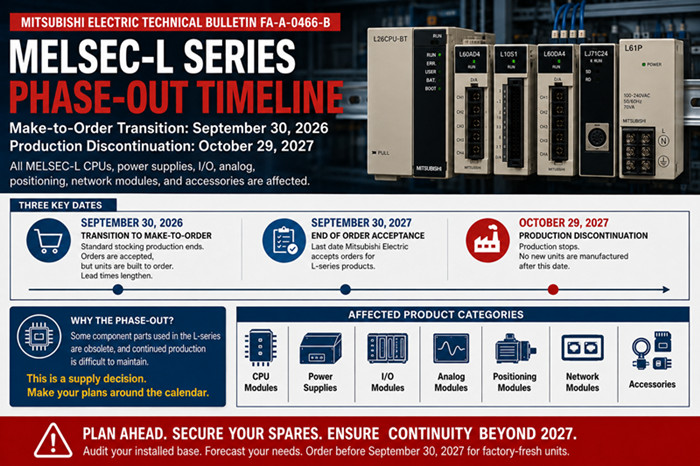
September 30, 2026 is about five weeks from today. On that date, the Mitsubishi MELSEC-L series of compact PLCs moves to make-to-order status, the first formal step in a phase-out that ends with production discontinuation on October 29, 2027.
The deadline comes from Mitsubishi Electric technical bulletin FA-A-0466-B, first issued in September 2025 and revised in July 2026. For maintenance teams, panel builders, OEMs, and distributors, the practical meaning is straightforward: normal off-the-shelf availability of MELSEC-L hardware ends this month. After September 30, 2026, units are built only against confirmed orders, lead times grow, and prices firm up. After October 29, 2027, no new units are produced at all, and the only sources of hardware are existing stock, surplus channels, and the used market.
The same date carries a second weight for the Mitsubishi installed base. September 30, 2026 is both the final order cutoff for the MELSEC-Q series, announced in bulletin FA-A-0418-A, and the make-to-order transition for MELSEC-L. Two major PLC families reach their deadlines on the same day, which means the spares market for both families tightens at the same moment.
MELSEC-L was positioned between the FX and Q families. It was widely used in small-to-mid machine control, packaging, and building systems across Asia, the Middle East, and Europe. That footprint matters here. The phase-out hits more than new designs. Every running machine, installed panel, and maintenance stockroom that still carries L-series cards is in scope. The bulletin applies to the entire product family: CPUs, power supplies, I/O, analog, positioning, network modules, and accessories all move on the same schedule.
Bulletin FA-A-0466-B sets out a three-step timeline. Here it is in plain form:
Date | Event | What it means in practice
September 30, 2026 | Transition to make-to-order | Standard stocking production ends. Orders are accepted, but units are built to order. Lead times lengthen.
September 30, 2027 | End of order acceptance | Last date Mitsubishi Electric accepts orders for L-series products.
October 29, 2027 | Production discontinuation | Production stops. No new units are manufactured after this date.
The window between the first date and the second date is the order acceptance period: a full year in which you can still place orders, but only against a make-to-order schedule. Anyone who needs new L-series hardware for a project that will run past 2027 should treat September 30, 2027 as the real last-chance date for factory-fresh units.
The stated reason in the bulletin is concise: some component parts used in the L-series are obsolete, and continued production is difficult to maintain. That language matters. When a PLC family depends on semiconductor, connector, and passive components that are no longer manufactured, the vendor cannot sustain production no matter how strong the demand is. The calendar in the bulletin reflects a supply decision, not a demand decision.
For buyers, the reason sets expectations. This is not a temporary allocation issue that will resolve itself. The component base is gone, the product line is being wound down on a fixed calendar, and the repair support window that follows is the final service horizon. Plans that assume the L-series will be available indefinitely will not survive contact with the calendar.
The bulletin names the entire L-series catalog. Every model in the family is affected, and the list below follows the bulletin's own grouping. Keep a copy of these tables next to your panel documentation: they are the reference list for the audit described later in this article.
Model | Notes
L02CPU | CPU module
L02CPU-SET | CPU set
L06CPU | CPU module
L06CPU-P | CPU with power supply
L06CPU-P-SET | CPU set with power supply
L06CPU-SET | CPU set
L26CPU | CPU module
L26CPU-BT | CPU with CC-Link master function
L26CPU-BT-SET | CPU set with CC-Link master function
L26CPU-P | CPU with power supply
L26CPU-PBT | CPU with power supply and CC-Link master function
L26CPU-PBT-SET | CPU set with power supply and CC-Link master function
L26CPU-P-SET | CPU set with power supply
L26CPU-SET | CPU set
All fourteen CPU variants move on the same dates. The SET versions ship as configured packages, and the P variants integrate the power supply into the CPU unit. The BT and PBT variants carry CC-Link master functionality, which becomes a deciding factor in the migration analysis later in this article.
Model | Function
L6EXB | Branch module
L6EXE | Extension module
LC06E | Extension cable
LC10E | Extension cable
LC30E | Extension cable
The branch and extension modules are on the no-replacement list in the bulletin, so systems built with multi-rack L-series layouts face a redesign when the time comes.
Model | Function
L61P | Power supply module
L63P | Power supply module
The L61P has no MX-F counterpart. The L63P has a nominal counterpart, but the wiring is incompatible, as detailed in the replacement section below.
Model | Type
LX40C6 | Input module
LX41C4 | Input module
LX42C4 | Input module
LX10 | Input module
LY10R2 | Output module
LY18R2A | Output module
LY40NT5P | Output module
LY41NT1P | Output module
LY42NT1P | Output module
LY40PT5P | Output module
LY41PT1P | Output module
LY42PT1P | Output module
LH42C4NT1P | High-speed I/O module
LH42C4PT1P | High-speed I/O module
The LX10 AC input module is one of the models with no replacement in the bulletin. Machines that read AC signals through an LX10 need a different input strategy during migration.
Model | Type
L60AD4 | Analog input module
L60ADVL8 | Analog input module
L60ADIL8 | Analog input module
L60DA4 | Analog output module
L60DAVL8 | Analog output module
L60DAIL8 | Analog output module
L60AD2DA2 | Analog input/output module
L60TCTT4 | Temperature input module
L60TCRT4 | Temperature input module
L60TCTT4BW | Temperature input module
L60TCRT4BW | Temperature input module
L60RD8 | Analog input module
L60MD4-G | Analog module
This is the group where the bulletin's compatibility warnings are the strictest. Every analog and temperature module in this table requires a full re-engineering effort in any migration, because the suggested FX5 replacements are fully incompatible with the L-series analog line.
Model | Type
LD75P1 | Positioning module
LD75P2 | Positioning module
LD75P4 | Positioning module
LD75D1 | Positioning module
LD75D2 | Positioning module
LD75D4 | Positioning module
The LD75 family connects through a 40-pin connector, and the suggested FX5 path uses screw terminals. Motion axes built on these modules need a new wiring plan before any hardware swap.
Model | Type
LD62 | High-speed counter module
LD62D | High-speed counter module
LD40PD01 | Flexible I/O module
Model | Type
LJ61BT11 | Network module
LJ71C24 | Network module
LJ71C24-R2 | Network module
LJ71E71-100 | Network module
LJ71GF11-T2 | Network module
LJ72GF15-T2 | Network module
LJ72MS15 | Network module
Model | Type
LJ51AW12AL | AnyWireASLINK master module
L6ADP-R2 | Adapter
L6ADP-R4 | Adapter
L6DSPU | Display unit
L6EC | END cover
L6EC-ET | END cover with ERR terminal
L6TE-18S | Spring clamp terminal block
The LJ51AW12AL stands out in this group for a different reason: it is the only model in the entire L-series catalog with a shortened repair support window, which is covered in the next section.
Repair support for the MELSEC-L series runs until October 31, 2034, seven years after the production stop, for every model except one. The exception is the LJ51AW12AL AnyWireASLINK master module. Because it was jointly developed with Anywire Corporation, its repair support ends much earlier: October 31, 2028, one year after production ends.
Model group | Repair support until
All MELSEC-L models except LJ51AW12AL | October 31, 2034
LJ51AW12AL (AnyWireASLINK master, joint development with Anywire Corporation) | October 31, 2028
The bulletin includes a caveat that buyers should not miss: even during the repair support window, repair may be impossible if the required parts are no longer available. Repair support is a commitment to service units, not a guarantee that every repair succeeds. For critical machinery, treat the repair window as a planning horizon, not a safety net. The practical consequence for AnyWireASLINK users is severe: the LJ51AW12AL has a one-year repair horizon after production stops, so spare modules for that specific card deserve priority on any stocking list.
The primary migration direction for MELSEC-L CPUs in the bulletin is the MELSEC MX Controller MX-F family. The MX-F models listed as the L-series counterparts are: MXF100-8-N32, MXF100-8-P32, MXF100-X32, MXF100-Y16R, MXF100-Y32N/P, MXF100-H32N/P, MXF100-16-N32, and MXF100-16-P32.
The MX-F is a newer, faster controller family, and the specification deltas are large in both directions. Some numbers improve dramatically. Others get smaller, and a few functions disappear entirely. That is the difference between a migration and a drop-in replacement. The MX-F is not a socket-compatible swap for the L-series, and the tables below show exactly where the gaps are.
Feature | L02CPU | MXF100-8-N32
Max I/O points | 1024 | 512
Program capacity | 20K steps | 200K steps
Instruction speed | 40 ns | 1.25 ns
Memory | 80 KB | 30 MB
Ports | USB mini-B + Ethernet | USB Type-C + Ethernet + CC-Link IE TSN
The program capacity jump from 20K to 200K steps and the speed jump from 40 ns to 1.25 ns are the headline numbers. The I/O ceiling drops from 1024 to 512 points, which is a real constraint for larger machines. The port layout changes completely: USB mini-B and Ethernet give way to USB Type-C, Ethernet, and CC-Link IE TSN. Differential input capability is lost on the MX-F, which matters for any application that used differential inputs on the L-series.
Feature | L26CPU | MXF100-8-N32
Max I/O points | 4096 | 512
Program capacity | 260K steps | 200K steps
Instruction speed | 9.5 ns | 1.25 ns
The L26CPU comparison shows the tradeoffs most clearly. I/O capacity drops from 4096 to 512 points. Program capacity drops from 260K to 200K steps, the rare case where the migration target has less program space than the original. Speed improves from 9.5 ns to 1.25 ns. The L26CPU-BT and L26CPU-PBT models carry CC-Link master and local station functions, and those functions are not available on the MX-F at all. If your application depends on CC-Link master capability from the CPU, the MX-F path closes that door.
The bulletin is explicit that some L-series modules have no replacement in the MX-F line: L6EXB, L6EXE, LC06E, LC10E, LC30E, LX10, and L61P. For systems that use branch modules, extension modules, extension cables, AC inputs, or the L61P power supply, there is no MX-F counterpart. Those functions have to be redesigned or handled by a different family, and the affected machines should be flagged first in any spares plan.
The L63P has a nominal counterpart in the MX-F line: the power options on the MXF100-8-N32, MXF100-8-P32, MXF100-16-N32, and MXF100-16-P32. The bulletin warns that the wiring is incompatible. The L63P uses screw terminals; the MX-F uses spring clamp terminals. Wire size changes from 0.75-2 mm² to 0.3-1.5 mm². The 5V output drops from 5.0 A to 0.72 A. A panel built around the L63P cannot reuse its wiring or its 5V budget, so the power supply swap is a panel modification, not a module exchange.
For analog I/O, the replacement direction in the bulletin points to the FX5 family: FX5-4AD, FX5-8AD, FX5-4DA, and FX5-4LC. The bulletin's position is blunt: these modules are fully incompatible with the L-series analog modules. Wiring differs, programs differ, buffer memory addresses differ, and specifications differ. Replacing an L60AD4 or an L60TCTT4 with an FX5 module is a full engineering change, not a card swap. Every analog channel has to be re-engineered, rewired, and reprogrammed, and the buffer memory addressing differences mean the PLC program itself cannot carry over.
The LD75 positioning modules map to the FX5-16ET and FX5-16ES-H, but again the wiring is incompatible. The LD75 connects through a 40-pin connector; the FX5 modules use screw terminals. Any motion axis that runs on an LD75 module needs a new wiring plan and a new program before the hardware swap can happen.
The second migration direction is the MELSEC iQ-R platform. The bulletin notes that the R00CPU can replace L02CPU-class CPUs, with tradeoffs. The R61P is the power supply option, and the RC06B, RC12B, and RC30B cables replace the L-series extension cables. For serial communication, the RJ71C24-R2 and RJ71C24-R4 adapters are the counterparts to the LJ71C24 and LJ71C24-R2.
Migration to iQ-R runs through GX Works3, and Mitsubishi Electric's reference document is the Q-to-iQ-R migration guide, L08510ENG. The guide was written for the Q-series path, and it carries over to L-series users because the two families share the same migration toolchain and much of the same program structure.
The iQ-R route tends to suit sites that are already standardizing on iQ-R elsewhere in the plant. If the rest of the line runs iQ-R, moving the L-series machines to an R00CPU keeps one engineering environment and one set of spares. The MX-F route suits smaller machines where the higher program capacity and speed of the MX-F are useful, and where the I/O ceiling of 512 points is not a constraint.
Three workstreams cover most of what needs to happen between now and September 30, 2026.
Audit the installed base. Build the list of every L-series module in service, by model number and by site. The tables in this article give the full catalog, so the audit is a matter of walking the panels and matching what is inside them to the list. Pay attention to the modules with no replacement: L6EXB, L6EXE, LC06E, LC10E, LC30E, LX10, and L61P. Any machine that depends on those has no clean upgrade path, and its spares strategy is the priority.
Order what you need before the transition. Until September 30, 2026, L-series hardware is still produced to stock. After that date, everything is make-to-order, lead times grow, and prices firm up. For projects already in the pipeline, place the orders now. For spares, buy the modules that are cheap to hold and hard to replace later. The order acceptance window runs to September 30, 2027, but ordering earlier means shorter lead times and better pricing.
Plan the migration on a calendar. Decide, machine by machine, whether the path is MX-F, iQ-R, or a rebuild with a different family. The spec tables in this article settle the easy cases. Machines that need more than 512 I/O points, or that use CC-Link master functions, or that rely on differential inputs, will not fit the MX-F path without design changes. Analog-heavy machines face a full re-engineering job under either path, because the FX5 modules are fully incompatible and the MX-F has no direct analog counterpart. Put a migration date next to each machine and treat the repair support deadline as the backstop, not the plan.
For a site that buys Mitsubishi PLC spare parts, the MELSEC-L phase-out changes the buying calculus in three ways.
First, timing. The make-to-order transition on September 30, 2026 is the point where lead times grow and prices firm up. Any L-series module that a site expects to need in the next five years is cheaper and faster to obtain before that date than after it.
Second, the end of production. After October 29, 2027, no new L-series units exist. Every module bought from that point forward comes from surplus stock or the used market. PLC spare parts suppliers that hold L-series inventory become the only source of new-condition hardware, and that inventory does not get replenished.
Third, the repair reality. The repair support window runs to October 31, 2034 for almost every model, but the bulletin states plainly that repair may be impossible if parts are unavailable. A long repair window does not create new units, and it does not guarantee that a failed module can be fixed. The only reliable protection for a critical machine is physical spares on the shelf, and that is doubly true for the LJ51AW12AL with its one-year repair horizon.
The practical rule: buy the spares you need before September 30, 2026, hold the modules with no replacement path first, and treat every year of remaining service life as a year that needs hardware on hand. Compare your audit list against the Mitsubishi PLC spare parts catalog and close the gaps this quarter.
When exactly does the MELSEC-L series go make-to-order?
September 30, 2026. From that date, Mitsubishi Electric builds L-series units only against confirmed orders instead of producing to stock.
How long can I still order new L-series units?
Order acceptance runs from September 30, 2026 until September 30, 2027. That one-year window is the last chance to order factory-new hardware.
When does production stop?
October 29, 2027. After that date no new L-series units are manufactured, and supply comes only from stock, surplus, or the used market.
How long does repair support last?
Until October 31, 2034 for all models except the LJ51AW12AL. The bulletin also warns that repair may be impossible if the required parts are no longer available, so the window is not a guarantee.
Why does the LJ51AW12AL have a shorter repair window?
The LJ51AW12AL is an AnyWireASLINK master module developed jointly with Anywire Corporation. Its repair support ends October 31, 2028, one year after production stops.
Can I swap an L26CPU for an MXF100-8-N32?
Not as a drop-in. I/O capacity drops from 4096 to 512 points, program capacity drops from 260K to 200K steps, and the CC-Link master and local station functions of the L26CPU-BT and L26CPU-PBT are not available on the MX-F.
Are the FX5 analog modules a direct replacement for the L60 series analog modules?
No. The FX5-4AD, FX5-8AD, FX5-4DA, and FX5-4LC are fully incompatible with the L-series analog modules. Wiring, programs, buffer memory addresses, and specifications all differ.
Which L-series modules have no replacement?
L6EXB, L6EXE, LC06E, LC10E, LC30E, LX10, and L61P have no MX-F counterpart in the bulletin.
What happens to my spares supply after October 29, 2027?
Only surplus and used stock remains. Repair support continues, but it does not create new units. Sites that need L-series hardware for running machines should hold physical spares before the make-to-order date.
· Pull the L-series model list from your maintenance system and match it against the affected model tables in this article.
· Flag every machine that uses L6EXB, L6EXE, LC06E, LC10E, LC30E, LX10, or L61P. Those have no replacement path and need spares first.
· Check which CPUs are in the field: L02CPU, L06CPU, or L26CPU variants. The MX-F and iQ-R paths differ by CPU class.
· List the analog and positioning modules in service. Every one of them means a full re-engineering job, so count them early.
· Place orders for project hardware and critical spares before September 30, 2026, while units are still built to stock.
· Put a migration date on each machine and a spares budget next to it. The September 30, 2027 order cutoff is the real last-chance date for new hardware.
· Review the Q-series situation at the same time. The Q-series final order cutoff falls on the same day, September 30, 2026, so both families compete for the same spares market at the same moment.
URL Slug: mitsubishi-melsec-l-phase-out-make-to-order-2026
--------------------------------------------------------------------------------------------
🏢 About TZ Tech
TZ Tech is a leading supplier of industrial automation, electrical, instrumentation, and telecommunications components. We specialize in sourcing ready-to-ship distributor stock, allowing us to offer highly competitive pricing and short lead times. Thanks to our extensive inventory, we can even source rare and discontinued parts that are hard to find elsewhere.
🛡️ Our Quality Commitment
We understand that quality is your top priority. Every component undergoes a strict screening and inspection process so you can buy with absolute confidence. For legacy or discontinued parts, we believe in complete transparency and will always provide an honest, accurate report on the product's condition. Plus, all brand-new parts come backed by a full 1-year warranty.
✉️ Get in Touch
Have a project or a part you need? Send us your inquiry today! Our team is dedicated to providing a fast response within 6 hours (excluding weekends).


Please read on, stay posted, subscribe, and we welcome you to tell us what you think.


Sitemap | Blog | XML | Privacy Policy
In addition, with your permission, we want to place cookies to make your visit anointeraction with slOC more personal. For this we use analytical and advertisingcookies. With these cookies we and third parties can track and collect yourinternet behawior inside and outside super-instrument.com. With this we and third parties adapt super-instrument.com and advertisementsto your interest. By clicking Accept you agree to this. If you decline, we only usethe necessary cookies and you unfortunately will not receive any personalizedcontent. Please visit our Cookie policy for more information or to change yourconsent in the future.
Accept and continue Decline cookies