
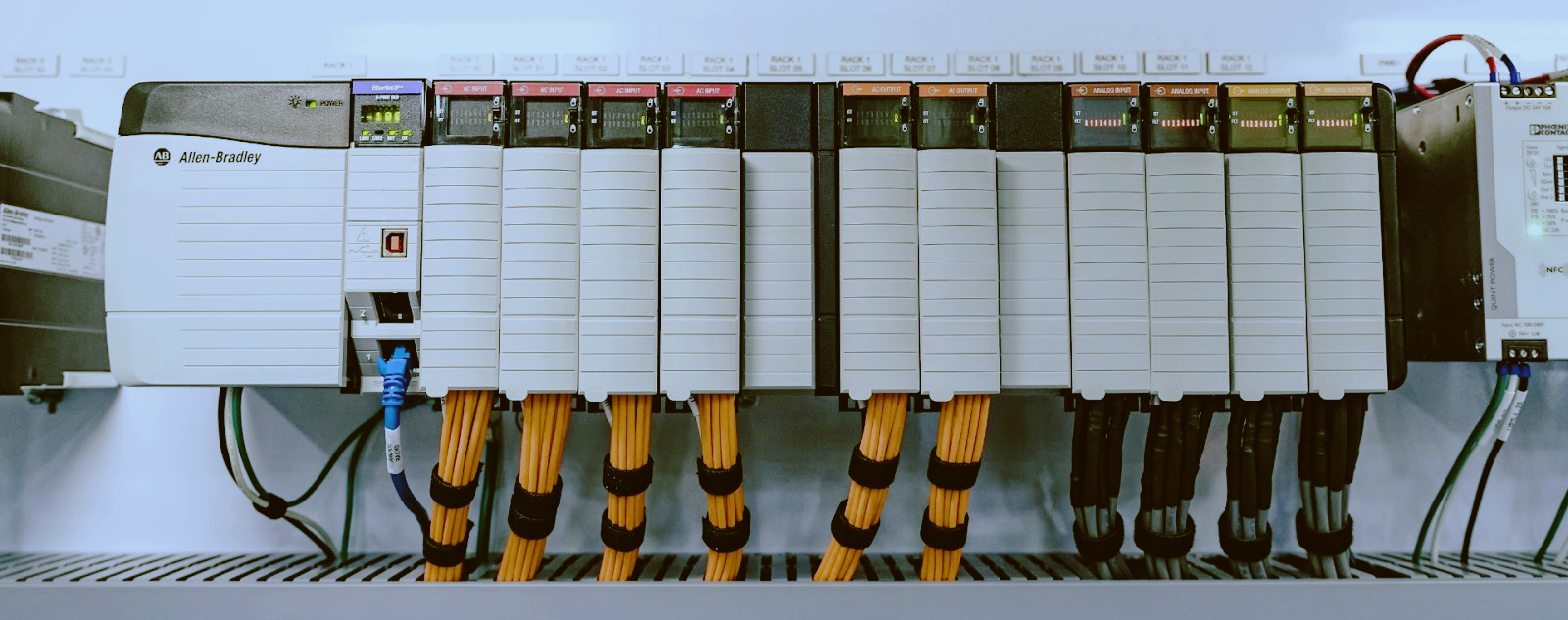
Allen-Bradley PLC-5: End-of-Life Guide, Replacement Options & Where to Find Spare Parts
The phone rang at 11 PM on a Tuesday. Ammonia refrigeration skid at a cold storage facility — the whole system dropped into fail-safe, product temperature climbing. The PLC-5 had a solid red PROC LED and no amount of power cycling brought it back. I swapped in a spare 1785-L80B, reloaded the program from a floppy disk, and had the refrigeration back online before the first pallet of frozen meat started to soften. That CPU ran continuously for fourteen years. It chose that night to die.
The PLC-5 family was discontinued years ago. Last-order dates passed. But the installed base is enormous, and these systems do not fail on a schedule that suits your budget cycle.
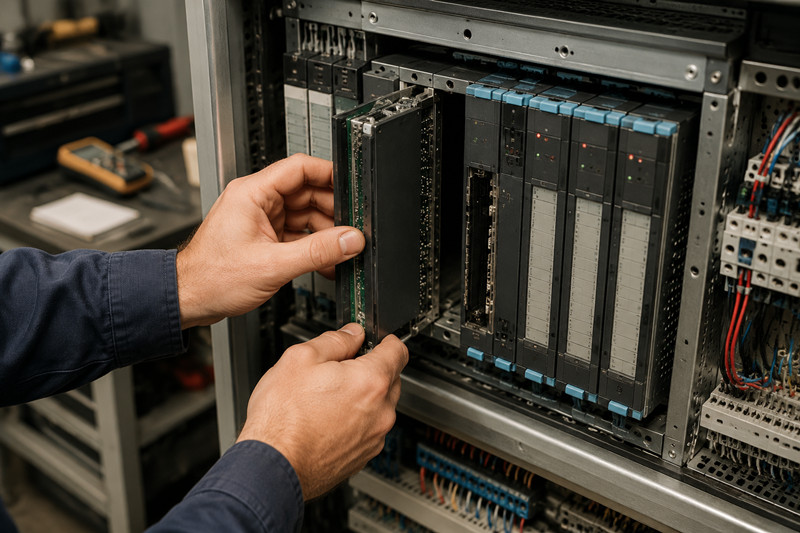
Replacing a working control system costs six figures and requires a plant shutdown. A PLC-5 running a batch reactor that has been making the same product since 1997 — the program is debugged, the operators know it, and the production manager has no appetite for a migration project that risks weeks of commissioning delays.
The 1771 I/O rack and 1785 processors were built when Rockwell over-engineered everything. Gold-plated backplane connectors. Heavy-gauge steel chassis. A 1771-PS7 from 1992 will still regulate within spec if the capacitors have not dried out.
I have seen PLC-5 systems running steel mill table drives, chemical batch sequencing, pipeline valve control, and half the automotive transfer lines built in the 1990s. The capital request for a migration sits in a drawer, waiting for a catastrophic failure or a budget year that never comes.
After twenty-plus years in the field, here is what actually fails — not what the manual says can theoretically fail.
The 1771-PS7 provides 5V and 24V DC to the backplane. The electrolytic capacitors inside have a finite life — roughly seven to ten years in a ventilated panel. In a sealed cabinet running at 50°C ambient, those caps drift out of spec in five years.
Symptoms of a failing PS7:
· Intermittent rack faults clearing on power cycle
· Flashing or dim PWR LED
· Unexplained I/O communication errors on specific slots
· 5V rail measuring below 4.75V on a multimeter
When the PS7 fails completely, the entire rack goes dark. I carry a spare 1771-PS7 in my truck.
The PS7 has a distinct failure signature depending on line voltage. On 120V/60Hz (North America), rectifier diodes tend to fail before the caps. On 230V/50Hz (Europe, Middle East), input filter capacitors fail first — the higher RMS voltage stresses the dielectric harder. Stock with CE and UL certification requirements in mind.
The 1785 processors use a 3.6V lithium battery (1770-XY) to maintain the user program in SRAM when main power is off. Below approximately 3.0V, the CPU sets a BAT LED warning. Below 2.5V, you have an empty CPU.
The critical detail: the battery drains faster when the CPU is powered on than when it is off. A 1785-L80B running continuously drains its battery in twelve to eighteen months — about half the life of the same battery in a powered-off spare.
Replace the backup battery every twelve months, on a schedule. Write the replacement date inside the cabinet door with a paint marker. I have seen plants lose programs because the maintenance manager assumed the battery lasts five years. It does not in a warm panel running 24/7.
Specific processor models to watch:
· 1785-L80B — Full-featured processor with 256K memory. Highest battery drain due to larger SRAM array. Check BAT LED quarterly.
· 1785-L40B — Mid-range processor, 128K memory. Slightly longer battery life than the L80B.
When the program is lost, you need three things: the backup file (.RSP from RSLogix 5), the correct processor firmware, and a working connection to download.
The 1771-IBD uses optical isolators that degrade over time. After fifteen to twenty years, the current transfer ratio drifts. The input stops reliably detecting the OFF state — the CPU sees a logic 1 when the field device is de-energized. Replace the module when you see phantom ON states.
1771-OB (24V DC Sourcing Output) — The Darlington transistor arrays fail shorted or open. A shorted output keeps the load energized when the logic says OFF. The 1771-OB has no output fuse. Keep spares.
1771-IXE (Thermocouple/Millivolt Input) — Uses a custom hybrid ASIC that is no longer manufactured. When the ASIC fails, the module outputs random values or locks at a fixed reading. These are getting expensive on the secondary market because new-old-stock is exhausted.
RSLogix 5 is the only way to program and troubleshoot the PLC-5 family. Rockwell stopped selling new licenses years ago. Version 8.20 is the last release — a 32-bit application running on Windows 7 and Windows 10 in compatibility mode. Windows 11 is unreliable.
Common RSLogix 5 issues in 2026:
· DH+ communication via 1784-PCMK — The PCMCIA card is obsolete. Driver support ended with Windows 7. USB-to-DH+ converters (1784-U2DHP) cost $500-$1,200 and are themselves discontinued.
· Serial DF1 upload — Requires a real RS-232 port. FTDI chipset-based USB adapters are the most reliable. Prolific-based adapters cause random corruption.
· Ethernet upload (1785-L80C/L80E) — The most reliable method if your processor has Ethernet. Set a static IP, connect directly with a crossover cable, and use the Who Active feature.
· Program file corruption — RSLogix 5 uses a serialization scheme. If an uploaded .RSP file will not download back to the CPU, create a new file and upload data tables first, then the program separately.
Keep a dedicated laptop running Windows 7 or Windows 10 32-bit with RSLogix 5 installed. Do not let IT update it. Do not connect it to the internet.
You will eventually have to migrate. Here is the realistic breakdown.
The native replacement for PLC-5 is ControlLogix — the 1756-L8x series. Rockwell provides a migration toolkit that converts most ladder logic automatically. Simple discrete logic converts cleanly. PID loops, MSG instructions, and block transfers (BTR/BTW) require manual rework.
Cost: a single ControlLogix chassis, processor, power supply, and communication module runs $5,000-$8,000 list. A full cabinet migration for a medium system (128 I/O points) runs $30,000-$60,000 in parts and engineering.
CompactLogix (5069-L3x or 5069-L4x series) is the lower-cost alternative at $2,000-$4,000 per processor. The 5069 I/O modules cost about 30% less than 1756 modules.
Trade-offs:
· CompactLogix supports fewer I/O points per chassis
· No DH+ or Remote I/O built in — requires explicit communication modules
· The 5069 backplane does not support 1771 adapter modules — all new I/O required
For small to medium PLC-5 systems (under 128 I/O points), CompactLogix is the sensible choice. For large systems with significant analog I/O or existing ControlNet/RIO networks, the ControlLogix path saves integration headaches.
Some vendors pitch a PAC migration as a drop-in replacement. It is not. The backplane, I/O, power supply, and programming environment all change. The only thing you keep is the field wiring. Budget for a complete system replacement.
New-old-stock PLC-5 and 1771 components are disappearing from traditional distribution. Rockwell does not manufacture them anymore. The remaining supply lives in the surplus and independent distributor network.
Your best sourcing strategy: buy from an industrial automation spare parts specialist with tested inventory. At tztechio.com, the Allen-Bradley category carries curated PLC-5 processors, 1771 I/O modules, power supplies, and chassis — including 1785-L80B and 1785-L40B processors, 1771-IBD and 1771-OB I/O, and hard-to-find modules like the 1771-IXE thermocouple input. Broader PLC parts for other legacy platforms are also available.
If you maintain PLC-5 systems, supply tightens every quarter. Priority order:
1. 1771-PS7 power supply — Most common failure point. Stock two per active chassis.
2. 1785-L80B or L40B processor — One spare CPU per two systems. Buy tested units with verified battery backup circuitry.
3. 1770-XY batteries — Buy a case of twelve. Change every twelve months across all systems.
4. 1771-IBD and 1771-OB — Two of each per system. Highest failure rate among I/O modules.
5. 1771-IXE or other analog input modules — One spare per module type. Hardest to find.
6. 1771 chassis — One spare backplane per system size. A cracked chassis means full rewiring.
7. RSLogix 5 installation media and license — If you do not have it, find a licensed copy now. When your programming laptop dies, you will not be able to set up a new one.
The PLC-5 is not coming back. Rockwell will not re-release it. Every day makes spare parts harder to find and more expensive. The plant manager who says "we will migrate next year" has been saying that for five years. The refrigeration skid CPU I replaced at 11 PM that Tuesday night was the same one the plant planned to migrate in 2019.
Keep spares. Change batteries. Maintain your RSLogix 5 laptop. And when the budget appears for a migration, do it before the PLC-5 fails — not after. A controlled migration beats an emergency replacement every time.
-------------------------------------------------------------------------------------------------------------------
🏢 About TZ Tech
TZ Tech is a leading supplier of industrial automation, electrical, instrumentation, and telecommunications components. We specialize in sourcing ready-to-ship distributor stock, allowing us to offer highly competitive pricing and short lead times. Thanks to our extensive inventory, we can even source rare and discontinued parts that are hard to find elsewhere.
🛡️ Our Quality Commitment
We understand that quality is your top priority. Every component undergoes a strict screening and inspection process so you can buy with absolute confidence. For legacy or discontinued parts, we believe in complete transparency and will always provide an honest, accurate report on the product's condition. Plus, all brand-new parts come backed by a full 1-year warranty.
✉️ Get in Touch
Have a project or a part you need? Send us your inquiry today! Our team is dedicated to providing a fast response within 6 hours (excluding weekends).


Please read on, stay posted, subscribe, and we welcome you to tell us what you think.


Sitemap | Blog | XML | Privacy Policy
In addition, with your permission, we want to place cookies to make your visit anointeraction with slOC more personal. For this we use analytical and advertisingcookies. With these cookies we and third parties can track and collect yourinternet behawior inside and outside super-instrument.com. With this we and third parties adapt super-instrument.com and advertisementsto your interest. By clicking Accept you agree to this. If you decline, we only usethe necessary cookies and you unfortunately will not receive any personalizedcontent. Please visit our Cookie policy for more information or to change yourconsent in the future.
Accept and continue Decline cookies