
The SIMATIC S5 Is Still Running Your Plant: A 6ES5 Field Guide for 2026

The phone rang at 2:37 in the morning. I knew it was a plant before I picked up. Nobody calls at 2:37 in the morning to talk about the weather.
"It's Karim. The dairy. Mixer line three stopped at 2:10. The CPU light is out."
Karim runs maintenance at a dairy that fills yogurt cups for half the Gulf states. I had stood in his electrical room six months before that call. I remembered the cabinet: a Siemens SIMATIC S5-115U, a row of brown and beige modules, a bank of green LEDs, and a small battery holder clipped to the CPU card. That machine was delivered in 1988. It had been filling cups before Karim was born.
"Did you change the battery, Karim?"
Silence. Then: "What battery?"
That is how almost every S5 emergency starts. Not with a blown module. Not with a shorted output. With a battery.
The 6ES5980-0AA11 is a 3.6 volt lithium cell about the size of a D battery. It keeps the CPU's RAM alive when the mains power drops. When it dies, the RAM goes blank, and the CPU wakes up with no program to run. The machine stops, the alarm sounds, and somebody calls somebody like me at 2:37 in the morning.
Karim got lucky. His predecessor had left a disk backup and an old laptop with STEP 5 installed, so we had the line running by 5:40. The six o'clock shipping deadline held by twenty minutes.
Not every plant is that lucky. In thirty years of working on these machines, I have watched the same scene play out in cement plants, bottling lines, steel mills, and water treatment stations on three continents. The S5 refuses to die, and the people who keep it alive make the same mistake: they ignore the battery until the battery forces the issue.
Consider this the conversation I wish I could have with every maintenance team that still carries an S5: why the machine is still there, what actually breaks, where to find 6ES5 spares in 2026, and when to start walking toward S7.
Siemens introduced the SIMATIC S5 in 1979, replacing the S3 series. The early S5-110A and the big S5-150U came first, and then the family grew to cover the whole market. The S5 was built around one programming language, STEP 5, and that decision is a big reason the family survived so long. One language, three ways to write it: statement list (STL), ladder (LAD), and function plan (FUP). One family of programmers, from the PG675 through the PG7xx series and later STEP 5 on a PC. Learn one S5, and you could walk up to any of them.
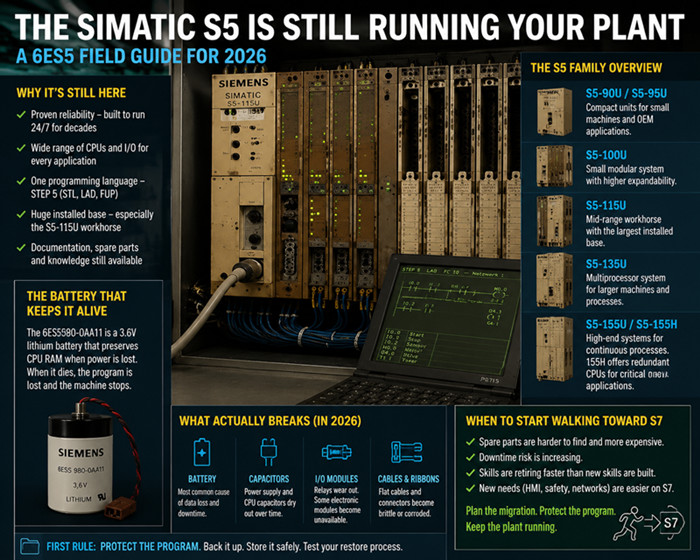
The range covered everything a factory needed. Small machines got the compact S5-90U and S5-95U. Small modular systems got the S5-100U. The middle of the market, which is where most factories live, got the S5-115U. Big continuous processes got the S5-135U and the S5-155U, and the redundant S5-155H ran the applications where stopping was not an option.
The S5-115U became the workhorse. Its CPUs, from the small 941 up to the 945 with floating point math, sat in a rack with a power supply, interface modules, and I/O cards, and they ran packaging lines, conveyors, pumps, presses, and mixers for decades. I have opened cabinets in Rotterdam, Cairo, Houston, and Dubai and found the same brown modules inside. The S5-115U is the most widespread PLC Siemens ever built for the mid-range, and the installed base never really went away. Plants did not replace them because they worked.
They still work. That is the uncomfortable truth of 2026: tens of thousands of S5 systems are running production right now, most of them S5-115U, some of them running 24 hours a day, seven days a week, for thirty or forty years. The design was overbuilt. The documentation culture around it was strong. The machines around it, the motors, gearboxes, and valves, are older than most of the engineers who maintain them. Nobody replaces a working line to fix a problem it does not have.
If you walk into a plant and see an S5, here is what you are looking at.
The S5-90U and S5-95U are the compact units, the 95U with more memory and a few built-in functions. They live inside packaging machines, labelers, and small presses. The S5-100U is the small modular system, a step up in expandability. The S5-115U is the mid-range workhorse with the huge installed base, the one you will meet nine times out of ten. The S5-135U is a multiprocessor system for bigger machines, and the S5-155U and S5-155H sit at the top, running steel mills, chemical plants, and power station auxiliaries, the H version with redundant CPUs for the applications that cannot stop.
Every one of them speaks STEP 5. That was the genius of the family. One language from the smallest 90U to the biggest 155H. A maintenance man who learned STEP 5 in 1985 could still read a program in 2005, and the same skill works today.
I learned on a 115U in 1991. An old paper mill, a CPU 944, and a PG685 programmer the size of a suitcase. The senior electrician, a man named Bert, showed me how to pull the EPROM submodule out of the CPU, stick it in the programmer, and read the program. He told me something I have never forgotten: "The program is worth more than the machine. Guard the program." Thirty years later, that is still the first thing I check on any S5 site. Do you have the program? Where is it? On EPROM? On disk? On a printout in a drawer?
The S5 hardware is tough. The failure list is short, and it has not changed in thirty years. Everything that dies on an S5 dies in one of four places: the battery, the power supply, the memory, or the I/O.
The 6ES5980-0AA11 lithium cell is the number one cause of S5 downtime in the world. It is a consumable, like a filter or a bearing, but nobody treats it like one. The cell costs a few dollars. The downtime it causes, when the program vanishes from RAM, costs thousands.
I have a rule I tell every customer: change the battery every two to three years, on a schedule, with a sticker on the cabinet door. Buy two spares and store them in the cabinet. A battery is not a spare part you order after the failure. It is a spare part you install before the failure.
The first sign is the battery lamp on the CPU front, but that lamp only comes on when the voltage is already low. Check it the honest way: measure the cell with a multimeter, under load if you can, and replace it if it reads below about 3.2 volts. And never change the battery with the power off, because that is the moment the RAM forgets everything. Change it with the system running, or with the CPU powered up and the program safely in EPROM.
If the worst happens and the RAM is blank, all is not lost. If you kept the program on an EPROM submodule, you can copy it back into RAM from the programmer. If you kept a disk backup, you can load it. If you kept only a printout, you get to retype it, line by line, and I have done that twice in my life and I hope never to do it again.
The second most common failure is the power supply. The S5-115U uses the 6ES5 951-7LD21 for AC mains and the 6ES5 955-7LD21 for 24V DC plants. These modules are full of electrolytic capacitors, and capacitors age whether the machine runs or not. After twenty-five years, the 5V rail starts to sag. The PLC does strange things: spurious faults, random stops, outputs that drop for no reason. Then one day the module gives up.
I remember a cement plant in Upper Egypt where the line stopped twice a week for months. Every time, the same fault, a mysterious CPU stop with no error. They changed the CPU, the battery, the memory. I walked in, looked at the 6ES5 951, and measured 4.6 volts on the 5V rail. The capacitors were dried out. We swapped the power supply and the mystery never came back.
The tell is the little voltage lamp on the front of the module. If it looks dim, or if the 5V rail measures under 4.9 volts, replace the module before it replaces your night's sleep. Power supply modules are one of the most traded 6ES5 parts today, both used and NOS, because every S5 owner eventually needs one.
The program often lives on an EPROM submodule, the 6ES5 375 series and similar, plugged into the CPU. These are remarkably reliable. They hold their data for decades. But they are not immortal, and they have one weakness: the UV window.
Ultraviolet light erases EPROMs with a quartz window. Sunlight is ultraviolet light. I have seen a spare EPROM stored on a windowsill for six years, and when the plant finally needed it, it was blank. I have also seen a lightning strike take out an EPROM through the field wiring, which is why the program backup should live in more than one place.
My rule: keep the master program on a PC, keep a copy on EPROM or EEPROM inside the cabinet, and keep a printout in the office. Three copies. One of them will survive whatever happens.
The I/O cards are the soldiers of the system. They take the punishment from the field, and they die the most interesting deaths. The 6ES5 421 and 6ES5 422 digital input cards, 16 and 32 channels, fail when a surge comes in on the field wiring. A lightning storm, a shorted solenoid, a crane touching a power line, and the optocouplers inside give up. The 6ES5 441 and 6ES5 451 digital output cards fail when a load shorts or when somebody wires 220V into a 24V output. I have seen output cards returned with actual scorch marks on the plastic.
The good news: I/O cards are the easiest 6ES5 modules to replace, and they are still widely available as used and new old stock. The bad news: the field wiring around them is often the real problem, and a new card on old wiring is a new card waiting to die. Check the wiring first. Then swap the card.
The other quiet killer is the interface modules, the IM 305, IM 306, and IM 308 that connect the racks. They fail rarely, but when a rack goes dark, everyone blames the CPU first. Reseat the IM modules, clean the backplane contacts, and check the flat cables before you order anything.
Keep this table on the cabinet door. It covers the faults I have seen most often in the field, and the part numbers you will actually need.
Fault | Likely cause | Fix | Spare part number
CPU dead, no LEDs, program gone | Backup battery flat, RAM lost the program | Replace battery, reload program from EPROM or PC backup | 6ES5980-0AA11
Battery lamp lit on CPU front | Cell voltage low | Measure under load, replace cell with power on | 6ES5980-0AA11
No 5V rail, power supply LED dark | Failed 6ES5 951/955, aged capacitors, blown fuse | Replace the power supply module | 6ES5 951-7LD21 (AC) or 6ES5 955-7LD21 (DC)
Input channel stuck on or off | Surge damage, failed optocoupler, bad field connection | Check wiring, swap input card | 6ES5 421-7LA11 or 6ES5 422-7LA11
Output will not switch, fuse keeps blowing | Shorted load, failed transistor or triac | Clear the short, replace output card | 6ES5 441-7AA11 or 6ES5 451-7LA11
Spurious CPU stops, corrupt program, wrong cycle times | Aged EPROM or EEPROM submodule | Reload program, replace submodule | 6ES5 375-0LC21 (EPROM)
Expansion rack dark, IM error LEDs on | Loose or failed IM module, corroded backplane | Reseat, clean contacts, replace interface module | 6ES5 305, 6ES5 306, or 6ES5 308
The honest answer to the question I get every week: yes, you can still buy 6ES5 modules in 2026, and the market is healthier than most people think.
Siemens officially discontinued the S5 family long ago. Production stopped with it, and the factory repair service is gone. That sounds like a dead end, but the market filled the gap years ago. Two kinds of stock keep the S5 world alive.
New old stock (NOS) is the treasure: modules that sat in warehouses for decades, never installed, still in the original packaging. A surprising amount of 6ES5 stock survived, because distributors and OEMs bought deep when Siemens announced the end of production. NOS power supplies, CPUs, and I/O cards still change hands every month.
Used modules come from decommissioned plants. When a factory finally migrates to S7, the entire S5 cabinet often goes to a dealer who tests the modules and resells them. A tested, working used module with a warranty is a perfectly good spare for a machine that will run another ten years. Beyond specialist dealers, used 6ES5 modules also show up on general marketplaces, but there the risk is the test report: an untested module is a lottery ticket, and a module that was pulled from a flood-damaged cabinet is worse than no module at all.
At tztechio.com we keep a working stock of exactly the modules that fail, the batteries, power supplies, memory submodules, and I/O cards, and we test every used module before it goes on the shelf.
Before you buy any used or NOS module, check three things. First, the order number on the label, the full MLFB like 6ES5 421-7LA11, because a one-digit difference can mean a different voltage or polarity. Second, the version number, because later versions of the same module usually carry fixes. Third, ask whether the module has been tested and whether it carries a warranty. A dealer who tests modules and backs them is worth more than the module itself.
Prices follow the laws of supply and demand, and 6ES5 demand is still real. Batteries and power supplies are the highest turnover items. Some modules, the rare 155U CPUs and the redundant 155H parts, have gone up in value over the years. The market is mature, and it will be there for a while, because the installed base is still enormous.
The S5 will not run forever. The question is not whether to migrate, but when, and how to do it without a fire drill.
The honest advice from someone who has done this many times: do not migrate a working line just because the PLC is old. The machine works. The spares are available. The program is understood. That combination is worth real money. Plan the migration, buy the spares, and migrate when one of these things happens: the spares start getting hard to find, the machine must talk to a modern MES or ERP system, the last person who understands the program retires, or the S5 fails in a way that cannot be repaired.
When the time comes, the path leads to the S7-300 for mid-range machines and the S7-400 for the big ones. The two families are cousins. STEP 7 speaks a language close to STEP 5, and Siemens built a conversion tool into STEP 7 that translates S5 programs to S7. The tool does the heavy lifting, and then a human does the real work.
Because the translation is never clean. S5 timers, flags, data blocks, and the S5-115U's addressing all have S7 equivalents, but they do not line up one for one. A good conversion project is a bench test first: convert, simulate, test every input and output against the old printout, then cut over on a planned weekend. I have seen a well-prepared team convert a whole bottling line in one weekend. I have also seen a rushed team convert a single pump station in a week. The difference was preparation, not the PLC.
There is also a middle path. If the S5 itself is healthy but the plant needs modern communication, gateways can put an S5 on PROFIBUS or industrial Ethernet and let it talk to an S7 or a modern SCADA. That buys years of life without touching the control logic. It is a real option, and it is often the smart one.
Whichever path you take, the first step is the same as Bert taught me in 1991: guard the program. Before anything else, make sure the S5 program is backed up in at least two places, because a conversion starts from a backup, not from a prayer.
When you are ready to look at what comes next, our PLC controllers page covers the S7 side of the story, and we can help you match the right controller to the machine you are actually running.
If you carry an S5, this is the short list I give every customer, the one I wish Karim had been given in 2019:
1. Change the 6ES5980-0AA11 battery every two to three years, on a schedule, with the power on. Keep two spares in the cabinet.
2. Back up the program in three places: PC, EPROM, printout. Verify the backup actually loads, once a year.
3. Stock one spare power supply, 6ES5 951 or 6ES5 955 depending on your plant, and one spare of each critical I/O card.
4. Keep the cabinet clean and cool. Dust and heat kill capacitors and connectors. Check the cabinet filter, and clean the backplane contacts when you are in there.
5. Label everything. When the S5 finally leaves the building, the next engineer will bless your labels.
6. Buy the spares before you need them. The module you need in an emergency is the one nobody stocked.
We carry the full range of industrial automation spares, and the S5 section of our Siemens catalog is built around exactly these failure points.
Is the SIMATIC S5 still supported by Siemens?
Officially, no. Siemens discontinued the S5 family and closed the repair service years ago. Unofficially, the market never stopped supporting it. Used and NOS modules, third-party test and repair services, and experienced engineers keep the installed base alive. Support for the S5 in 2026 means the spares market, not the factory.
Can I still buy 6ES5 modules in 2026?
Yes. Batteries, power supplies, CPUs, memory submodules, and I/O cards are all still traded, as used modules and as new old stock. Some 6ES5 parts, especially the power supplies and I/O cards, are available within days. The rare 155U and 155H parts take longer, which is exactly why you should stock them before you need them.
How do I check the S5 backup battery?
Measure the 6ES5980-0AA11 cell with a multimeter, ideally under load. A healthy cell reads above 3.2 volts. Below that, replace it, with the system powered up so the RAM never loses the program. The battery lamp on the CPU is a late warning. The multimeter is the early warning.
How long does the battery last?
Two to five years is the practical range, depending on temperature and how often the plant loses power. The cell drains faster in hot cabinets. Change it on a two to three year schedule and you will never have to think about it again.
Can I program an S5 with a modern PC?
Yes, with patience. STEP 5 version 7.2 runs on older Windows systems, and many engineers run it inside a virtual machine with a CP5611 card on the plant network. It is museum software, but it works, and it is still the only official way to read and edit an S5 program. If your only programmer is a retired engineer with a PG720 in his garage, make friends with him now.
Do I have to migrate to S7?
No. If the machine runs, the spares are available, and the program is safe, keeping the S5 running is a legitimate strategy. Migrate when the risk outweighs the cost, not because a salesman says the technology is old. The S5 is old. Old is not the same as broken.
Somewhere right now, an S5-115U is counting yogurt cups, or bottles, or kilowatt-hours, and it will still be counting tomorrow. These machines were built to outlast the people who installed them, and most of them have. They ask for very little. A battery every couple of years. A spare power supply on the shelf. A program that is backed up in three places.
Give them that, and they will keep running while you plan the future at your own pace. That is the deal I have made with every S5 I have ever met.
Change the battery. Guard the program. Call us when you need the parts.
------------------------------------------------------------------------------------------
🏢 About TZ Tech
TZ Tech is a leading supplier of industrial automation, electrical, instrumentation, and telecommunications components. We specialize in sourcing ready-to-ship distributor stock, allowing us to offer highly competitive pricing and short lead times. Thanks to our extensive inventory, we can even source rare and discontinued parts that are hard to find elsewhere.
🛡️ Our Quality Commitment
We understand that quality is your top priority. Every component undergoes a strict screening and inspection process so you can buy with absolute confidence. For legacy or discontinued parts, we believe in complete transparency and will always provide an honest, accurate report on the product's condition. Plus, all brand-new parts come backed by a full 1-year warranty.
✉️ Get in Touch
Have a project or a part you need? Send us your inquiry today! Our team is dedicated to providing a fast response within 6 hours (excluding weekends).


Please read on, stay posted, subscribe, and we welcome you to tell us what you think.


Sitemap | Blog | XML | Privacy Policy
In addition, with your permission, we want to place cookies to make your visit anointeraction with slOC more personal. For this we use analytical and advertisingcookies. With these cookies we and third parties can track and collect yourinternet behawior inside and outside super-instrument.com. With this we and third parties adapt super-instrument.com and advertisementsto your interest. By clicking Accept you agree to this. If you decline, we only usethe necessary cookies and you unfortunately will not receive any personalizedcontent. Please visit our Cookie policy for more information or to change yourconsent in the future.
Accept and continue Decline cookies