
ABB ACS 800 Drives in the Field: The Questions Engineers Ask Before They Order a Spare
The junior engineer has been on the floor for four months. He can read a drawing, he can tag a cable, and he has learned that the plant does not slow down for anyone. What he has not learned yet is how to stand in front of a faulted cabinet and decide what to do next. That is what the older man is for. Twenty-six years in drives, most of them on this same line, and a habit of answering questions with better questions.
They are standing at a wall of ACS 800 drives. Six of them, running a paper converting line that has not been idle for more than a shift at a time in years. The junior engineer is holding a laptop bag he will not need until later. The older one has a coffee he sets down on the top of a cabinet nobody is supposed to put coffee on.
This is how the morning goes. The younger man asks. The older man answers. Neither of them writes anything down.
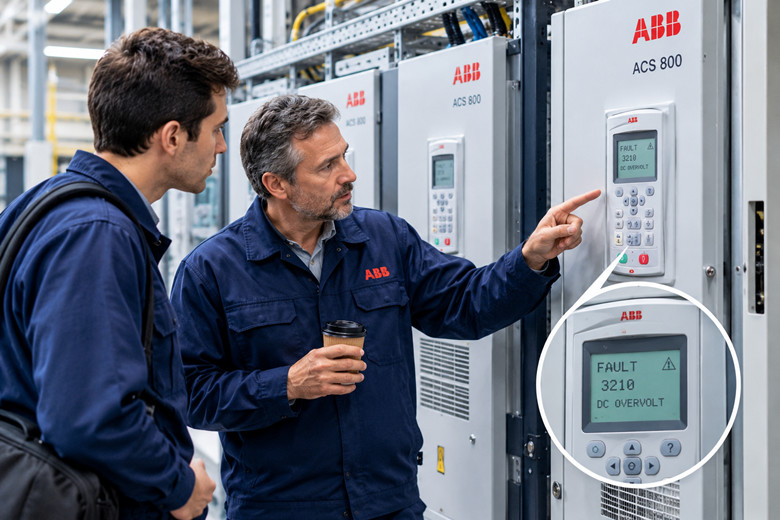
"The panel says FAULT 3210. Is the drive dead?"
The junior engineer points at the panel text. FAULT 3210. He asks if the drive is finished. The older one does not even look up.
"When did the line last coast to a stop by itself?" he asks. "That is what that code is telling you."
The junior engineer blinks.
"It is not telling you the drive is dead. It is telling you the DC link went over the top. 3210, DC OVERVOLT. The DC bus climbed past the upper limit and the drive latched the fault because it does not trust a bus that high. Most of the time the drive is fine. Something put energy back into it."
The junior engineer asks how energy gets back into the bus when the drive is supposed to be sending energy out.
"Same reason a car engine brakes with a downshift," the older one says. "The load was driving the motor instead of the motor driving the load. A fast decel, a heavy overhung load, a winder that stops faster than the drive is ready for. The motor becomes a generator, the energy goes back down the DC bus, and there is nowhere for it to go except up. If the drive has a braking resistor and the chopper is working, it burns off. If it does not, that bus keeps climbing until 3210 trips."
The junior engineer asks if that means the drive is undersized.
"Sometimes. Not usually. Usually it means the decel ramp is aggressive for the inertia, or the brake chopper is not enabled, or the braking resistor is open. First thing I look at is when it happens. If 3210 lands at the end of every stop cycle, you have a regenerative problem and it is repeatable. If it lands randomly mid-run, you have something else going on, and it is worth checking the supply."
The older man picks up the coffee, takes a drink, puts it back.
"Now. Which reset does it take?"
The junior engineer thinks. "Manual?"
"Right. 3210 is latched. It is not going to clear itself with the next start command. You get down the panel, you read it, you understand it, and then you reset. If you reset it faster than you understand it, you are going to see it again and you will not know why. That is the part that wastes a shift."
The younger man writes nothing down. He is learning that the older one does not like it when he writes things down before he understands them.
The DC bus itself deserves a mention here that the younger man will not forget. On a 400 V class ACS 800, the bus can sit above 540 VDC for several minutes after the input contactor opens. The panel goes dead, the fan stops, and it feels finished. It is not. If he is going to put a hand near power wiring or the braking resistor terminals, he locks out first. That is not a rule someone wrote for the binder. That is a rule because the capacitors hold a charge and they hold it longer than anyone expects.
The older one adds one more thing, almost as an afterthought. "There is a warning that looks like this but is not. FF30, OVERVOLTAGE. If you are seeing FF30, the drive is telling you the bus is high and it is still running. That is a heads-up, not a stop. Do not treat a warning like a fault. The drive has not latched anything. It is asking you to look."
The junior engineer asks what the difference is between a warning and a fault in practice.
"A warning is the drive still making product. A fault is the drive not making product. Everything else follows from that."
"It tripped on overcurrent. Do I change the drive or the motor?"
Now it is a different cabinet. 2310, OVERCURRENT. The junior engineer has already started toward the spares crib. The older one puts a hand on the cart.
"Slow down. What do you think 2310 means?"
"Too much current."
"On the output. It is the output stage. The current the drive sends to the motor went past the trip limit. Do not read it as earth fault and do not read it as a power stage failure. Those are 2330 and 2210. Different codes, different causes, different money. If you treat them like one thing, you are going to buy the wrong part."
The junior engineer asks how he keeps them apart.
"2330, earth fault, is an imbalance in the sum of the phase currents. Current leaving the drive on one leg is not coming back the way it should, so it is leaking somewhere, a motor winding to frame, a pinched cable in a tray, water in a junction box. 2210, POWERF INV, is the drive telling you its own inverter power stage has a problem, and that one is a drive conversation, not a motor conversation. 2310 is the output current simply being too high for too long. That is the one where you genuinely have to look outward before you look inward."
The younger man asks the question he came to ask. Drive or motor.
"Neither until you have checked four things." The older one counts on his fingers because he has done this a thousand times. "Load. Acceleration time. The motor. The motor cable."
He takes them one at a time.
"Load first, because it is free. Has anything changed? A thicker product, a jammed conveyor, a mechanical brake that never fully released, a pump running against a closed valve. If the process got harder, the drive will trip to protect itself and it is doing its job. That trip is information, not a fault."
"Acceleration time second. If the ramp is too short for the inertia, the drive tries to push the motor to speed faster than the motor can follow and the current spikes. Group 22 is where the ramps live. You are not looking to stretch every ramp in the plant. You are looking at the ramp on the axis that tripped."
"Motor third. Insulation, windings, bearing drag, the obvious things. If the motor has been getting hot or has been sitting, this is where you find it."
"Cable fourth, and this is the one people skip. Motor cable, terminations, the run in the tray, the connection at the motor terminal box. A loose termination or a damaged conductor will show up as current problems long before it looks broken."
Then he says the thing the junior engineer has never heard.
"Open the motor circuit and look for power-factor correction capacitors."
The junior engineer asks why.
"Because if somebody put power factor correction capacitors in the motor circuit, the drive sees a capacitive load it was never designed to switch, and you get current problems that make no sense. Find them, take them out of the drive's circuit, and the fault usually stops. Nobody puts them there on purpose. Somebody does it for plant power factor and never tells the drives group, and then a year later a drive trips on overcurrent and everybody blames the drive."
The younger man asks a fair question. What if all four are clean.
"Then you have probably got a real output stage problem and you are into a drive conversation. That is the point where a spare earns its shelf space. Until then, do not spend a part. You can read the fault history on the CDP-312 before you touch anything, and if you have DriveWindow Light on the laptop you can pull the trend and see what the current was doing in the second before the trip. A one-second trace tells you more than an hour of guessing."
He nods at the cart. "Put it back."
"Can I just reset it and keep running?"
The junior engineer asks this one quietly, because he suspects the answer.
"You can. You have, probably. Everybody does once." The older one is not angry about it. "The question is what you learned."
He looks at the junior engineer.
"If it trips once a month and you reset it and it runs another month, you have a chronic problem and you are living with it. Fine, that is a decision. But you should be making it on purpose, with a note in the shift log, so that when it finally fails at three in the morning during a rush order, whoever is on shift knows this drive has been giving trouble and knows where to look. A reset with no note is a lie you tell the next guy."
The junior engineer asks when a reset is genuinely the right call.
"When you understand what tripped it and the condition has passed. Undervoltage is the honest example. 3211, DC UNDERVOLT. That is the bus below the lower limit, and most of the time it is a supply sag, a brownout, a generator transfer, something upstream that has already cleared. The drive did the right thing and stopped. Once the supply is back, reset and carry on. Same with FF31, UNDERVOLTAGE, which is the warning version. Those are supply events, not drive events."
The junior engineer asks about the braking resistor warning.
"FF61, BRAKE RES OVERHEAT. That is a warning on the braking resistor, not a drive fault. It means the chopper has been dumping energy into that resistor and the resistor is getting hot. If you reset past it and keep running a downhill load, you are going to cook the resistor and possibly worse. That one you do not reset until you understand your duty cycle. Group 27 is where the brake chopper control lives, and if you are seeing FF61 the chopper is at least turning on and trying. The question is whether the resistor can take the cycle."
The junior engineer asks how he tells a repeatable fault from a random one.
"Same way you tell anything. Timing and history. Read the fault log. If the same code is in there at the same point in the cycle, it is repeatable and it is a design or duty problem. If the codes are all over the place, different codes in different places, you have a supply or environment problem, loose wires, heat, dust, a contactor chattering. The fault log is the cheapest diagnostic tool on the machine and half the people on this floor never open it."
The older one drains the coffee and sets the cup down on the floor, which is at least an improvement.
"One more thing about reset, and this is the one that hurts. Do not reset a fault you do not understand while the machine is running with someone working near it. 3210 comes from energy coming back, which means something is moving. 2310 comes from current, which means something is straining. Neither of those is safe to repeatedly reset with your hand in the guard. Understand it, then reset it."
"How do I tell whether it is the drive or the cable?"
The junior engineer has a drive that will not run and no fault he can name. He asks the broad question.
The older one answers with a question. "What does it do when you command a start?"
"Nothing. It just sits there."
"Then you do not have a drive fault yet. You have a drive that is not being told to run, or is being told and refusing. Those are different. What does the panel say?"
The younger man admits he did not look at the panel first.
"Look at the panel first. Always. Some drives will sit there with a fault you never reset because you were looking at the wrong cabinet. The CDP-312 is not decoration. It will tell you what the drive thinks is true."
Then he walks them through the split between a drive problem and a cable problem, because it comes up constantly and the answer is usually cheaper than people fear.
"A cable problem is often an earth fault. 2330. The sum of the phase currents is not what it should be, so current is going somewhere it should not. An earth fault is a wiring fault until proven otherwise. Meghom the motor, look at the cable, check the terminations, look for moisture. The drive is complaining about the circuit it is feeding, and the circuit is more likely to degrade than the drive is."
The junior engineer asks whether the drive ever causes its own earth fault reading.
"Not usually. If the drive itself reports 2330 and the motor and cable are clean, you have a drive conversation. But you check the inexpensive thing first. Always the inexpensive thing first."
The older one moves to the next idea.
"Power stage is different. 2210, POWERF INV, is the inverter power stage calling out. That is the drive's own hardware. You do not fix it with a cable. That one is a spare drive or a service call, depending on what you keep on the shelf."
Then he gets to the load side.
"Overcurrent, 2310, sits in the middle. It can be a cable, it can be a motor, it can be a process load, and it can occasionally be the drive. That is why you check the four things in order before you decide. The code tells you where the current went over the limit. It does not tell you why. The why is your job."
The junior engineer asks if there is a shortcut.
"There is a shortcut, and it earns its place. Swap the motor cable to a known good drive on the same frame size and see if the fault follows the cable or the drive. If the fault follows the cable, it is the cable. If it stays with the drive, it is the drive. You only do that if you have a spare and a safe way to isolate, and you only do it after you have looked at the cheap things. But it settles arguments in twenty minutes that would otherwise take a shift."
The younger man asks about intermittent faults, the ones that never happen while you are standing there.
"Those are the worst and the most common. Heat, vibration, moisture, a termination that is tight enough to pass a tug test and loose enough to arc under load. For those you are looking at trends, not codes. DriveWindow Light will log current and torque over time. If you can catch one trip in the trend you can usually see whether the current was climbing slowly (load) or spiking suddenly (connection) or flat and fine (something else entirely). One good trend saves a lot of parts."
"What spare parts should we keep for an ACS 800?"
The junior engineer has been given the spares budget and does not know how to spend it. He asks what belongs on the shelf.
The older one thinks about it properly, because this is the question that decides whether a three a.m. callout is a two hour job or a three day wait.
"First, understand what ages. A drive is a wear item. It is not a monument. Three things wear out faster than everything else: the DC bus capacitors, the cooling fan, and the internal battery. Those are the parts that decide the life of the unit, and they are the parts you want sitting on a shelf before you need them."
He starts listing, and for once he does not mind if the younger man writes it down.
Fans. Fans first, because they fail first and they are cheap and a stopped fan cooks the drive quietly. One fan per frame size you run is the floor. Two is better if you run the same frame on a critical line.
The internal battery, because it holds parameters and the real time clock. If you have ever powered up a drive after a long outage and found it back at defaults, you have met a dead battery. Keep the right battery for your frames.
Capacitors, meaning the DC bus capacitors, for the frame sizes that matter to you. You are not stocking a capacitor bank for every drive in the plant. You are stocking for the two or three drives whose failure stops the line.
The control panel. A CDP-312 on the shelf means that when a panel dies you are not blind on that drive. People forget the panel is a part of the system, and it fails like any other part.
Software and documentation, which is not a part but is a spare. A copy of DriveWindow Light on a plant laptop, a copy of the parameter file for each drive, and the parameter list for each unit. A drive with no parameter record is a drive you have to rebuild from scratch.
The braking resistor and chopper parts, if any of your lines have regenerative duty. Group 27 controls the chopper, and the resistor is a wear item under heat cycling. If your line does stop cycles that trip 3210 or warn FF61, you have duty that eats resistors, and you should know that before it fails.
A spare drive of the critical frame, ideally with the same firmware, preloaded with the parameter file. This is the expensive one and the one that pays for itself first. It buys you time, and time on a running line is the whole currency.
The junior engineer asks how he decides between stocking parts and stocking a whole drive.
"Ask what a day of downtime costs, then ask which is cheaper. If a fan is fifty dollars and a day down is fifty thousand, you fill the shelf with fans and you never think about it again. If your critical line has one drive and no backup, you buy a spare drive and you treat it like insurance, which is what it is. Nobody at a plant ever regretted having a spare drive when the original failed at the worst possible moment."
The younger man asks where to get legacy parts, since the ACS 800 is not a new product.
"That is a real question now. The ACS 800 came after the ACS 600 and it has been in service a long time. It is still working all over this plant and plenty of others, but you cannot walk into a new-product catalog and order every piece of it off the shelf the way you could twenty years ago. For the current products you go to the manufacturer. For the legacy support parts you go to the aftermarket, and you buy from someone who knows the difference between an ACS 600, an ACS 800 and an ACS880, because the part numbers are close enough to trip you up." This is where a supplier like ABB automation spare parts earns its place, and the same is true of the general VFD and drive spares that keep a mixed plant running.
The older one adds a caution.
"When you buy used or refurbished, you want the parameter file and you want the firmware version. A drive that arrives with a different firmware than the one it replaces can bite you on the setup. Ask before you buy, not after. A supplier who cannot tell you the firmware is a supplier you should not be buying a critical spare from."
"When is it time to stop repairing and look at a new drive?"
The junior engineer asks the question that has been hanging over the whole morning.
The older one does not give a number right away. He asks one.
"How many times this year?"
The junior engineer does not know.
"That is the answer, then. Start counting." He leans on the cabinet. "A drive is worth repairing while the repairs are rare and the cause is known. You replace a fan, you replace a battery, you write it in the log. That is maintenance and it is fine and it is cheaper than a new drive. When you start replacing the same class of part over and over, when you replace fans and the drives keep failing, you have a thermal problem, not a fan problem. When you replace a drive and the replacement fails the same way, you have an application problem, not a drive problem. Neither of those is solved by buying more drives."
The junior engineer asks about the money side.
"Money is real, and it works two ways. A legacy drive that costs four hundred dollars a year in parts and never stops the line is a bargain. A legacy drive that costs four hundred dollars a year in parts and stops the line twice a quarter is not a bargain, it is a tax. You have to price the downtime in, not just the parts. Everyone in this plant knows what an hour of downtime costs. Multiply by the hours the drive has cost you this year and the answer usually stops being a debate."
The younger man asks how long a drive lasts.
"That varies by duty, environment and how it has been treated. Dust, heat and moisture take years off. A drive in a climate-controlled electrical room with clean airflow outlives a drive in a hot cabinet in a dusty area by a wide margin. The capacitors and the fans and the battery are what age, and they age faster in a bad environment. So the honest answer is: you watch the parts that age, and you decide on evidence."
The older one gives a shortcut, because he always does eventually.
"Three strikes in a year on a drive that is not otherwise cheap to fix, or one strike that costs you a full shift, that is when I open the conversation. And if the drive is doing a job where the new family does something the old one cannot, that is a separate reason to move, and it is a better reason."
He looks at the junior engineer. "Which brings us to your next question. You were going to ask it."
"What do we replace it with?"
The junior engineer asks it.
"ACS880," the older one says. "That is ABB's current general purpose drive family and it is the forward path. Not a secret and not controversial. The interesting question is not which drive, it is what you have to know before you put it in."
The younger man asks what he has to know.
"First, that a migration is planning, not a swap. You are not going to pull an ACS 800 and push an ACS880 into the same programming and walk away. Different family, different parameters, different structure. Some things carry over cleanly, some things you rebuild by hand, and the only way to know which is which is to sit down with the actual parameter list of the actual drive before you order anything. Do not assume compatibility. Prove it."
The junior engineer asks about the physical side.
"Mounting, cabling, cooling, the enclosure, the motor cable lengths, the braking arrangement. The new drive may want different clearance or a different cabinet arrangement. If you run a line with six of these and you migrate one, you have a mixed plant now, and a mixed plant means your spares list just got longer and your people need to know both families. That is a real cost and it belongs in the decision."
The older one straightens up.
"Second, and this is the one people get wrong, a migration is not always a replacement. If you are migrating because the old drive is failing, fine, that is a repair. If you are migrating because you are planning for the future, do it in a way that you can repeat, one line at a time, with each one documented, so that two years from now you are not standing in front of a cabinet trying to remember what somebody did."
The junior engineer asks whether he should just keep repairing the ACS 800 forever.
"No. But also no to ripping out drives that are fine. The ACS 800 is a legacy drive that is still widely in service and still doing real work in this building. The right posture is not panic about its age and not denial about its age. It is this: keep the ones that are healthy, stock the parts that wear, count the failures, and when a specific drive has earned its replacement, replace that one and document what you learned. Then the next one is faster and cheaper."
The younger man asks about the parameter file again.
"It matters more now, not less. When you migrate, the parameter file of the old drive is the specification of the job it was doing. Group 20 for the limits, group 22 for the ramps, group 27 for the brake chopper, all of it. If you lose that file you are not migrating a drive, you are reverse engineering an application from scratch, and that is a different and much longer job. Save the file. Save it before the drive fails, not after."
The older man looks at the panel wall, six drives humming, and then at the junior engineer.
"Call the supplier before you call anybody else," he says. "The manufacturer for the current family, a legacy specialist for the ACS 800 support parts. Tell them the frame size, tell them the firmware, tell them what the drive is doing. A supplier who sells both families and asks you the right questions is worth more than a discount." He gestures at the laptop bag the junior engineer has been carrying all morning. "Now go pull the parameter files off all six of these before something else happens. That is the one thing on this list you can do today that you cannot do after a failure."
The junior engineer finally takes out the laptop. That, the older one decides, is the most useful thing that has happened all morning.
🏢 About TZ Tech
TZ Tech is a leading supplier of industrial automation, electrical, instrumentation, and telecommunications components. We specialize in sourcing ready-to-ship distributor stock, allowing us to offer highly competitive pricing and short lead times. Thanks to our extensive inventory, we can even source rare and discontinued parts that are hard to find elsewhere.
🛡️ Our Quality Commitment
We understand that quality is your top priority. Every component undergoes a strict screening and inspection process so you can buy with absolute confidence. For legacy or discontinued parts, we believe in complete transparency and will always provide an honest, accurate report on the product's condition. Plus, all brand-new parts come backed by a full 1-year warranty.
Have a project or a part you need? Send us your inquiry today! Our team is dedicated to providing a fast response within 6 hours (excluding weekends).


Please read on, stay posted, subscribe, and we welcome you to tell us what you think.


Sitemap | Blog | XML | Privacy Policy
In addition, with your permission, we want to place cookies to make your visit anointeraction with slOC more personal. For this we use analytical and advertisingcookies. With these cookies we and third parties can track and collect yourinternet behawior inside and outside super-instrument.com. With this we and third parties adapt super-instrument.com and advertisementsto your interest. By clicking Accept you agree to this. If you decline, we only usethe necessary cookies and you unfortunately will not receive any personalizedcontent. Please visit our Cookie policy for more information or to change yourconsent in the future.
Accept and continue Decline cookies