Siemens S7-1500 System Power Supply Phase-Out: Four Part Numbers, One Order Deadline
November 02, 2026*Industry news | November 2, 2026*
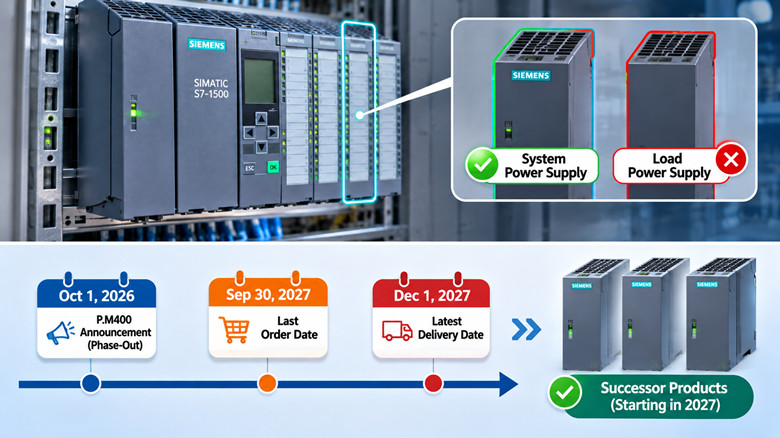
Siemens has moved four SIMATIC S7-1500 and ET 200MP system power supplies into phase-out, and the milestone ladder is now published. The announcement is support entry 110005831 on Siemens Industry Online Support. It sets the P.M400 announcement milestone at 1 October 2026 for the following article numbers: 6ES7505-0KA00-0AB0, 6ES7505-0RA00-0AB0, 6ES7505-0RB00-0AB0, 6ES7507-0RA00-0AB0 and the 6ES7507-0RA00-0AB0-ZC77 variant. Orders for all of them can be placed until 30 September 2027. The latest possible delivery date is 1 December 2027.
I read the notice the way I read any notice that lands on my desk: not as a technology story, but as a line item that has to be funded before a date, by somebody, in a year when the maintenance budget has already been argued over twice. Four power supply part numbers does not sound like much until you count how many cabinets on your site contain one of them and how many of your colleagues could name the part without opening the door.
The successor part numbers are already named, and this is where the notice gets interesting. Only one of them is available today. The other three are planned for the first half of next year.
What Siemens actually announced
The affected products are system power supplies, not load power supplies, and the difference matters when you go looking for them in a cabinet because the two families sit next to each other and look similar from a meter away.
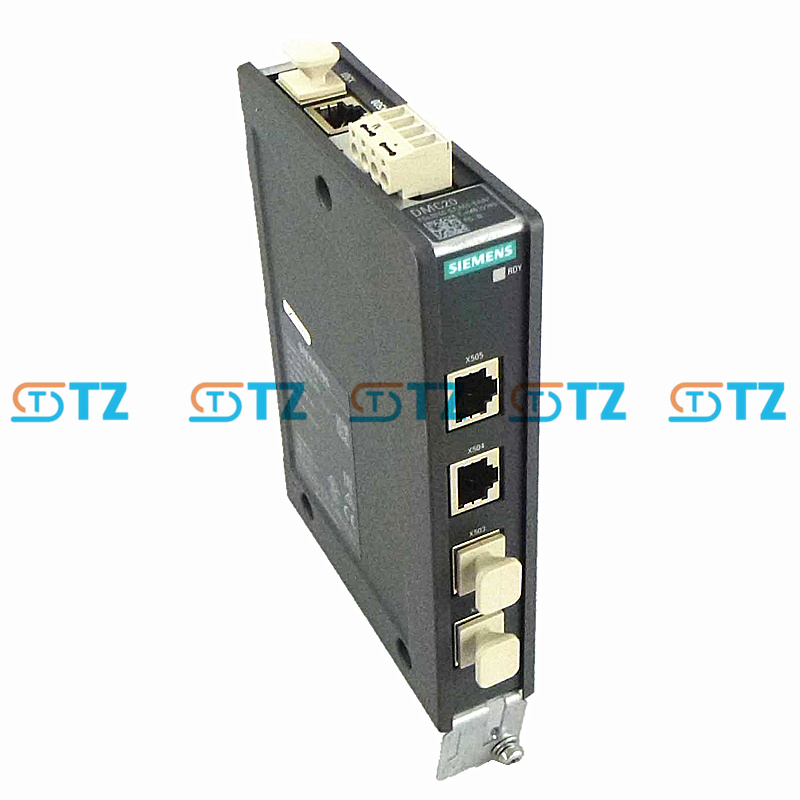
A system power supply feeds the internal electronics of the S7-1500 and ET 200MP modules through the backplane bus. The CPU carries an integrated system power supply of its own, and depending on the configuration up to two additional system power supply modules can be added alongside it. That is the Siemens description in the S7-1500/ET 200MP manual collection, and it is the reason a system power supply that browns out does not take down one module. It takes down the logic of everything on the rail behind it.
The four affected part numbers, as listed in the phase-out entry:
Two things are worth reading twice. The first is that Siemens states the products are being revised and replaced by function-compatible successor products. Revised, not retired into the void. The second is that only the 25 W unit's successor is available now. The 120/230 V AC/DC replacement is planned for the first quarter of 2027, and both 60 W DC units are planned for the second quarter of 2027. Those planned availability dates are stated in the notice itself, so they are not rumours, but they are also plans rather than committed delivery schedules.
For anyone who buys power supplies by the part number rather than by the family name, the practical read is this: the old part number stays orderable as a new part until 30 September 2027, while three of the four replacement part numbers do not start appearing until 2027. Between now and then, if one of these units fails, the old number is still the new-part route. After 1 October 2027 the route changes to the spare parts process, and inside the European Union it changes to repair component only.
The milestone ladder, and what P.M400 really commits Siemens to
Siemens uses a four-step lifecycle ladder, and the same October 2026 wave includes a second notice that spells the definitions out. The ET 200SP interface module announcement, support entry 110006152, states plainly what each milestone means, so there is no need to guess at the abbreviations.
P.M400, announcement of product phase-out, means components up to and including that milestone are still available without restriction as new parts. In other words, the announcement date is not the date your supply dries up. It is the date the clock becomes visible.
P.M410, type cancellation, is the step where a component is only available as a spare part, and where delivery restrictions can attach. That is the 1 October 2027 date in the power supply notice. From that date, the affected power supplies can only be ordered through the spare parts process and, in the EU, only as repair components.
P.M490, discontinuation, is the last step, where nothing can be ordered except for warranty cases. The power supply notice gives a latest possible delivery date of 1 December 2027 rather than a P.M490 date, which is a subtle difference worth noticing. A last delivery date tells you when the factory will stop shipping. It does not tell you when the last unit has already been sold to somebody else.
I have watched three of these cycles now on this site, and the failure mode is always the same. The announcement is read, filed, and considered handled because the order book is still open. Then the failure happens in the last quarter of the final order year, when the secondary market has already noticed the deadline, and the replacement gets bought at a number that would have been refused outright eighteen months earlier.
The successor dates do not line up with the phase-out dates
Here is the part of the notice that I would push up to my own purchasing team this week. The gap between "the old part is still orderable" and "the new part is available" is not a gap at all in one direction and it is a real one in the other.
The PS 25 W 24 V DC replacement, 6ES7505-0KA01-0AB0, is already available according to the notice. That is the easy one. Any cabinet that was specified with the 0KA00 unit has a clean upgrade path with no availability window to worry about.
The PS 60 W 120/230 V AC/DC replacement is planned for the first quarter of 2027. Until that date, a new build or a repair that needs a 6ES7507-0RA00-0AB0 has exactly one new-part route, and it is the part number being phased out. If you are commissioning a machine in the first quarter of 2027 and the drawing calls for this supply, the drawing is still valid, and it will still be valid in September of that year. It simply inherits a deadline it did not have before.
The two 60 W DC units are the awkward ones. Both successors are planned for the second quarter of 2027, which means the better part of two quarters in which the old number is the only new part available and the new number is a plan. That is not a warning about scarcity. It is a warning about quotations, because a distributor who quotes a part number with a planned availability date is quoting an intention, and procurement systems are not built to carry that distinction.
There is also the question of what the replacement parts actually are. The notice calls them function-compatible successors, which in Siemens language means the function is carried over. It does not promise that a cabinet drawing, a spare parts list, an ERP item record, a maintenance procedure or a skills matrix stays untouched. Every one of those artifacts carries the old number, and somebody has to change them. The 25 W unit moving from 0KA00 to 0KA01 is the sort of change that gets made silently in a bill of materials and then discovered two years later when a technician orders the old number from a stale document.
Why a power supply failure looks like a CPU failure
The reason I care about this particular notice more than its size suggests is that system power supply faults are routinely misdiagnosed, and the misdiagnosis is expensive in exactly the wrong direction.
A system power supply that is degrading does not usually announce itself. The module electronics on the backplane stop behaving consistently. You get intermittent communication faults that move from module to module depending on which slot is drawing at the moment. You get a CPU that restarts under load and leaves an entry in the diagnostic buffer that points at the last module to complain rather than at the supply feeding it. You get I/O that drops out for one scan and comes back, which the operator reports as "the machine hiccuped" and which the maintenance log records as an unexplained stop.
The technician arrives, reads the diagnostics, finds a module with a poor signal, and swaps it. The symptom moves. Eventually somebody swaps the CPU, because that is the expensive part everyone suspects. The fault disappears for a while, because the new CPU's integrated system power supply is now carrying a load it was not carrying before, and then it comes back.
What I want on the wall of every maintenance office is a single sentence: if the fault follows the rail rather than the slot, check the supply before you check the modules. It costs twenty minutes with a meter and it saves a CPU.
The other reason this matters for the phase-out is that power supplies are the least documented asset in most plants. Nobody photographs the label on a system power supply when they photograph the nameplate of a CPU. When the notice arrives, the question "how many of these do we have" cannot be answered from memory, and often cannot be answered from the asset register either, because the power supply was never treated as an asset. It came with the cabinet. It is part of the panel, not part of the inventory. That is precisely how a phased-out part number survives in fifty cabinets and appears in no spare parts list.
The HF variant deserves one more line, because it is the one I would most like to have on the shelf. The PS 60 W 24/48/60 V DC HF carries energy buffering for data backup in the CPU, up to 20 MB of retentive data according to the manual collection. That function is the difference between a controlled shutdown and a lost recipe after a mains dip. It is also the least understood of the four units, which makes it the hardest to substitute in a hurry.
The same October wave hit the ET 200SP interface module
The power supplies are not traveling alone. The ET 200SP announcement in the same wave covers the IM 155-6 PN ST interface module in three order numbers: 6ES7155-6AU02-0BN0, the 6ES7155-6AA02-0BN0 bundle, and the 6ES7155-6AW02-0BN0 version for the BaseCarrier.
The dates follow the same shape. P.M400 on 1 October 2026. P.M410 on 1 October 2027, with orders accepted until 30 September 2027 and a latest delivery date of 1 December 2027. From 1 October 2027 the spare parts process applies, and in the EU, repair component only.
Where this notice differs is the long tail and the successor timing. The planned P.M490 for the interface module itself, 6ES7155-6AU02-0BN0, is 1 October 2036, a full ten years after the announcement, which is the pattern Siemens used for the S7-1200 first generation as well. The bundle and BaseCarrier versions show a planned P.M490 of 1 October 2027, meaning the assembled bundle disappears from new-part ordering a decade before the bare module does. If your spares strategy assumes the bundle part number will be around as long as the module, the notice says otherwise.
The successor is the IM 155-6 ST, with a planned start of delivery in April 2027. Siemens describes it as functionally compatible with limitations: the ET connection has limitations, the 6AW02 version also has limitations with the BusAdapter and the Server Module, and the 6AU02 module has limitations with the ET connection and the BusAdapter. "Functionally compatible with limitations" is the phrase to carry into your engineering review, because a limitation on the BusAdapter is a limitation on how the station connects, and a limitation with the Server Module is a limitation on how you service a station without pulling it apart.
For reference, the bundle that is being phased out is described in the Siemens Industry Mall as the PROFINET interface module with hot swap support, up to 32 I/O modules and 16 ET 200AL modules, optional PROFINET strain relief, PN security class 1, supplied as interface module plus server module 6ES7193-6PA00-0AA0 and BusAdapter BA 2xRJ45 6ES7193-6AR00-0AA0. A successor that is compatible with limitations against that feature list is not the same article, and the difference will be found by whoever has to fit it into a running line at two in the morning.
What the EU repair-component rule changes
Both notices carry the same sentence about the European Union, and it is longer than it looks. From P.M410, in the EU, the product may be used exclusively as a spare part to replace an identical component in the event of repair or maintenance. It may not be used to manufacture new products, to expand existing systems, or to construct new systems or parts of them. Distributors are required to pass those conditions down the distribution chain.
For a maintenance department, that is a rule about what the part is allowed to be used for, not about whether you can buy it. Replacing a failed 6ES7507-0RA00-0AB0 with an identical unit in the same panel is a repair. Building a new panel, adding a second rack to an existing machine, or shipping a new machine into the EU with one of these inside after 1 October 2027 is where the compliance question starts.
I have seen this handled badly once, and the cost was not the part. It was the documentation exercise afterwards, when a machine builder had to demonstrate what was fitted to a delivered line. The rule is simple enough to respect: if the cabinet has not been built yet, use the successor. If the cabinet is installed and a supply has failed, you are inside the intended use.
There is a further wrinkle for anyone who thinks that a phase-out announcement is a good moment to buy a lifetime of stock. The order window closes 30 September 2027, the last delivery date is 1 December 2027, and after that the spare parts process governs. Whatever you buy in that window is what you own, because there is no route to buy more later except the secondary market and the repair loop. That is a stocking decision, and it should be made with a failure history rather than with a feeling.
The audit I would run before the year ends
Here is what I would put in front of my own team this quarter. It is not complicated, and it does not need a consultant.
None of that requires a budget. It requires somebody with a torch and an afternoon, and it produces a document that will still be useful when the next wave of notices arrives, which it will.
What I would not do
I would not buy a pallet of system power supplies because a notice crossed my desk. A phased-out part is not automatically a scarce part, and the announcement milestone is followed by a year of unrestricted new-part ordering and, for one of these modules, a spare parts tail that runs to 2036. Stocking is a decision about failure rate, criticality and lead time, not about a date on a notice.
I would also not treat the successor as a like-for-like substitution without reading the compatibility notes. Siemens says function-compatible. The engineering change is small on paper and the shelf-level change is not: drawing, bill of materials, firmware compatibility check in the project, and whatever the panel builder's documentation says.
And I would not let the ET 200SP bundle detail pass unnoticed, because that is the item with a 2027 discontinuation date sitting next to a module that lives until 2036. Anyone who reads the module's ten-year tail and assumes the bundle shares it is going to be surprised in the wrong year.
Questions buyers are asking this quarter
*Are these power supplies discontinued now?* No. Siemens has announced phase-out with effect from 1 October 2026, and they remain orderable as new parts until 30 September 2027 according to the notice, with a latest possible delivery date of 1 December 2027.
*Can I still order 6ES7505-0RA00-0AB0 as a new part?* Yes, inside that order window. Its successor, 6ES7505-0RA01-0AB0, is planned for the second quarter of 2027, so the old number is the new-part route until then, subject to your distributor's own allocation.
*Is the -ZC77 variant a different part?* It is a certificate variant of the 6ES7507-0RA00-0AB0, and it has its own successor, 6ES7507-0RA01-0AB0-ZC77, with the same planned first-quarter 2027 timing. Read the suffix off the label before you order anything.
*What changes for EU customers after 1 October 2027?* The part can be ordered through the spare parts process and used only as a repair component, replacing an identical component during repair or maintenance. It cannot be used to build new products, expand systems or build new systems, and distributors must pass those conditions along.
*Does the ET 200SP IM 155-6 PN ST disappear in 2027?* The bundle and BaseCarrier versions show a planned P.M490 of 1 October 2027, while the 6ES7155-6AU02-0BN0 module shows 1 October 2036. The successor IM 155-6 ST has a planned start of delivery in April 2027, and Siemens describes compatibility as functional with limitations.
*Is the CPU affected?* These notices cover system power supplies and the ET 200SP interface module. The CPUs themselves are a separate lifecycle question and should be checked against their own product lifecycle entry before anyone assumes anything either way.
For plants running SIMATIC hardware and sourcing spares against notices like this one, Siemens PLC and automation parts is the starting point, PLC hardware covers the wider controller and I/O range, and the plant-level view of installed systems is at industrial automation. Whatever you order, read the article number and the suffix off the unit itself first. The notice was written against Siemens' numbers, not against your drawing.

Please read on, stay posted, subscribe, and we welcome you to tell us what you think.


Sitemap | Blog | XML | Privacy Policy
In addition, with your permission, we want to place cookies to make your visit anointeraction with slOC more personal. For this we use analytical and advertisingcookies. With these cookies we and third parties can track and collect yourinternet behawior inside and outside super-instrument.com. With this we and third parties adapt super-instrument.com and advertisementsto your interest. By clicking Accept you agree to this. If you decline, we only usethe necessary cookies and you unfortunately will not receive any personalizedcontent. Please visit our Cookie policy for more information or to change yourconsent in the future.
Accept and continue Decline cookies