Rockwell CompactLogix 5390 launch: what the October 13 announcement actually says
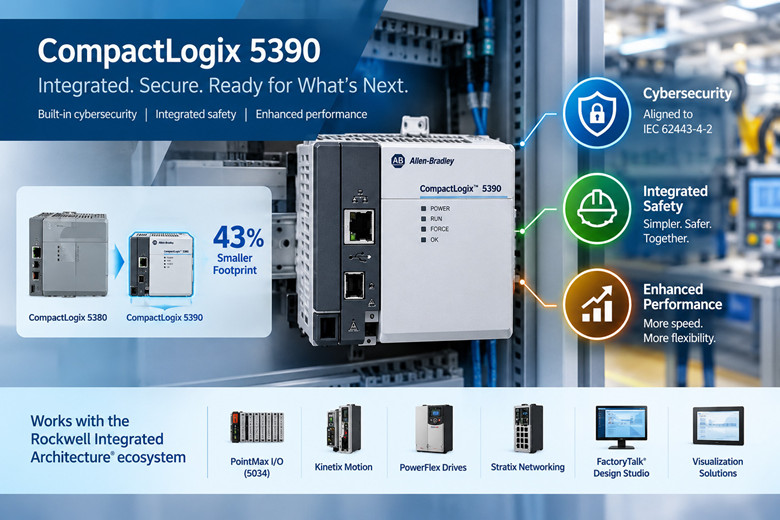
October 28, 2026Rockwell Automation announced the CompactLogix 5390 controller in a press release dated October 13, 2026, issued from Milwaukee through PR Newswire. The document introduces the CompactLogix 5390 as the latest advancement in the company's Integrated Architecture controller family and states its purpose in one line: help machine builders and manufacturers optimize performance, security, safety, data and flexibility. It also makes one number public. The new controller has a footprint 43 percent smaller than previous CompactLogix 5380 controllers.
That is the whole of the quantitative disclosure. Everything else in the release is capability language, a list of products the controller works with, and a quote from a product manager. For a buyer with budget authority, the useful work starts where the release stops.
This analysis separates three things: what Rockwell stated, what those statements imply for a panel layout or a purchase order, and what nobody has published yet. The gaps are not a criticism of the announcement. They are the normal condition of a launch release, and they define the questions a distributor should be able to answer before anyone signs.
The release describes the 5390 as bringing together built-in cybersecurity, integrated safety and enhanced performance in a single control platform. Read that sentence the way a panel builder reads a bill of materials. Three functions that historically arrived as separate boxes are now offered inside one controller envelope, at least according to the marketing.
Security gets a standard attached to it. Rockwell says the controller's capabilities are aligned to IEC 62443-4-2 and describes the product as ready for the EU Cyber Resilience Act. I/O gets a family name: support for local PointMax I/O, which the release says enables more modular architectures.
The physical claim is the one that will end up in a quotation spreadsheet. Rockwell states the 5390 is 43 percent smaller than previous CompactLogix 5380 controllers and connects that reduction to two commercial outcomes, less panel space and more standardized designs across machine families.
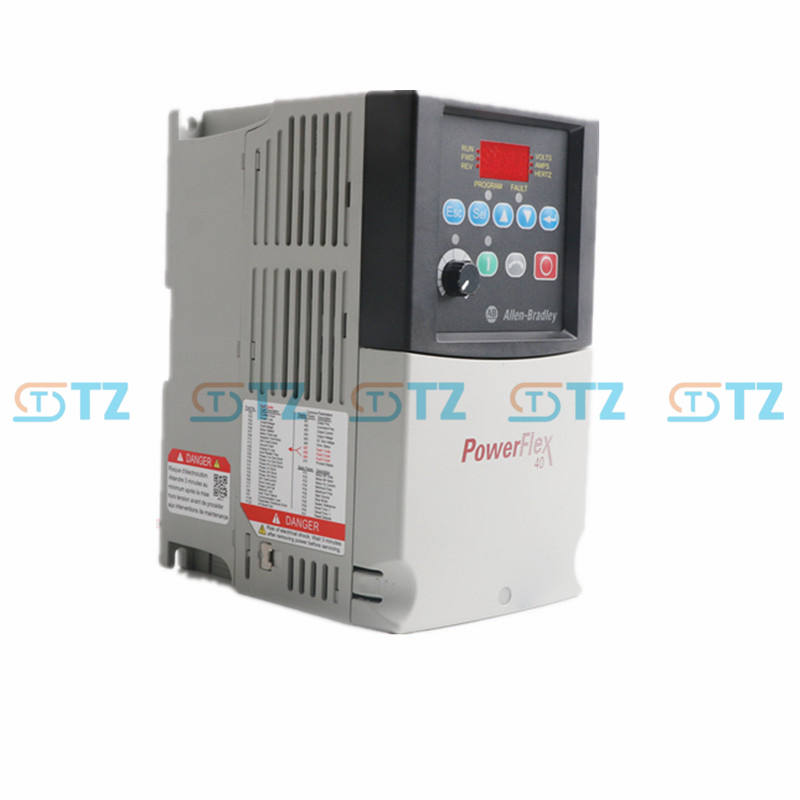
Compatibility is spelled out as a list rather than a diagram. The controller works inside the Rockwell Integrated Architecture ecosystem and integrates with PointMax I/O (5034), Kinetix motion, PowerFlex drives, Stratix networking, FactoryTalk Design Studio software and other visualization solutions.
One quote carries the customer rationale. Siva Iyyamperumal, senior product manager at Rockwell Automation, said customers are being asked to do more than deliver performance and also have to address cybersecurity and safety requirements. The sentence is short and does a lot of framing work. It presents security and safety as buyer requirements that arrived from outside the machine, not as features Rockwell decided to add for their own sake.
Table 1: What the October 13, 2026 Rockwell release states
| Item | What the release says | How to read the statement |
|---|---|---|
| Product | CompactLogix 5390 controller | Named product, new launch |
| Family | Latest advancement in the Integrated Architecture controller family | Positioning, no generation label |
| Stated purpose | Help machine builders and manufacturers optimize performance, security, safety, data and flexibility | Positioning |
| Core capability | Built-in cybersecurity, integrated safety and enhanced performance in one platform | Capability claim, no benchmarks |
| Security standard | Capabilities aligned to IEC 62443-4-2 | Alignment, not a certificate number |
| Regulation | Described as ready for the EU Cyber Resilience Act | Readiness claim, no declaration cited |
| I/O | Support for local PointMax I/O | Capability claim, no module list |
| Footprint | 43 percent smaller than previous CompactLogix 5380 controllers | The only numeric claim in the document |
| Ecosystem | PointMax I/O (5034), Kinetix motion, PowerFlex drives, Stratix networking, FactoryTalk Design Studio, visualization solutions | Compatibility list without part numbers |
| Commercial terms | Not stated | Absent from the release |
The date deserves a note of its own. October 13, 2026 is the manufacturer's own press release date, not a date assigned by a magazine, a distributor or a trade show. When this article refers to the announcement, it means the document Rockwell published that day and nothing later.
Most of the release is context. Three claims change decisions, and each one changes a different decision.
The first is the footprint reduction. Panel space is the constraint that shows up last in a project and costs the most to fix. A controller that occupies 43 percent less footprint than the previous generation gives a designer room for terminal blocks, disconnects or a larger drive without changing the enclosure. Rockwell frames the benefit as standardization across machine families, which is the more valuable version of the claim. A single controller envelope that covers a range of machines means one panel layout, one set of drawings and one spare part held on a shelf.
The second is security carried inside the controller rather than added beside it. For years, a machine that needed network security bought it as a separate appliance, an industrial firewall or a managed switch with filtering. Each of those devices needs its own panel space, its own power, its own firmware process and its own place in a support contract. A controller with security built in changes the architecture discussion, even if the release does not say what the built-in functions actually do.
The third is the combination of safety and standard control on one platform. A machine with safety functions has usually needed either a dedicated safety controller or a safety-rated variant, and the split shows up in programming, wiring and validation. Rockwell's claim that integrated safety sits in the same platform as the control logic points toward a single project and a single tag database. It does not, on its own, tell an integrator what safety integrity level the product reaches. That figure is absent.
Table 2: Claims in the release against evidence published so far
| Claim | Release wording | Verifiable today | Still missing |
|---|---|---|---|
| Smaller footprint | 43 percent smaller than previous CompactLogix 5380 controllers | The percentage itself, as a manufacturer claim | Dimensions, mounting depth, weight |
| Built-in cybersecurity | Capabilities aligned to IEC 62443-4-2 | The standard named, the alignment stated | Certificate, assessed scope, security functions list |
| CRA readiness | Described as ready for the EU Cyber Resilience Act | The claim exists in writing | Declaration of conformity, timeline, covered products |
| Integrated safety | Integrated safety in a single control platform | The phrase in the release | Safety ratings, SIL or PL level, certified function set |
| Enhanced performance | Enhanced performance, no metric | Nothing numeric | Scan times, memory, task capacity, axis count |
| Modular architecture | Local PointMax I/O support | The I/O family named | Module list, channel counts, density, pricing |
| Ecosystem fit | Named integration with motion, drives, network, software | The product families named | Firmware version matrix, software release requirements |
Read the two columns together and the shape of the announcement becomes clear. Rockwell published the direction of travel with enough specificity to be quoted, and held back every figure an engineer would use to size a system. That is a deliberate sequencing choice, and it is common at launch. It also means the trade press, this article included, cannot yet write the sentence that buyers want most: what the thing costs and when it ships.
A footprint figure is an area figure. It describes the panel face the controller occupies, not the volume behind it, and the difference matters when a designer starts moving parts around.
Consider how a typical compact control panel is organized. Wire duct runs horizontally across the back plate and eats usable area before any device is mounted. DIN rail sits between duct runs. Terminal blocks, breakers, relays and a power supply take the lower third. The controller occupies a slot near the top, and the space around it is reserved for cable bend radius and for the clearance a technician needs to land a screwdriver on a terminal. Reducing the controller's face area by 43 percent does not return 43 percent of the panel to the designer, because the clearance zones do not shrink at the same rate.
What it does return is rail length and layout freedom. A narrower controller lets a designer keep a single horizontal rail for the control group instead of breaking the rail and adding a second tier. On a machine where the panel is already at its size limit, that can be the difference between keeping the enclosure and moving up a size, which changes the cutout in the machine frame, the door hardware, the cooling calculation and the shipping weight.
Depth is the other half of the story, and the release says nothing about it. A controller that is smaller on the face but deeper behind the plate can collide with duct or with the back of a door-mounted HMI. Until dimension drawings appear, treat the percentage as a face-area claim and verify depth before committing a layout.
Standardization is the commercial argument, and it is stronger than the space argument. A machine builder who runs four models on one panel architecture spends real money maintaining four sets of drawings, four spare-part lists and four sets of assembly instructions. If one controller covers the range, the bill of materials collapses toward a common core. The 43 percent figure makes that consolidation easier to justify internally, because the smaller envelope fits the smallest machine in the family without forcing a redesign of the largest.
Field note: Do not resize an enclosure on the strength of a press release percentage. Panel thermal performance is driven by total watts dissipated inside the enclosure, not by the footprint of one component. A smaller controller with the same power loss puts the same heat into a smaller box, and the enclosure temperature rise can get worse. Confirm the watt figure and rerun the thermal calculation before you change the enclosure size or the filter arrangement.
The claim that will decide most projects is not in the release at all. Buyers will want to know whether the 5390 fits an existing panel cutout pattern, whether the terminal arrangement is compatible with wiring already documented, and whether a machine built last year can take the new controller without redrawing the layout. None of those answers are published.
Local PointMax I/O support is the least glamorous line in the release and possibly the most consequential for machine design. Local I/O means the slices sit on the controller's own backplane or rail rather than across a network, and that changes where the cabinet boundary falls.
A distributed layout puts a network node in each zone of the machine. That is the right answer for a long line with stations spread over twenty meters, because it shortens home-run cable and lets a station be tested on its own. It is the wrong answer for a compact machine with a single enclosure, where every remote node adds a power supply, a network drop and a device that can fail.
Local PointMax I/O points the design back toward the compact case. Slices stack next to the controller, wiring lands on the same rail, and the whole control group stays inside one enclosure. Rockwell's phrase for this is more modular architectures, which reads as an invitation to build a machine from a small set of repeated I/O blocks rather than a fixed channel count.
The ecosystem list in the release is worth mapping before a project kickoff, because it describes the four interfaces a compact machine actually uses.
Control layer       CompactLogix 5390 controller (announced 2026-10-13)
Local I/O           PointMax I/O, 5034 family
Motion              Kinetix
Drives              PowerFlex
Network             Stratix
Engineering         FactoryTalk Design Studio
Visualization       Rockwell and third-party HMI options
Not published       Catalog numbers, memory, axis count, scan time, price
A scope sequence that keeps a project honest, in the order the decisions actually get made:
Step three is where most compact machine projects lose time. A controller announcement describes a family, and a family supports a range of drives, but the specific pairing is governed by firmware and software versions that the release does not list.
Rule of thumb: If a new controller requires a software version your maintenance team has not installed, budget the training and the first-project learning curve as part of the controller cost. On a single-machine order, engineering time usually exceeds the hardware delta.
Two phrases in the release will be quoted more than any other, and both need parsing.
IEC 62443-4-2 is the part of the IEC 62443 series that sets technical security requirements for industrial automation and control system components. It is written for the product, not for the plant. A vendor that meets it has documented and implemented a set of component-level requirements covering things like account management, integrity protection, confidentiality and event logging.
Rockwell's wording is that the controller's capabilities are aligned to that standard. Aligned is not certified. A certificate naming the product and the assessed scope is a different document from a release sentence, and only the certificate tells a buyer which requirements were assessed and which were excluded.
The EU Cyber Resilience Act is a horizontal regulation covering products with digital elements sold in the EU, and its main obligations phase in from December 2027. Readiness for that regulation is a forward-looking position, not a compliance finding. No product can hold a CRA declaration of conformity before the regime's obligations apply, which is why manufacturers are using the word ready rather than compliant.
For a machine builder shipping into Europe, the practical question is not whether the controller is aligned. It is what evidence the builder can put in a technical file, and what obligations fall on the machine builder rather than the component supplier. Those obligations are split, and the split is exactly what a distributor should be able to explain.
Warning: Treat aligned, ready and certified as three different words with three different meanings. If a quotation, a proposal or a customer specification requires a certified component, ask for the certificate and check that the product name and the assessed scope on it match what you are buying. A press release sentence is not a substitute, and a compliance officer will not accept one.
The security claim also has a design consequence that the release does not spell out. Built-in security only helps if the machine's network architecture uses it. A controller with hardened functions behind an unmanaged switch on a flat network has the same exposure as before. Segmentation, account control and update policy are still engineering work, and they still belong in the project scope.
This section exists because the absence of information is itself information, and because a buyer who assumes the missing details will be available at quotation time usually loses a week.
The release contains no order or catalog numbers. It names product families, not purchasable items. A distributor cannot quote from the announcement, and a maintenance planner cannot add the controller to a spares list using the announcement.
The release contains no memory figures, no axis counts, no scan times and no performance benchmarks of any kind. Enhanced performance is stated without a metric, a comparison or a test condition. Any article that prints a scan time for this controller at this point is guessing.
The release contains no price. It contains no ship date and no availability window. It says nothing about distributor stock, first-allocation quantities or regional launch sequence. Buyers in the Middle East and Europe have no published indication of when the product reaches their channel.
The release contains no end-of-sale date for the CompactLogix 5380. It does not describe the 5390 as a replacement, and it does not put a date on any transition. Anyone who tells you the 5380 stops being orderable on a particular date is repeating something Rockwell has not said.
The release also omits the safety detail that a validation engineer needs: no safety integrity level, no performance level, no certified function list, no statement about which safety I/O families pair with the controller.
None of this is unusual. A launch release is a positioning document written for a trade audience, and Rockwell published the parts that generate coverage. The technical publication, the firmware release notes and the price book come later, on their own schedule.
The release gives a distributor very little to work with, which makes the quality of the answers a useful test of the channel. Bring the I/O count and the axis count with you and ask the following.
Table 3: Buyer questions for a distributor, and why each one matters
| Question | Why it matters | A useful answer looks like |
|---|---|---|
| What is the order number for the configuration I need? | The release has no catalog numbers, so the item cannot be quoted from the announcement | A specific number from a current price book or configurator |
| What is the ship date or availability window? | No date was published, and a project schedule cannot absorb an open one | A dated allocation or a written statement that none exists yet |
| What is the price, including required software? | Controller price alone understates the project if a software upgrade is needed | Line-item pricing with license and support separated |
| Which software version is required, and do I need to upgrade? | Unpublished, and it drives training and validation cost | A version number and a migration note |
| What safety ratings apply, and which safety I/O pairs with it? | The release states integrated safety without a rating | Certified ratings and a compatible I/O list |
| Is there a certificate for IEC 62443-4-2, and what scope does it cover? | Aligned is not certified | A certificate reference and the assessed product scope |
| What is the firmware update and security advisory process? | CRA readiness is a lifecycle position, not a one-time feature | A published advisory channel and update policy |
| What is the status of the 5380, in writing? | No end-of-sale date was announced, and planning needs certainty | A written statement of current lifecycle status |
| Can I get dimensions and a thermal figure now? | The 43 percent claim is a face-area figure | A dimension drawing and a watt figure |
A checklist to take into the meeting:
If a distributor cannot answer the first three items, the conversation is about a future product rather than a purchase. That is a legitimate conversation, but it belongs in a design review, not in a purchase order.
Background first, because it explains why the comparison keeps coming up. The CompactLogix 5380, in the 5069 family, is the compact controller line that many panel builders specify today for machines in the mid range. Rockwell's Integrated Architecture includes Studio 5000 as the engineering environment that programs across the family. Neither of those statements is a specification, and this article does not offer one for either product.
The 5390 arrives beside that installed base, not on top of it. The release says nothing about a replacement, a migration path or a date, and the 5380 remains the line that existing drawings, spare-part lists and maintenance procedures reference.
For a new machine design, the 5390 is worth evaluating on the footprint and security claims alone, provided the missing figures arrive before the layout is frozen. For an existing machine that is already validated and shipping, changing the controller is a project with a validation cost that a smaller footprint rarely repays. For a builder running several machine models on one panel architecture, the standardization argument is the one that can justify the engineering hours.
Spares strategy needs its own decision. A shop that holds one controller per machine family is exposed if a new family enters the mix before the old one leaves. Holding both is a cost, and the cost is smaller when the two share I/O and software, which is a question for the compatibility matrix rather than the release.
Engineering labor is the line item buyers underestimate. A new controller in a plant means a software version decision, a programming standards review, a validation pass on safety functions and a training session for the people who will troubleshoot it at two in the morning. None of those costs appear on a quotation, and all of them land on the project.
Bottom line: The CompactLogix 5390 is a credible direction with a thin public record. The footprint claim is specific enough to plan around once dimensions arrive. The security and safety claims are specific enough to start a compliance conversation, not to close one. No price, no ship date and no 5380 transition date have been published, so any budget built this month rests on assumptions that should be written down and dated.
A news analysis is only as useful as its separation of confirmed fact from expectation. The public record after the announcement is short enough to set out in full.
2026-10-13   CONFIRMED   Press release issued from Milwaukee via PR Newswire
2026-10-13   CONFIRMED   Product named: CompactLogix 5390 controller
2026-10-13   CONFIRMED   Claim: 43 percent smaller footprint than the 5380
2026-10-13   CONFIRMED   Claim: IEC 62443-4-2 alignment, CRA readiness wording
2026-10-13   CONFIRMED   Claim: local PointMax I/O support
Not stated   UNKNOWN     Order and catalog numbers
Not stated   UNKNOWN     Memory, axis count, scan time, task performance
Not stated   UNKNOWN     Price, currency and regional pricing
Not stated   UNKNOWN     Ship date or availability window
Not stated   UNKNOWN     Distributor stock and first allocation
Not stated   UNKNOWN     End-of-sale or transition date for the 5380
The confirmed column is short, and it is still enough to act on. Designers can start a layout study. Compliance teams can open a question about certificates. Procurement can ask for a written availability position. Maintenance planners can note that a new family exists and resist the urge to standardize on it before the price book confirms it is orderable.
The unknown column is where the risk sits, and it is not a small risk. A machine project that assumes an availability window and a price will either slip or absorb a change order. A panel layout that assumes a depth will be redrawn. A compliance file that cites a press release will be rejected.
What the announcement does establish is direction. Rockwell is putting security and safety into the compact controller rather than selling them as adjacent products, and it is using panel space as the commercial argument for consolidation. Both moves point toward fewer boxes in a cabinet and a shorter bill of materials.
Whether that direction reaches a given machine this year depends on documents Rockwell has not published. Until they appear, the correct posture is interest with a written list of open questions, and a quotation that names exactly which assumptions it rests on.

Please read on, stay posted, subscribe, and we welcome you to tell us what you think.


Sitemap | Blog | XML | Privacy Policy
In addition, with your permission, we want to place cookies to make your visit anointeraction with slOC more personal. For this we use analytical and advertisingcookies. With these cookies we and third parties can track and collect yourinternet behawior inside and outside super-instrument.com. With this we and third parties adapt super-instrument.com and advertisementsto your interest. By clicking Accept you agree to this. If you decline, we only usethe necessary cookies and you unfortunately will not receive any personalizedcontent. Please visit our Cookie policy for more information or to change yourconsent in the future.
Accept and continue Decline cookies