Rockwell Retires the FLEX I/O ControlNet Adapter: October 31 Last Sale, No Successor Named
October 13, 2026*Industry news | October 12, 2026*
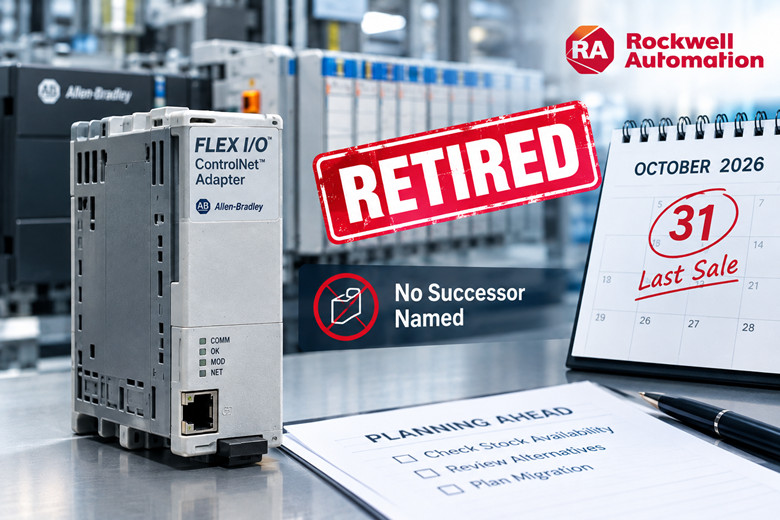
Rockwell Automation has set October 31, 2026 as the discontinuation date for the FLEX I/O ControlNet adapter, and there is no successor product named. The affected part numbers are 1794-ACN15, the standard ControlNet adapter, and 1794-ACNR15, the redundant-media version.
That gives a plant roughly three weeks from today to place a last-time buy. After that, the adapter comes off the shelf in Rockwell's catalog, and the only route to a replacement is whatever distributors and independent suppliers still hold in stock.
A stopped line does not care how clever the migration plan is. It cares that the adapter on the shelf fits. So the October 31 date is not an engineering footnote, it is a purchase order deadline, and it arrives in three weeks.
Read the rest of the picture before you decide how much stock to buy. The ControlNet adapter is one part in a wider FLEX I/O retirement cycle, and the lead times on what remains tell you how much slack you actually have.
The date that matters is October 31
October 31 is the last day the 1794-ACN15 and 1794-ACNR15 can be ordered from Rockwell. The product page carries lifecycle status End of Life with that discontinuation date, and the wording is direct enough to leave no room for interpretation: "Rockwell Automation announces that as of October 31, 2026, the Flex ControlNet Adapter will be discontinued and no longer available for sale. Customers are encouraged to remove references to the affected product(s)."
That last sentence is the one worth reading twice. Rockwell is telling you to scrub the part number from your drawings, your bills of material and your maintenance procedures. It is not telling you what to put in its place.
The replacement category on the product page is "Engineering Replacement." That is a specific and unhelpful phrase for anyone who owns this hardware. A functional replacement drops in and does the same job. An engineering replacement means the job can still be done, but the design changes, and the people who do the design work are not the ones holding the maintenance budget.
No successor part number is listed. That is the detail that should drive your purchasing decision this month.
When a vendor names a replacement, you can plan around it. You read the data sheet, you check the dimensions, you order one for the bench and you find out what breaks. When the replacement field is blank, you are the one writing the migration plan, and you are doing it without a vendor telling you which way to go.
For a plant that keeps legacy ControlNet running because it works and because the capital was approved in a different decade, this is the moment where the platform question lands on the desk. Either you buy shelf stock to extend the life of what you have, or you accept that the ControlNet footprint is now on a countdown that you have not defined.
The countdown is real either way. Rockwell has stopped selling. Every adapter in the field is now one failure away from being a problem you cannot buy your way out of at the usual channel.
What is going out of production, and what is not
The retirement does not touch every FLEX I/O adapter at once, and the gaps between the dates matter more than the dates themselves. Here is the model list, with what each one means for the shelf.
The two ControlNet adapters go first, and they go together. The XT variant, the one built for hot, cold and dirty conditions, gets an extra fourteen months and a named destination. The EtherNet/IP adapter gets almost two more years and a clean functional replacement.
That pattern is not random. The platform is not being killed in one stroke. It is being retired from one network protocol at a time, and ControlNet is at the front of the queue.
If you keep both a standard ControlNet adapter and an XT unit in the same plant, which is common on sites with a mix of climate-controlled panels and outdoor or washdown enclosures, the two are not on the same clock. Do not let one date blur into the other during a budget conversation. The XT users have a named successor and more time. The standard ControlNet users have neither.
The EtherNet/IP side is the part of the answer that is still comfortable. The 1794-AENTR is Active Mature and Rockwell posts a 5 day lead time. That is not a part that is about to strand you. It is a part you can order through normal channels and get in the same week.
The reason that matters here is that the EtherNet/IP adapter is the natural landing spot if the plant moves off ControlNet. It exists, it ships fast and it is not on a discontinuation list. That combination gives you an option, and the option costs less sleep than the blank field next to the ControlNet part.
Start with what a FLEX I/O adapter actually does. One adapter connects up to eight FLEX I/O modules to the network. On the ControlNet side, that traffic runs on ControlNet V1.5. The adapter is the single point where a rack of I/O either talks to the controller or goes dark.
One adapter, up to eight modules, one network connection. When that adapter fails, you do not lose one input point. You lose the whole rack.
That is the number to hold onto when you are deciding how many to buy. The exposure per adapter is not the cost of the adapter. It is everything wired through it.
Why a 73-day lead time makes this worse than it looks
The 1794-ACN15 product page lists an estimated lead time of 73 days. Seven hundred and thirty hours of waiting, and that is Rockwell's own estimate on a part that is being discontinued in three weeks.
Sit with that for a moment. The last date to order is roughly three weeks away. The lead time to receive is roughly ten and a half weeks.
Those two numbers do not line up, and that mismatch is the whole story. An order placed on the last day of October does not arrive in October. It arrives somewhere in the first half of January, if the estimate holds.
That is the trap in a last-time buy. People hear "last order date" and picture a firm deadline they can work backward from. In practice, a last-time buy is a commitment to wait, and you place it before you know what the next twelve months of failures will look like.
For a maintenance planner, this changes the shape of the decision. You are not choosing between buying now and buying later at the same price and the same availability. You are choosing between securing stock at a known lead time and gambling that nothing in the rack fails while the channel is closing behind you.
A 73 day lead time is also a signal about the supply chain behind the part. Long lead times on end-of-life hardware usually mean the part is built to order, or drawn from shrinking inventory, or subject to allocation. None of those conditions improve after the discontinuation date. They get worse, then they get scarce, then the only stock left is what is already sitting on shelves.
The EtherNet/IP adapter's 5 day lead time sits right next to that 73 day figure on the same catalog, and the contrast is the point. One is a part you can order this afternoon. The other is a part you commit to months in advance to receive it at all.
The practical reading is straightforward. Availability after October 31 is not a question of price. It is a question of whether anyone still holds the part. Distributor stock and independent suppliers are the channel, and that channel thins every month.
If you have a critical rack, the lead time is the argument for acting this month rather than in the first week of November. The difference between ordering on October 24 and ordering on November 3 is not three percent of a purchase order. It is the difference between Rockwell's supply chain and whatever is left in the secondary market.
If you need help locating what is still available, discontinued Allen-Bradley parts is a reasonable place to start a search, and it is worth doing it before the last sale date passes rather than after.
The two realistic paths: keep the platform, or move to EtherNet/IP
Once the adapter is gone from the catalog, the plant has two honest options. Everything else is a variation on one of them.
The first path is to keep the platform. You buy enough adapters to carry the ControlNet racks through the horizon you are willing to plan for, you store them properly, and you keep running. This path does not require a capital project, a controller change or a shutdown window. It requires a purchase order and a shelf.
The cost of this path is the shelf itself. Adapters that sit for years draw no power and cost nothing to hold, but they tie up working capital, they have to be stored somewhere dry and stable, and someone has to keep track of them. The benefit is that a failure on a Tuesday afternoon becomes a fifteen minute swap instead of a production event.
The second path is to move to EtherNet/IP. This is where the plant stops treating ControlNet as a permanent fixture and starts treating it as a project. The 1794-AENTR exists, it is Active Mature, it ships in about 5 days, and it is the adapter the FLEX I/O platform is heading toward.
Moving means more than changing the adapter. The controller side has to speak the same protocol, the network layout changes, the addressing changes, and the people who maintain the system have to learn a different set of tools. That is why this path is a project and not a purchase order.
It is worth being clear about the size of the gap. ControlNet V1.5 and EtherNet/IP are different networks with different cable plants, different topology rules and different diagnostics. A rack does not migrate by swapping one card. The rack has to be rehosted on a network that the rest of the control system may or may not already speak.
For some plants, that work is already underway. Any site that has been modernizing its control layer for the past decade probably has an EtherNet/IP backbone somewhere, and the FLEX racks are the last ControlNet island still connected. For those sites, the discontinuation is a schedule nudge, not a crisis.
For other plants, the FLEX I/O ControlNet racks are the backbone. They were installed as the smart, flexible option at the time, and the rest of the plant grew up around them. For those sites, the second path is a genuine capital conversation, and the first path is the one that keeps the lights on while that conversation happens.
The practical answer for most operations is a blend. Buy shelf stock for the adapters that carry the racks you cannot afford to stop, and start the engineering work on moving the racks that are either less critical or already near a planned outage.
The one thing the blend is not, is free. Every month you spend deciding is a month the last-time-buy window is shorter, and the price and availability of whatever is left in the secondhand channel is a moving target.
If you are weighing both paths, Rockwell Automation spares is a useful reference point for what is still being sourced and supplied in the aftermarket, so you can price the stock side of the decision against the project side.
What an unplanned adapter failure actually costs the operation
This is where people want a number, and this is where a responsible article refuses to give one. Downtime cost depends entirely on the plant, and any single figure quoted here would be invented, wrong for your site and useless as a budgeting input.
Here is how to build your own number instead.
Start with your line rate or your product throughput, whatever unit you already track output in. Multiply by the value of that output. That gives you the cost of an idle hour.
Now add the labor that stands around while the line is down. Add the restart cost, which for some processes is real scrap and for others is hours of warm-up and re-qualification. Add overtime if you recover the lost volume with extra shifts.
The result is your cost per stopped hour. That is the number that belongs in the decision, and it is a number only you can calculate.
Then do the arithmetic that matters. If the adapter is on the shelf, the failure costs you a swap: call the electrician, power down the rack, change the card, power up, verify. A couple of hours on the wide end, often less.
If the adapter is not on the shelf, the clock keeps running. You call your suppliers, you find out nobody has immediate stock, you wait. Now add the freight cost of an expedited shipment, and the premium that any scarce part commands when the seller knows you need it today.
That gap between a swap and a wait is the entire justification for holding spares. It is also the number that makes a shelf of adapters look cheap.
The 73 day lead time on the 1794-ACN15 turns a normal supply order into a production event. A part that is normally a next-week purchase becomes, after October 31, a part that might not be purchasable at all at the price or speed you are used to.
There is a second cost that is easy to forget. A rack that has lost its adapter takes its up to eight I/O modules offline with it. If those modules feed a safety interlock, a batch recipe or a quality measurement, a "two hour electrical fix" can turn into a batch rejection or a quality hold that outlasts the repair by a wide margin.
That is why the spares question is never really about the adapter. It is about the rack, and the rack is about whatever the plant does with the signals.
If you have never built a downtime cost figure for your own site, do it now, while the part is still purchasable. It is much easier to justify a stock purchase with a real number on a spreadsheet than with a feeling that spare parts are probably a good idea.
For plants keeping older platforms alive, legacy PLC hardware is often the practical source for the parts the original vendor no longer sells, and knowing your source before a failure is part of the same calculation.
A spares audit you can run this week
This is a walk-the-floor exercise and it does not need a project code. The goal is a single honest number: how many 1794-ACN15 and 1794-ACNR15 adapters your site actually depends on.
Start at the panel. List every FLEX I/O rack that has a ControlNet adapter. For each one, write down the panel name, the process it serves, and whether the process is critical or can wait. Do not skip the awkward ones in remote corners of the plant; those are the racks most likely to be forgotten during planning and most painful to reach during a failure.
Now count the adapters. Note whether each one is a 1794-ACN15 or a 1794-ACNR15. If your site uses redundant media anywhere, the ACNR15 count is the one to watch, because both versions share the same October 31 discontinuation and neither has a named successor.
Next, check your own storeroom before you check anyone else's. Some sites are sitting on adapters they bought years ago and never recorded. A shelf count is free information, and it can change your whole buying plan in an afternoon.
Then compare what you need against what you hold. The gap between those two numbers is what you are buying this month.
As you go, note the failures. If an adapter has failed in the last couple of years, write down why. An adapter does not fail in isolation. Heat, vibration, dirty power and loose backplane connections all take a toll, and a rack with a history of failures will keep failing after the catalog closes. Racks with clean histories are the better candidates for the longer migration timeline.
Two more things go on the audit sheet.
First, list the XT racks separately. The 1794-ACNR15XT runs to December 31, 2027 with a named replacement in the 5094-AENTRXT, so it is a different line item with a different urgency. Mixing it into the standard ControlNet count will either overstate or understate your exposure.
Second, write down who owns the decision. Every last-time-buy that stalls does so because the maintenance department wants the stock, the finance department wants the justification, and nobody wrote down whose signature is on the purchase order. Fix that before the last week of October.
Once the audit sheet is done, the buying decision is arithmetic, not opinion. You know how many racks you carry, how many adapters you hold, and how many months of coverage you want. Multiply the gap by the unit cost, present it against your own downtime cost figure, and the conversation with finance runs itself.
Do the audit this week even if the answer is "we already have enough." The audit is cheap. Finding out you were short is expensive.
If your audit turns up gaps you need filled fast, industrial automation spares is the kind of source to have on standby before the deadline, not after it.
The rest of the FLEX I/O lifecycle picture
Zoom out, because the ControlNet adapter is not the only date on the calendar, and a plant that only reacts to this one will be doing the same exercise again in a year.
Here is the sequence, in the order it arrives.
Read that as one continuous retirement of the FLEX I/O adapter family, protocol by protocol. ControlNet first, in two waves, with the standard adapters leading and the XT variant following fourteen months later. Then the oldest EtherNet/IP adapter, the 10BaseT version, with a functional replacement already named and a target two years out.
The destination is consistent. Every retired adapter points, directly or eventually, at the EtherNet/IP side of the platform. The 5094-AENTRXT is the named replacement for the XT ControlNet adapter. The 1794-AENTR is the named replacement for the 1794-AENT. The 1794-AENTR itself remains Active Mature, shipping in about 5 days, with no retirement date announced.
The pattern tells you what the platform wants to be. FLEX I/O stays. ControlNet goes. EtherNet/IP is where the racks are expected to land.
For a maintenance manager, that pattern is more useful than any single part number. It means the migration plan you write today, whether it finishes next year or in five years, has one obvious direction. It also means the 1794-AENTR is the part you should understand now, because it is the adapters' future, and it is the one part in this whole family that is still easy to buy.
Be precise about what Rockwell has and has not announced, because imprecision here costs money. What is documented is the sales discontinuation and the dates above. Rockwell has not announced an end of repair, an end of support, or a cut-off for spare parts through its own service channels. Do not let anyone in your next planning meeting claim otherwise.
What the discontinuation does mean is concrete enough. The part is no longer sold. Availability becomes a question of existing stock. And the farther you get from October 31, the thinner that stock gets and the more the secondary market sets the price.
That is the whole reason to treat the date as a purchase order deadline. It is not the day the part dies. It is the day the part stops being an order and starts being a search.
Three weeks is not much runway, but it is enough to run the audit, count the racks, and place the order while the part is still a part number in a catalog rather than an inquiry to a supplier. The plants that will come out of this cleanly are the ones that spend the next week on the floor with a clipboard, not the ones that will spend the first week of November on the phone.
The calendar is set. The successor field is blank. The only variable left is how many you decide to put on the shelf.

Please read on, stay posted, subscribe, and we welcome you to tell us what you think.


Sitemap | Blog | XML | Privacy Policy
In addition, with your permission, we want to place cookies to make your visit anointeraction with slOC more personal. For this we use analytical and advertisingcookies. With these cookies we and third parties can track and collect yourinternet behawior inside and outside super-instrument.com. With this we and third parties adapt super-instrument.com and advertisementsto your interest. By clicking Accept you agree to this. If you decline, we only usethe necessary cookies and you unfortunately will not receive any personalizedcontent. Please visit our Cookie policy for more information or to change yourconsent in the future.
Accept and continue Decline cookies