Siemens vs Mitsubishi PLC 2026: Which Brand Offers Better Value?
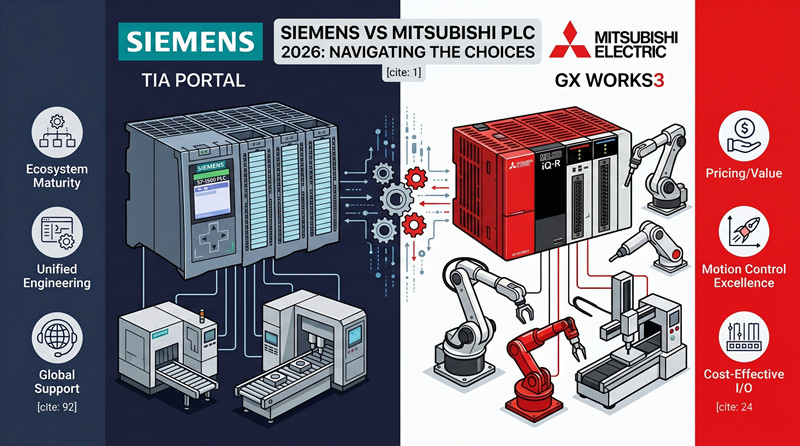
May 11, 2026Siemens and Mitsubishi Electric represent two distinct poles of the global PLC market. Siemens dominates European and Asian process industries with its TIA Portal ecosystem. Mitsubishi holds significant market share in Japanese manufacturing and cost-sensitive OEM applications across Asia.
This comparison cuts through the brand loyalty and focuses on what engineers and procurement managers actually need to know: which platform delivers better value for your specific application.
Siemens' SIMATIC S7-1500 series represents its premium offering. The S7-1500 1515-2 PN sits in the mid-range with 2MB program memory and execution speeds competitive with Allen Bradley's ControlLogix. For OEM applications, the S7-1200 series delivers a compact, cost-effective entry point.
Key differentiators for Siemens hardware:
· Technology CPUs (T variants): Built-in motion control functions eliminate separate motion modules for many applications
· ET200SP: Ultra-compact distributed I/O with push-in terminals and auto-configuration
· PROFINET: Native deterministic Ethernet with superior real-time performance compared to EtherNet/IP
· Integrated display: S7-1500 CPUs include an onboard display for diagnostics without a PC
Mitsubishi's MELSEC iQ-R series targets mid-to-high-end applications, competing directly with Siemens S7-1500. The iQ-R R04EN offers 400KB program memory with execution speeds matching or exceeding similarly-priced Siemens CPUs.
Key differentiators for Mitsubishi hardware:
· MELSEC iQ-F (FX5): Compact PLC with built-in EtherNet, positioning itself between Siemens S7-1200 and S7-1500 in price/performance
· CC-Link IE: Mitsubishi's proprietary gigabit Ethernet backbone with superior bandwidth for high-speed data exchange
· Multiple CPU architecture: iQ-R allows multiple CPUs (PLC, motion, CNC) on the same base, sharing memory natively
· Cost-effective I/O: Mitsubishi's I/O pricing undercuts European competitors significantly
Specification | Siemens S7-1500 1515-2 PN | Mitsubishi iQ-R R04EN
Program Memory | 2 MB | 400 KB (+ 256 KB standard RAM)
Bit Execution | 0.05 μs | 0.02 μs
Max I/O Points | 262,144 | 256,000
Ethernet Ports | 2 x 1 Gbps | 2 x 1 Gbps
Built-in Motion | Yes (T variant) | Via iQ-R Motion CPU
Typical Price | $3,000 - $4,500 | $2,200 - $3,500
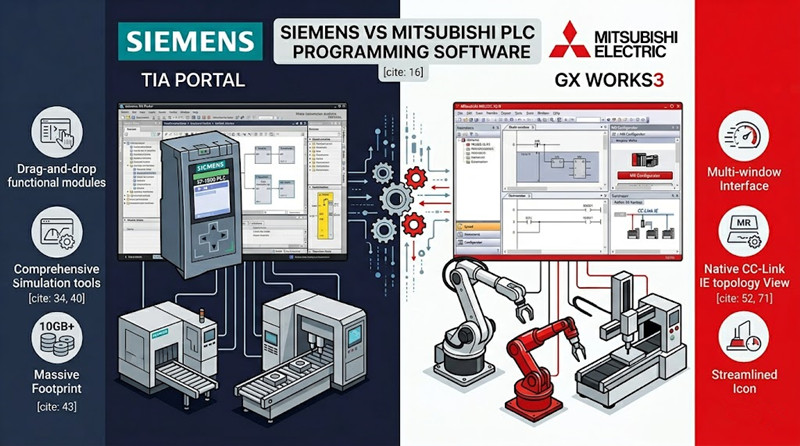
TIA Portal is Siemens' unified engineering environment, covering configuration, programming, simulation, and HMI design for the entire S7 portfolio. The Basic version is free for S7-1200 projects—a significant advantage for learning and small deployments.
Professional version licensing runs $2,000 to $10,000 depending on scope, making it more accessible than Studio 5000 for mid-sized operations.
Strengths:
· Unified environment for PLC, HMI, and drive configuration
· Excellent simulation tools for offline testing
· Integrated safety programming (F-CPU) in same environment
· Strong PLC simulation without hardware
Weaknesses:
· Large software footprint (10GB+ installation)
· Can feel slow on standard hardware
· Complex licensing structure for multi-user environments
GX Works3 programs the entire MELSEC iQ-R, iQ-F, and Q series from a single environment. Pricing is substantially lower than Siemens or Allen Bradley—full configuration packages often come included with hardware purchases from distributors.
Strengths:
· Included with most hardware purchases at no extra cost
· Simple project structure for straightforward applications
· Excellent motion control integration via MR Configurator
· Smaller installation footprint than TIA Portal
Weaknesses:
· Less mature simulation compared to TIA Portal
· Documentation quality varies—some functions lack clear explanations
· Smaller community compared to Siemens/Allen Bradley
For applications requiring precise motion, the platforms diverge significantly.
Siemens S7-1500 T CPUs integrate motion control natively. Configuring a servo axis requires defining the technology object in TIA Portal and calling the standard MC instructions in the PLC program. The integrated approach reduces cabinet hardware but ties you to Siemens drives for best performance.
Mitsubishi separates motion control into dedicated motion CPUs (RD77 or iQ-R Motion CPU) that coexist with the standard PLC CPU on the same base. This multi-CPU architecture means the PLC and motion controllers run independently, preventing motion functions from affecting PLC scan time. Mitsubishi's servo systems (MR-J4, MR-J5) offer excellent performance at competitive prices.
If your primary concern is motion control, Mitsubishi's dedicated motion approach often wins for multi-axis applications. For integrated PLC+motion on simple machines, Siemens T-CPUs are compelling.
Both platforms support standard industrial Ethernet, but the ecosystems differ.
Siemens fully commits to PROFINET as its primary industrial Ethernet protocol. For connections to third-party devices, Siemens offers flexible PROFINET interfaces. Modbus TCP/IP is also supported for legacy integration.
Mitsubishi supports CC-Link IE (its own gigabit industrial Ethernet), EtherNet/IP, and Modbus TCP/IP. CC-Link IE provides excellent performance within pure Mitsubishi ecosystems but requires additional configuration when integrating third-party devices.
If your facility already runs EtherNet/IP, both platforms work—but Mitsubishi may require additional configuration modules.
Mitsubishi has superior distributor coverage in Asia and strong presence in Japanese-owned manufacturing worldwide. Pricing tends to be more competitive for cost-sensitive projects.
Siemens dominates European industrial automation with the most extensive distributor and integrator network globally. Technical support quality in Europe and North America is generally excellent.
For global companies with mixed regional operations, Allen Bradley or Siemens often serve as the standard due to their global support infrastructure.
Choose Siemens if:
· Your operation is in Europe or Asia with strong Siemens distributor support
· You value integrated PLC+motion control (T-CPU) for simple machines
· TIA Portal's free S7-1200 tier fits your scale
· PROFINET infrastructure is already in place
Choose Mitsubishi if:
· Cost is a primary constraint
· Your facility uses Japanese equipment or has Japanese engineering staff
· You need multi-axis motion control at competitive pricing
· CC-Link IE ecosystem already exists
Siemens and Mitsubishi both deliver capable platforms. Siemens wins on ecosystem maturity, global support, and integrated engineering tools. Mitsubishi wins on pricing and motion control value.
For European process industries, Siemens is the natural choice. For Asian manufacturing and cost-sensitive OEM applications, Mitsubishi deserves serious evaluation. Either platform outperforms entry-level options—final selection should hinge on existing infrastructure, support availability, and total cost of ownership rather than hardware specifications alone.
Q: Is Mitsubishi PLC programming harder than Siemens?
A: Not inherently. GX Works3 uses similar IEC 61131-3 languages (ladder, structured text, function block). The learning curve depends more on documentation quality than platform complexity. Siemens' more comprehensive online resources give it an edge for self-learners.
Q: Can Mitsubishi PLCs communicate over EtherNet/IP?
A: Yes. Mitsubishi offers EtherNet/IP adapter modules and some CPUs have native EtherNet/IP support. Setup requires configuration of assembly instances but is well-documented.
Q: Which platform is better for simple packaging machines?
A: Mitsubishi iQ-F (FX5) or Siemens S7-1200 both excel for compact machines. Mitsubishi typically undercuts on hardware cost; Siemens offers better simulation tools. For OEMs building many identical machines, Mitsubishi's lower per-project cost adds up quickly.
Q: Do Mitsubishi PLCs support OPC UA?
A: Yes. MELSEC iQ-R and iQ-F series include OPC UA server functionality built into the CPU—no additional hardware or license required. Siemens charges for OPC UA licenses on S7-1500.
Q: What industries typically use Mitsubishi PLCs?
A: Japanese manufacturing (automotive, electronics, semiconductor), packaging equipment OEMs, and Asian process industries. Mitsubishi also has strong presence in building automation and water treatment globally.
· [Siemens PLCs](https://www.tztechio.com/siemens) — S7-1500, S7-1200, S7-300
· [Mitsubishi PLCs](https://www.tztechio.com/mitsubishi) — MELSEC iQ-R, iQ-F, MELSEC-Q
· [Industrial Motors & Drives](https://www.tztechio.com/allen-bradley) — VFDs and servo drives

Please read on, stay posted, subscribe, and we welcome you to tell us what you think.


Sitemap | Blog | XML | Privacy Policy
In addition, with your permission, we want to place cookies to make your visit anointeraction with slOC more personal. For this we use analytical and advertisingcookies. With these cookies we and third parties can track and collect yourinternet behawior inside and outside super-instrument.com. With this we and third parties adapt super-instrument.com and advertisementsto your interest. By clicking Accept you agree to this. If you decline, we only usethe necessary cookies and you unfortunately will not receive any personalizedcontent. Please visit our Cookie policy for more information or to change yourconsent in the future.
Accept and continue Decline cookies