Schneider Modicon vs Siemens SIMATIC: Which PLC Platform Wins for Process Automation?
June 01, 2026The Schneider Modicon vs Siemens SIMATIC decision hits process automation buyers harder than most platform selections. A refinery expansion in Kuwait, a chemical batch plant in Germany, or a municipal water treatment upgrade in Texas — all demand a PLC backbone that handles analog-heavy I/O, runs redundant architectures without downtime, and integrates with instrumentation installed years before the control system was even specified. Both Schneider Electric and Siemens position their high-end process controllers as purpose-built for these environments. The Modicon M580 ePAC and the SIMATIC S7-1500 family each carry decades of pedigree in continuous and batch process control. Choosing wrong means re-engineering the I/O topology mid-project or locking into a supply chain your procurement team cannot sustain.
---
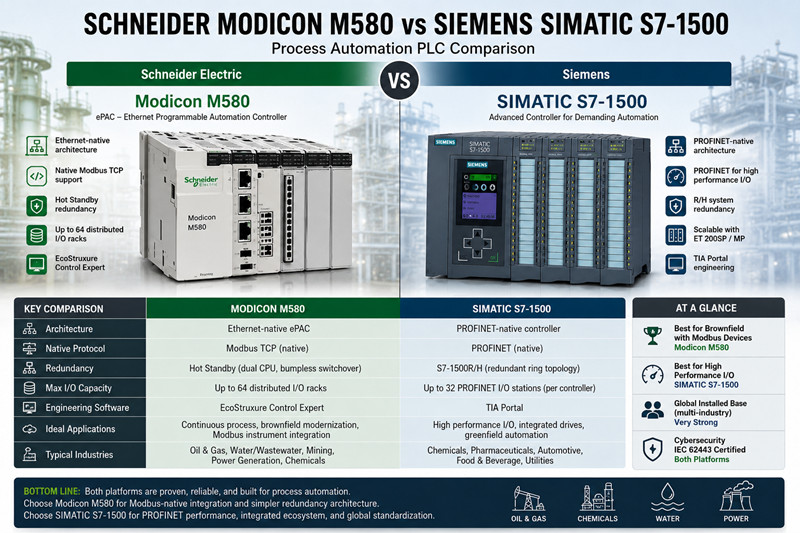
Schneider Electric's Modicon brand is the original PLC — the Modicon 084 shipped in 1969 and established the programmable controller category. Today, the Modicon M580 (part number BMEP584040 for the high-end CPU) anchors Schneider's process offering under the EcoStruxure architecture. The M580 is marketed as an ePAC — Ethernet Programmable Automation Controller — with native Ethernet backplane connectivity and the ability to run control loops across distributed I/O without a centralized rack. Below the M580, the Modicon M340 serves mid-range applications where redundancy is optional and project budgets are tighter. Both use EcoStruxure Control Expert (formerly Unity Pro) for configuration and programming.
Siemens SIMATIC answers with the S7-1500 family, led by CPUs like the 6ES7516-3AN02-0AB0 (CPU 1516-3 PN/DP). The S7-1500 sits above the compact S7-1200 and replaces the legacy S7-300/400 lines that dominated process installations for two decades. Siemens pairs the S7-1500 with the ET 200SP and ET 200MP distributed I/O families, and all engineering happens inside TIA Portal (Totally Integrated Automation Portal). For process-specific workloads, Siemens offers the S7-1500 Redundant (R/H) controllers and the dedicated S7-1500 Software Controller for virtualized deployments.
The philosophical split matters. Schneider built the M580 from the ground up as an Ethernet-native process controller with Modbus TCP woven into its DNA. Siemens treats process as one workload among many on the S7-1500, with PROFINET as its primary industrial protocol and Modbus TCP supported through function blocks rather than native silicon. That difference ripples through every engineering decision downstream.
---
A gas processing facility in Qatar upgrading from legacy Modicon Quantum hardware faces a straightforward migration path to the M580. Schneider's Quantum-to-M580 conversion tooling preserves the original Control Expert application logic, and the M580's Ethernet backplane lets the team reuse existing Quantum I/O modules through X80 drop adapters. The CPU BMEP584040 handles up to 64 distributed I/O racks — enough for a mid-size gas plant with roughly 4,000 I/O points. The native Modbus TCP support means existing flow computers and gas chromatographs with Modbus interfaces connect without protocol converters.
On the same project type, a Siemens SIMATIC S7-1500 with the 6ES7516-3AN02-0AB0 CPU would require PROFINET instrumentation or Modbus TCP function blocks (Siemens' MB_CLIENT/MB_SERVER instructions in TIA Portal). For greenfield Middle East installations where the EPC contractor specifies PROFINET field instruments — common on projects with European engineering firms — the S7-1500 integrates natively. Saudi Aramco's 2025 automation standards accept both platforms, but projects tied to German or Austrian EPC houses lean Siemens while French and Italian EPC specifications tilt toward Schneider.
A specialty chemicals plant in Ludwigshafen running IEC 61511 safety instrumented functions pushes both platforms to their limits. Modicon M580 safety CPUs (BMEP582040S) run TÜV-certified SIL2 safety logic alongside the process control program on the same hardware. The EcoStruxure Control Expert safety library includes pre-certified function blocks for emergency shutdown, burner management, and overfill protection — exactly what batch chemical operations need for regulatory compliance.
Siemens counters with the S7-1500 F-CPUs (6ES7516-3FN02-0AB0) that handle safety and standard programs in separate, isolated memory partitions. TIA Portal includes the Safety Advanced add-on, and Siemens' SIMATIC PCS 7 process control system layers on top of the S7-1500 for full DCS functionality when the application outgrows standalone PLC control. BASF and Bayer facilities across Germany, Switzerland, and the Benelux region run predominantly Siemens infrastructure, so the integrator ecosystem and spare parts availability tilt the decision toward SIMATIC regardless of pure technical merit.
A 40 MGD water treatment plant in Houston evaluating both platforms in 2026 highlights the North American dynamic. Schneider Modicon has deep penetration in US water utilities — many plants adopted Modicon Quantum in the 1990s and early 2000s during EPA-mandated SCADA upgrades. The M580's Hot Standby redundancy pairs two CPUs with bumpless switchover in under one PLC scan cycle, critical for continuous chlorination and pump control where any interruption risks a boil-water notice.
Siemens S7-1500R/H redundant configurations match this capability, but fewer US water system integrators specialize in TIA Portal compared to the Schneider-trained workforce. The practical factor: a plant maintenance electrician in Ohio who troubleshoots Modicon ladder logic 40 hours a week represents an installed base advantage that Schneider leverages heavily in municipal RFPs.
---
EcoStruxure Control Expert is a single-purpose process automation IDE. Schneider invested heavily in the IEC 61131-3 structured text and function block diagram editors optimized for continuous control — PID loops, analog scaling, totalizer blocks, and alarm management. The software feels purpose-built for process engineers rather than general automation programmers. Control Expert's Derived Function Blocks (DFBs) let users encapsulate standard control strategies (e.g., a three-element boiler drum level control) into reusable, version-controlled library elements that carry across projects.
TIA Portal is broader. It unifies PLC, HMI, drive configuration, and SCADA under one engineering framework. For process automation, this breadth cuts both ways. A controls engineer configuring a complex batch sequence in TIA Portal can drag the same PROFINET drive onto the network view they use for the PLC program — genuinely faster than toggling between separate tools. But TIA Portal's process-specific libraries are less mature than Control Expert's. Siemens addresses this gap with the PCS 7 overlay and the SIMATIC Process Device Manager, but those are additional licenses and training investments beyond the core TIA Portal package.
Schneider's ePAC redundancy model uses two physically identical M580 CPUs connected over an Ethernet Hot Standby link. The secondary CPU mirrors the primary's program memory and data tables in real time. On a primary failure, the secondary assumes control with scan cycle bumpless transfer — the I/O modules see the same controller identity and continue operating. Schneider's RIO (Remote I/O) drops support dual Ethernet connections, so the redundant pair connects to every I/O rack through independent network paths.
Siemens S7-1500R/H uses PROFINET ring topology for redundancy. Two CPUs connect through a sync fiber link, and the PROFINET ring connects both controllers to all I/O stations. If a cable breaks or a CPU fails, the ring automatically re-routes communication. Siemens' approach reduces the total Ethernet switch count compared to Schneider's dual-star topology, but requires careful ring dimensioning for larger installations where cumulative latency across dozens of I/O stations approaches the cycle time budget.
In practice, both architectures deliver sub-100ms switchover. The deciding factor is usually which topology the plant's existing network team is comfortable maintaining at 3 AM.
The protocol debate runs deeper than a spec sheet checkbox. Modicon M580 speaks Modbus TCP natively — the CPU's Ethernet stack includes a hardware Modbus parser that handles register reads and writes at wire speed. For process installations with Modbus flow meters, power monitors, and VFDs (which covers roughly 70% of brownfield process sites globally), the M580 eliminates protocol translation gateways entirely. Each I/O scan cycle pulls Modbus register data from field devices without additional programming.
Siemens S7-1500 uses PROFINET as its native protocol. PROFINET provides deterministic real-time I/O updates with sub-millisecond jitter — superior to Modbus TCP for high-speed discrete applications. For process automation, PROFINET's advantage manifests in instrument diagnostics: a PROFINET-compatible pressure transmitter pushes device health data (diaphragm rupture detection, electronics temperature, calibration drift) to the PLC automatically via the PROFINET device model. Modbus instruments require the PLC to poll diagnostic registers explicitly. Siemens' installed base of PROFINET-native instrumentation from Endress+Hauser, VEGA, and Siemens own SITRANS line gives the S7-1500 a richer plug-and-produce experience when the project specifies those vendors.
Both platforms carry IEC 62443-4-2 host device certifications as of 2026. Schneider Modicon M580 earned EDSA (Embedded Device Security Assurance) certification from ISASecure, covering the CPU firmware, Ethernet backplane communications, and the Control Expert engineering workstation link. The M580's Application Whitelisting feature locks the CPU to execute only digitally signed firmware and application code — preventing unauthorized program modifications even if an attacker compromises the engineering workstation.
Siemens S7-1500 holds IEC 62443-4-2 SL1 certification with the S7-1500 Security Integrated firmware package. Siemens' approach emphasizes defense-in-depth: CPU-level access control lists, signed firmware updates, and integration with SINEC NMS (Network Management System) for centralized security monitoring across the plant floor. The S7-1500's built-in VPN server allows encrypted remote access for integrator support without exposing the control network to the internet.
For Middle East projects with mandatory IEC 62443 requirements driven by national cybersecurity authorities (NCA in Saudi Arabia, DESC in Dubai), both platforms satisfy the compliance checklist. The differentiator is the integrator's familiarity with hardening each platform beyond the certification baseline.
---
Approximate pricing for equivalent process CPU configurations in 2026:
· Modicon M580 BMEP584040: $5,200–$6,800 depending on distributor and volume
· Siemens SIMATIC 6ES7516-3AN02-0AB0 (CPU 1516-3 PN/DP): $4,800–$6,200
· Modicon M340 BMXP342030 (mid-range, non-redundant): $2,100–$2,800
· Siemens S7-1500 6ES7513-1AL02-0AB0 (CPU 1513-1 PN, compact): $2,400–$3,100
Lead times fluctuate. In Q2 2026, Schneider M580 CPUs ship in 8–12 weeks from French manufacturing; Siemens S7-1500 CPUs run 10–14 weeks from German production. Both platforms saw extended lead times during the 2022–2024 semiconductor shortage, with gradual normalization through 2025 and 2026. Tztechio.com carries inventory of both Schneider and Siemens PLC hardware, with select M580 and S7-1500 CPU models available for immediate dispatch from regional warehouses.
EcoStruxure Control Expert licenses start around $2,500 for a single-seat development license. TIA Portal Professional V18 runs $3,200–$5,500 depending on the license bundle. Siemens also charges annual Software Update Service (SUS) fees, while Schneider uses perpetual licensing without mandatory maintenance — a factor that accumulates meaningfully over a 15-year asset lifecycle.
Q: Can I mix Modicon M580 I/O with Siemens S7-1500 CPUs?
No, the backplane protocols are incompatible. Modicon X80 I/O communicates over Schneider's Ethernet backplane protocol; Siemens ET 200SP/MP I/O uses PROFINET. You can bridge the two systems at the network level using Modbus TCP or PROFINET gateway modules, but mixing I/O on the same CPU backplane is not supported.
Q: Which platform is easier for a process engineer who doesn't program full-time?
EcoStruxure Control Expert is the more process-centric environment. The function block library includes pre-built PID, lead/lag, ratio, and totalizer blocks that map directly to process control terminology. TIA Portal requires more navigation to reach equivalent process functions. If your team consists of chemical engineers who learned PLC basics on the job, the Schneider tooling has a shallower initial learning curve.
Q: What's the real-world difference between ePAC redundancy and S7-1500R/H?
Both achieve bumpless switchover under one scan cycle for typical process applications. The Modicon ePAC dual-star topology uses more Ethernet switches but isolates network faults cleanly. The S7-1500R/H ring topology uses fewer switches but requires the entire ring to re-converge on a cable break. For plants with existing Siemens network infrastructure, the ring approach saves hardware cost. For greenfield installations where network design flexibility matters, the two are functionally equivalent.
Q: Does Schneider still support the old Modicon Quantum in 2026?
Yes. Schneider Electric maintains Quantum support through the EcoStruxure Control Expert compatibility mode and active spare parts production. However, new Quantum CPUs are no longer manufactured — Schneider's stated migration path is the M580 with Quantum I/O adapters. If your plant runs Quantum and the control strategy hasn't changed in 15 years, budget for an M580 migration within the next 3–5 years before spare part availability becomes constrained.
Q: Which platform wins on cybersecurity for Middle East NCA compliance?
Both platforms hold IEC 62443-4-2 certification and satisfy NCA and DESC baseline requirements. Siemens has more extensive documentation in Arabic and a larger in-region cybersecurity consulting practice. Schneider has deeper installed base in Saudi oil and gas, which translates to more field-validated security configurations. The tiebreaker is usually which vendor's local team provides the compliance documentation package faster during the project's FAT phase.
Q: Will my Siemens S7-300/400 program migrate to the S7-1500?
Partially. TIA Portal includes an S7-300/400 migration tool that converts STEP 7 projects, but process-specific function blocks (especially PID and APL library blocks from PCS 7) require manual rework. Expect 60–80% automated conversion for discrete logic and 30–50% for process control code. Budget engineering hours accordingly. Schneider Quantum-to-M580 migration follows a similar pattern — Control Expert converts the application structure automatically, but the I/O mapping and communication configuration require manual review.
-----------------------------------------------------------------------------------------------------------------------------------------------------------------
TZ Tech is a professional supplier for industrial automation and electrical parts, as well as some instrumentation, telecommunication parts. We mostly sell the ready stock of distributor, with competitive price and short lead time. Even discontinued parts we may also can supply as we have a large inventory here.
We understand what you concern, so we will ensure the quality. We strictly screen the components you require, so you don’t need worry about any quality issues with the goods you receive. For specialized parts that have long since been discontinued, we will sincerely inform you the actual condition of the goods. All brand new parts we will support 1 year warranty.
If you need any related parts, please feel free to send an inquiry. Our staff will support quick response within 6 hours. (except weekend here)

Please read on, stay posted, subscribe, and we welcome you to tell us what you think.


Sitemap | Blog | XML | Privacy Policy
In addition, with your permission, we want to place cookies to make your visit anointeraction with slOC more personal. For this we use analytical and advertisingcookies. With these cookies we and third parties can track and collect yourinternet behawior inside and outside super-instrument.com. With this we and third parties adapt super-instrument.com and advertisementsto your interest. By clicking Accept you agree to this. If you decline, we only usethe necessary cookies and you unfortunately will not receive any personalizedcontent. Please visit our Cookie policy for more information or to change yourconsent in the future.
Accept and continue Decline cookies