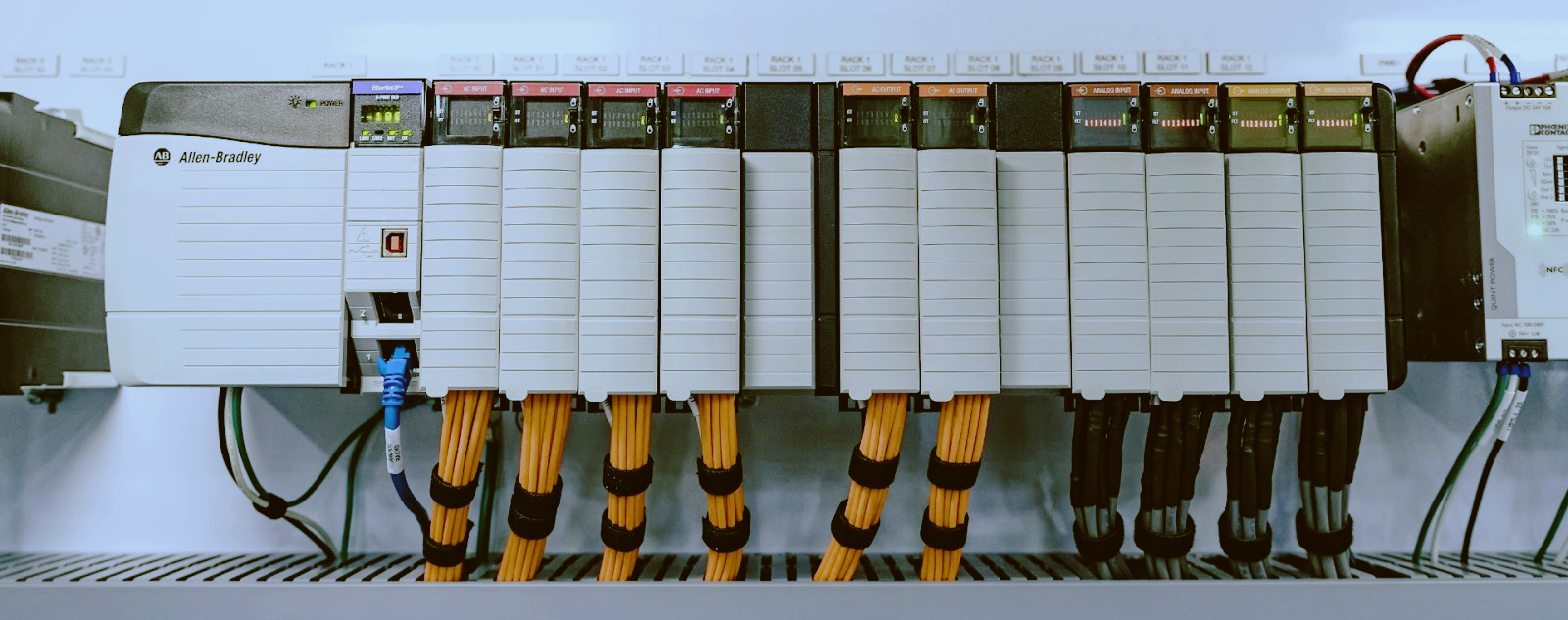
Mitsubishi FX3U Phase-Out: Last Order Date for FX3U and FX3UC Is March 31, 2028
September 10, 2026*Industry news | September 7, 2026*
Mitsubishi Electric has put an end date on the MELSEC-F FX3U, the micro PLC that has run a large share of the world's small machines since it launched in 2004. In Technical Bulletin FAM-A-0116-B, "Production Discontinuation of the MELSEC-F FX3U/FX3UC Series Models and Extension Models," issued in April 2026 and updated as Version B in May 2026, Mitsubishi sets out the formal wind-down: make-to-order production begins January 1, 2028, order acceptance closes March 31, 2028, production stops September 30, 2028, and repair support continues until September 30, 2035. The official bulletin PDF is public on Mitsubishi's technical news page.
The schedule matters well beyond the PLC industry's usual end-of-life notices. The FX3U is not a niche controller. Since 2004 it has been the default brain inside packaging lines, labeling machines, small water-treatment skids, HVAC panels, gate and valve controls, and OEM-built machines that ship to every market on earth, and it became the flagship of the MELSEC-F micro family. When a platform with that installed base gets a final order date, the news reaches past Mitsubishi's catalog into the spares strategy of every plant that still runs one.
The practical summary for buyers and maintenance engineers: normal catalog ordering of FX3U and FX3UC products continues through 2027. From January 1, 2028, Mitsubishi builds these models only to order, and the last day a new order can be accepted is March 31, 2028. Units ordered in that window will be produced in the months that follow, and new production ends September 30, 2028. Repair support then runs seven years, to September 30, 2035, with one exception: the FX3U-128ASL-M, developed jointly with Anywire Corporation, gets only about one year of repair support after production stops.
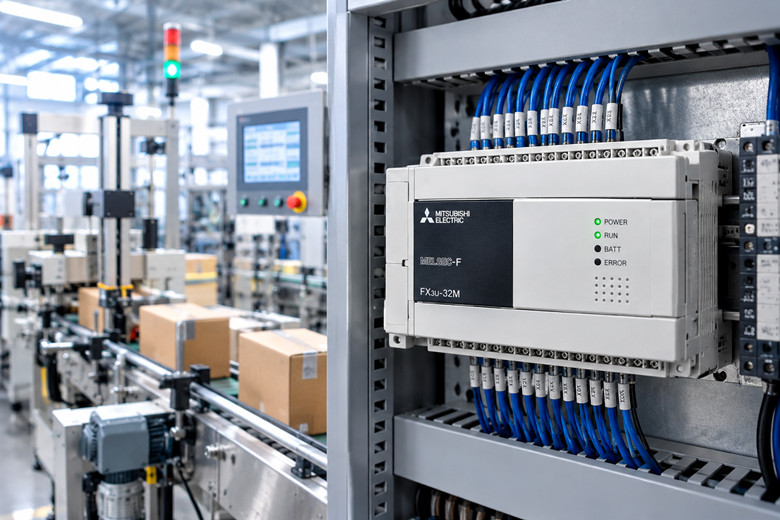
Mitsubishi's stated reason is the one that ends most long-lived electronics: the supply chain ran down. The bulletin says production parts for the target models have been discontinued one after another, making it hard to maintain production, and that the manuals for the target models will be discontinued as well.
The FX3U announcement is the latest step in a broader contraction of legacy MELSEC hardware. Through 2026 Mitsubishi set a September 30, 2026 final order deadline for the high-speed Universal Q CPUs under bulletin FA-A-0418-A and moved the MELSEC-L series to make-to-order under bulletin FA-A-0466-A. The pattern: Mitsubishi is concentrating development and production on current platforms, chiefly the MELSEC iQ-F (FX5) series for the small-machine class, giving each legacy family a defined, published end rather than an open-ended availability promise.
None of this makes the FX3U a bad controller or existing machines obsolete next year. It puts a clock on new supply, and the window to buy new units and stock spares for machines that will run into the 2030s is finite and published. For anyone who maintains FX3U equipment, the time to plan is now.
Milestone | Date | What it means in practice
Make-to-order production starts | January 1, 2028 | Mitsubishi stops building FX3U/FX3UC and related extension products for stock. Orders continue to be accepted, but production runs to order.
Last date for order acceptance | March 31, 2028 | Final day Mitsubishi will accept new orders for the affected models. After this date, no new orders can be placed through normal channels.
Production discontinuation | September 30, 2028 | Manufacturing ends. Orders placed before March 31 are produced in the intervening months; after this date there is no new production at all.
End of repair support, standard models | September 30, 2035 | Seven years after production discontinuation. Repair requests are handled within this window, subject to repair parts availability.
End of repair support, FX3U-128ASL-M | About September 30, 2029 | The AS-Link master module co-developed with Anywire Corporation gets roughly one year of repair support after production stops, about six years less than the rest of the family.
The arithmetic from the date of this article makes the urgency concrete. As of September 7, 2026, roughly nineteen months of order acceptance remain: about fifteen months of normal catalog ordering through the end of 2027, followed by the three-month make-to-order window from January 1 to March 31, 2028. Orders placed by March 31 will be built in the six months between the order deadline and the September 30 production stop.
For repair planning, the same arithmetic gives a nine-year repair horizon from today for standard models, ending September 30, 2035. The FX3U-128ASL-M is the outlier, with support ending around September 30, 2029, roughly three years from now; any site running that module should treat it as the first item in a spares review. The precise answer to "when is the FX3U discontinued": order acceptance ends March 31, 2028, and new production ends September 30, 2028; everything after that runs on inventory, old stock, and the repair channel.
The bulletin's coverage is broad, a sign of how deep the FX3U ecosystem ran. It covers FX3U main units across their power-supply variants, FX3UC connector-style main units, the FX2N and FX3U and FX3UC extension hardware that bolted onto those CPUs, the programming and communication accessories, and the memory cassettes many sites use for program storage.
Mitsubishi groups the affected FX3U main units by power supply type; the example model numbers below come from its own replacement guidance.
Affected group | Suffix types covered | Example models named in the bulletin
FX3U AC-powered main units | /ES types | FX3U-32MR/ES, FX3U-64MT/ES, FX3U-80MR/ES
FX3U DC-powered main units | /DS and /DSS types | Covered by the bulletin's model lists
FX3U UA1 types | UA1 variants | Covered by the bulletin's model lists
The /ES AC-powered family is the one most readers will recognize, since it accounts for the majority of FX3U machines wired to AC mains. The /DS and /DSS DC-powered variants cover installations that feed the controller from a 24 V DC bus, and the UA1 types are additional voltage variants Mitsubishi sold into specific markets; all are folded into the same discontinuation.
The example models show the shape of the affected range. FX3U-32MR/ES is the 32-point relay-output main unit that became the default controller for small machines; FX3U-64MT/ES is its 64-point transistor-output sibling for higher-speed applications; and FX3U-80MR/ES shows the bulletin reaching into the larger main units. Picking these three as worked examples signals that the phase-out covers the mainstream of the family, not just the edges.
The FX3UC is the connector-style compact version of the family, built for machines where panel space is tight and connector wiring replaces screw terminals. The bulletin covers the DC-powered FX3UC main units across their point sizes and suffix variants.
Affected group | Point sizes | Suffix types covered | Example model named in the bulletin
FX3UC DC-powered main units | 16, 32, 64, and 96 point | /D, /DS-T, /DSS, and /DS-TS types | FX3UC-64MT/D
FX3UC machines are common in compact OEM equipment where the connector format keeps wiring tidy and replacement fast. The FX3UC-64MT/D example anchors the replacement guidance: Mitsubishi maps it directly to the FX5UC-64MT/D, preserving the connector-style form factor in the migration path.
The affected list goes beyond main units. Because the FX3U system grew by extension, the bulletin covers the extension hardware many installations carry, and it reaches back into the FX2N catalog: FX3U installations frequently mix FX2N extension units with FX3U main units on the same DIN rail, which is why the extension list includes FX2N 32-point-class I/O units among other items.
Equipment class | What is affected | Notes
I/O extension units and extension models | FX2N, FX3U, and FX3UC I/O extension units and extension models | Includes FX2N 32-point-class I/O units; covers the modules used to grow systems beyond the main unit's onboard I/O
Programming and communication cables | FX-422CAB-150 and related cables | The cable family used to link PCs and programming tools to FX-series PLCs
Signal converters | FX-USB-AW | The USB signal converter used in PC-to-PLC programming and diagnostic setups
Memory cassettes | FX3U-FLROM-64L and FX3U-FLROM-1M | Mitsubishi lists no alternative models for these cassettes
The memory cassette item deserves special attention. The FX3U-FLROM-64L and FX3U-FLROM-1M are the flash memory cassettes that plug into FX3U main units for program storage and ROM operation, and the bulletin states that there are no alternative models for them, a stronger statement than a usual replacement note. Sites that use cassettes as their program backup method, or that run programs from ROM mode, will need an engineering answer rather than a purchasing one, because no direct successor exists.
For maintenance teams, the practical consequence is simple. The FX-422CAB-150 cable and the FX-USB-AW converter are what an engineer reaches for when a laptop has to talk to an FX3U for programming or diagnostics, and when they leave the catalog the everyday service loop changes. Buy the spares needed before the order deadline; the last-order clock applies to cables and converters just as it does to CPUs.
Mitsubishi's recommended alternatives are the MELSEC iQ-F series: FX5U, FX5UJ, and FX5UC, a recommendation it has made consistently for years. The iQ-F line is the stated successor platform for the small-machine class, and it moves engineering onto GX Works3 software rather than the GX Works2 environment that FX3U users know. The example mappings below are the bulletin's most useful guidance for engineers planning a changeover.
Existing FX3U model | Direct FX5 replacement | Alternative configuration in the bulletin
FX3U-32MR/ES | FX5U-32MR/ES | FX5UJ-40MR/ES
FX3U-64MT/ES | FX5U-64MT/ES | FX5UJ-60MT/ES plus FX5-8EYT/ES
FX3U-80MR/ES | FX5U-80MR/ES | Not listed
FX3UC-64MT/D | FX5UC-64MT/D | Not listed
/MS sink-triac output variants | /MT transistor units plus external relay adapter boards | FA-TH16YSR20S relay adapter, with FA-CBL10(Y)M20 accessories in some mappings
Read the table the way a design engineer would. The cleanest migrations are the direct ones: an FX3U-32MR/ES becomes an FX5U-32MR/ES with the same point count, relay output type, and model-number shape. The FX5UJ alternatives are the economy track: FX5UJ is the slim, cost-oriented entry point of the iQ-F line, and the bulletin shows a 40-point FX5UJ-40MR/ES absorbing a 32-point FX3U application. For the 64-point case, it pairs a 60-point FX5UJ-60MT/ES with an FX5-8EYT/ES eight-point extension to reach the needed I/O count.
The /MS mapping is the one that surprises people. The /MS sink-triac output variants were used where outputs had to switch AC loads without relay wear. In the iQ-F world, the bulletin routes those applications to /MT transistor-output units plus external relay adapter hardware, specifically the FA-TH16YSR20S relay adapter board with FA-CBL10(Y)M20 accessories in some mappings. In plain terms, the AC-switching function moves out of the PLC onto an external relay board driven by standard transistor outputs, and specifying that change means checking load currents, switching frequency, and panel space, because the external board occupies real estate the old triac outputs did not.
Three engineering realities sit behind every row of the mapping table. First, the iQ-F platform programs in GX Works3, not GX Works2; ladder written for the FX3U does not load into an FX5 as a finished program, and programs that lean on FX3U-specific modules or cassette-based ROM operation need the most rework. Second, the FX5U family adds capabilities the FX3U never had, including built-in Ethernet on the FX5U main units. Third, the FX5UC keeps the connector-style form factor for FX3UC users, so the mounting philosophy survives even where the program does not. For a Mitsubishi PLC parts buyer, migration is a project with an engineering budget, not a swap order, which is why starting before the 2028 deadline matters.
The FX3U installed base will not disappear in 2028. Machines built on FX3U controllers will keep running for a decade or more after production stops, because PLCs are retired when the machine is retired, not when the catalog changes. What the bulletin changes is the supply equation around those machines.
Consider the timeline from the plant floor. A machine bought new in 2026 has a repair-support horizon to September 30, 2035, roughly nine years from today, and an older machine has the same horizon. The bottleneck is not the repair window; it is new supply. After March 31, 2028, the only sources of new FX3U units are distributor inventory that has not sold, and after September 30, 2028, the only sources of any FX3U hardware are old stock, the used market, and the repair channel. None of those scale to cover a plant that finds a failed CPU in 2030 with no spares on the shelf.
That is the trap for the unprepared. The FX3U will not fail all at once in 2028; it will fail one machine at a time through the 2030s: a power supply after a surge, an output module after a shorted actuator, a CPU after years of heat cycling. Each failure is a trivial fix while new parts are available and a scheduling problem when they are not. The phase-out converts a routine spares question into a finite procurement window that closes March 31, 2028.
For OEMs the stakes are different but just as real. Any OEM still designing new machines around the FX3U in 2026 and 2027 is committing those machines to a platform whose order book closes in under two years. A machine program launched in 2027 with a five-year production run will need FX3U hardware until 2032, four years after Mitsubishi stops building it. That math requires either a large upfront spares buy or a mid-run platform change, the most expensive kind. The bulletin is effectively a design-freeze notice for OEMs: new-machine designs should move to the iQ-F line before the window closes, while existing FX3U-based products need a documented last-buy plan.
The phase-out does not force a single answer; it forces a decision, machine by machine. The keep-running case is strong for equipment that is mechanically sound and far from the end of its useful life: it needs a spares plan, not a new controller. The migration case is strong for machines that are already retrofit candidates, need new connectivity, or have outgrown the FX3U.
Factor | Lean keep running | Lean migrate to FX5
Machine remaining life | Five or more years of sound mechanical life | Machine already near retrofit or replacement
Spares position | Clean path to stock CPU, I/O, and accessories before March 31, 2028 | No budget or appetite for a last-buy stock position
Program complexity | Simple ladder, well documented, easily re-created if lost | Heavy use of FX3U-specific modules, cassettes, or AS-Link hardware
Connectivity needs | Standalone machine, current communications are enough | Plant now demands Ethernet, data collection, or remote access
Engineering resources | No in-house GX Works3 experience and no migration budget | Staff ready to move to GX Works3 and revalidate programs
FLROM cassette use | None, or program stored only as a file backup | ROM-cassette operation is part of the design, and there is no cassette alternative
The keep-running economics deserve a fair hearing. Stocking a spare CPU, a spare I/O module, and the accessories a machine needs is inexpensive relative to a migration, which carries engineering time, program conversion, revalidation, panel rewiring, documentation updates, and the risk of startup problems on a machine that was running fine before. For a healthy machine with simple control requirements, the last-buy spares route is frequently the lower-cost, lower-risk answer. The catch is that the last-buy has a deadline: March 31, 2028.
The migration case wins when the machine is already a retrofit candidate. If the plant is re-engineering the panel anyway, putting in an FX5U instead of buying a last FX3U costs little extra and resets the clock: the FX5 platform is current, its production is not under an end-of-life notice, and its repair horizon starts fresh. Migration also wins on capability, since FX5U main units bring built-in Ethernet and the iQ-F line is where Mitsubishi's development effort is concentrated. A plant that standardizes on iQ-F ends up with one engineering environment, GX Works3, instead of maintaining GX Works2 skills solely for an aging fleet.
The wrong answer is doing nothing until 2028 and letting the calendar make the decision. A plant that waits until January 2028 to start an audit will be placing last-buy orders in the same quarter it is trying to evaluate migrations, with order books tightening and no time for a second round of purchasing. Every machine in the fleet should carry an explicit keep-running or migrate label, with a date attached, before the make-to-order period begins.
Mitsubishi's repair support runs to September 30, 2035 for standard FX3U and FX3UC models, seven years after production discontinuation. That commitment is the reason the phase-out is not an immediate obsolescence event. But a repair-support window is not a guarantee that every failed board can be fixed on demand. Repairs depend on the availability of repair parts, and the bulletin's own rationale, components discontinued one after another, is the constraint that governs the repair channel as well. As the years pass, repair will get slower and less certain for the oldest modules, worth factoring into spares math rather than assuming effortless coverage for seven full years.
The FX3U-128ASL-M exception is the sharpest detail in the bulletin and the easiest to miss. The module, an AS-Link master unit developed jointly with Anywire Corporation, receives only about one year of repair support after production stops, placing its cutoff around September 30, 2029. A co-developed product depends on a partner's supply and service commitments, which run on a different clock than Mitsubishi's own hardware. Any site with FX3U-128ASL-M modules in service should treat them as the highest-priority spares item in the audit: one spare bought before the order deadline costs far less than a network master failure in 2031 with no repair path and no successor on the shelf.
There is also a documentation angle. The bulletin states that the manuals for the target models will be discontinued. Wiring guides, programming references, and special-function module documentation should be downloaded and archived before they disappear from Mitsubishi's documentation servers; archived manuals are cheap insurance, and the one asset in this phase-out that does not expire if you grab it now.
The bulletin rewards early action, and most of the actions are cheap today. A practical checklist for any plant or OEM running FX3U or FX3UC hardware:
1. Pull the installed-base list. Count every FX3U and FX3UC CPU, note the exact model and suffix (which determines AC or DC power, output type, and point count), and flag machines with FX2N extension units, FLROM cassettes, or an FX3U-128ASL-M.
2. Match your models against bulletin FAM-A-0116-B. The PDF is public; confirm every module you run is in scope, including extension units and accessories that are easy to forget.
3. Label every machine keep running or migrate, with an owner and a date, before the end of 2026.
4. Build the spares list for keep-running machines now: CPUs, I/O modules, power-related spares, an FX-422CAB-150 cable, an FX-USB-AW converter, and anything else the service kit needs. Price it while normal ordering is open.
5. Treat the FX3U-128ASL-M as urgent. Its repair support ends around September 30, 2029, about six years before the rest of the family, and a spare should be on order well before March 31, 2028.
6. Resolve the FLROM question. The FX3U-FLROM-64L and FX3U-FLROM-1M have no alternative models, so cassette-based program storage is an engineering task that should start now, not during a 2028 changeover.
7. Archive the manuals for every affected model before they are discontinued, and store them where the maintenance team can find them.
8. Put the dates on the calendar: normal ordering through 2027, make-to-order January 1 to March 31, 2028, production stop September 30, 2028. Set internal procurement deadlines at least a quarter ahead of each date.
9. For OEMs, freeze new-machine designs on FX5 and give existing FX3U-based products a documented last-buy plan with quantities and a date.
10. Run one migration pilot. Convert a simple machine's program to GX Works3 on an FX5U or FX5UJ and validate the bulletin's mapping against real I/O counts and panel constraints. A pilot done in 2027 makes the 2028 deadline a non-event.
Mitsubishi has given the market something it does not always get: a precise, published end date with years of warning, and a coherent replacement path in the iQ-F series. The takeaways are clean. New FX3U and FX3UC hardware remains available through normal ordering for the rest of 2026 and all of 2027. The make-to-order window from January 1 to March 31, 2028 is the final opportunity to place orders. Production ends September 30, 2028, and repair support continues to September 30, 2035, with the FX3U-128ASL-M exception ending around September 30, 2029.
For plants that act this year, the phase-out is manageable: spares can be stocked, manuals archived, keep-running machines secured, and migration candidates moved to FX5U or FX5UJ replacements on an engineering schedule rather than an emergency one. For plants that wait, the same phase-out becomes a scramble of last-minute orders in a three-month window, rising reliance on old stock, and machines whose repair path narrows year by year.
The FX3U earned its place by being dependable, inexpensive, and everywhere. The phase-out does not change that record; it changes the procurement rules, and the new rules have a deadline. The work starts with an audit and a calendar. The PLC spares categories and industrial automation parts sections at tztechio.com track this transition, and the Mitsubishi page is a practical starting point for locating FX3U stock and FX5 alternatives while both remain available through normal supply channels.
URL Slug: mitsubishi-fx3u-fx3uc-phase-out-news
----------------------------------------------------------------------------------------------
🏢 About TZ Tech
TZ Tech is a leading supplier of industrial automation, electrical, instrumentation, and telecommunications components. We specialize in sourcing ready-to-ship distributor stock, allowing us to offer highly competitive pricing and short lead times. Thanks to our extensive inventory, we can even source rare and discontinued parts that are hard to find elsewhere.
🛡️ Our Quality Commitment
We understand that quality is your top priority. Every component undergoes a strict screening and inspection process so you can buy with absolute confidence. For legacy or discontinued parts, we believe in complete transparency and will always provide an honest, accurate report on the product's condition. Plus, all brand-new parts come backed by a full 1-year warranty.
Have a project or a part you need? Send us your inquiry today! Our team is dedicated to providing a fast response within 6 hours (excluding weekends).


Please read on, stay posted, subscribe, and we welcome you to tell us what you think.


Sitemap | Blog | XML | Privacy Policy
In addition, with your permission, we want to place cookies to make your visit anointeraction with slOC more personal. For this we use analytical and advertisingcookies. With these cookies we and third parties can track and collect yourinternet behawior inside and outside super-instrument.com. With this we and third parties adapt super-instrument.com and advertisementsto your interest. By clicking Accept you agree to this. If you decline, we only usethe necessary cookies and you unfortunately will not receive any personalizedcontent. Please visit our Cookie policy for more information or to change yourconsent in the future.
Accept and continue Decline cookies