Beckhoff TwinCAT vs Allen-Bradley Studio 5000: PC-Based vs Traditional PLC in 2026
June 08, 2026You're staring at a project spec that could run on an Allen-Bradley ControlLogix rack — safe, proven, what every integrator in North America reaches for. But the project lead is asking whether PC-based control could cut hardware cost by 40% and give you room to add vision, analytics, and OPC UA without buying extra modules. Beckhoff TwinCAT keeps coming up in those conversations. So does the question no one asks out loud: *what's the catch?*
If you're making this call in 2026, you're not choosing between two brands of PLC. You're choosing between two fundamentally different philosophies of industrial control. One says the controller should be a hardened appliance. The other says the controller is software, and the hardware is whatever you want it to be. This article breaks down the real differences — not the spec-sheet marketing — based on how these platforms perform on actual factory floors in the Americas, Europe, and the Middle East.
TwinCAT (The Windows Control and Automation Technology) is not a PLC. It's a real-time software runtime that turns a standard industrial PC into a multi-axis motion controller, PLC, CNC, and IoT gateway — all running on the same hardware. It executes on a real-time kernel that sits alongside Windows, meaning your control logic runs deterministically while Windows handles the HMI, databases, and network stack.
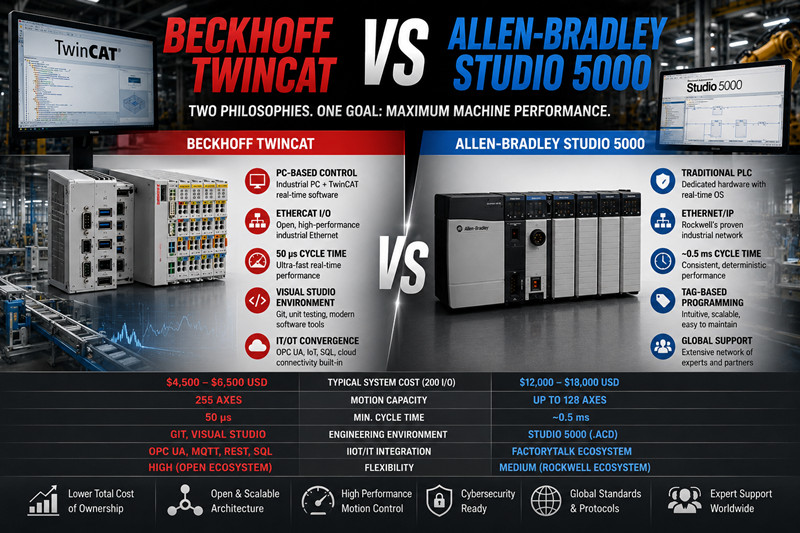
The key numbers: TwinCAT 3 supports cycle times down to 50 microseconds. It can handle 255 axes of coordinated motion on a single PC. The programming environment lives inside Microsoft Visual Studio, which means you get source control (Git), unit testing frameworks, and the full IDE tooling that software developers have used for two decades.
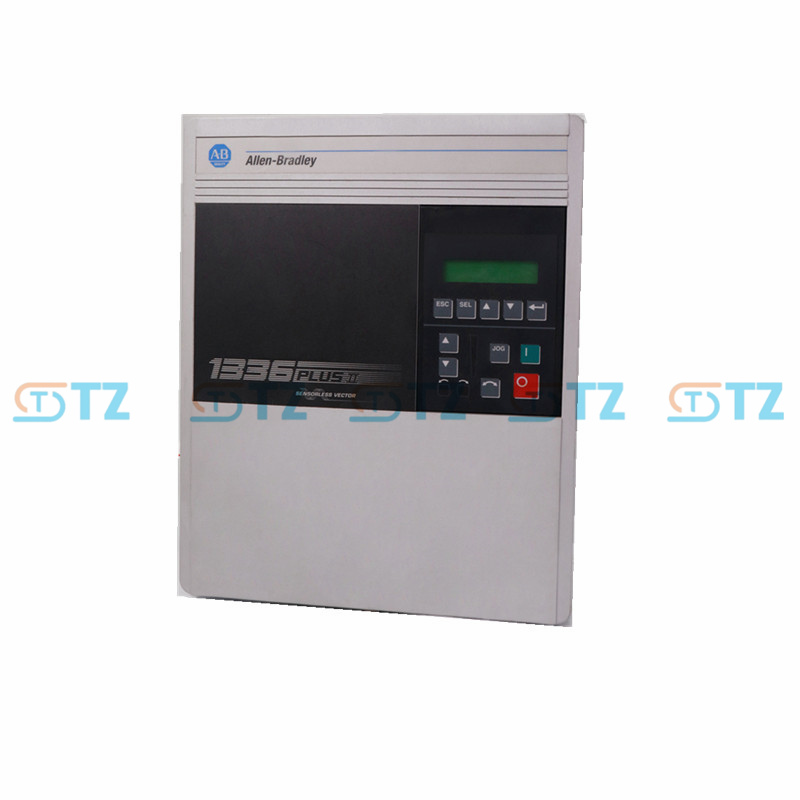
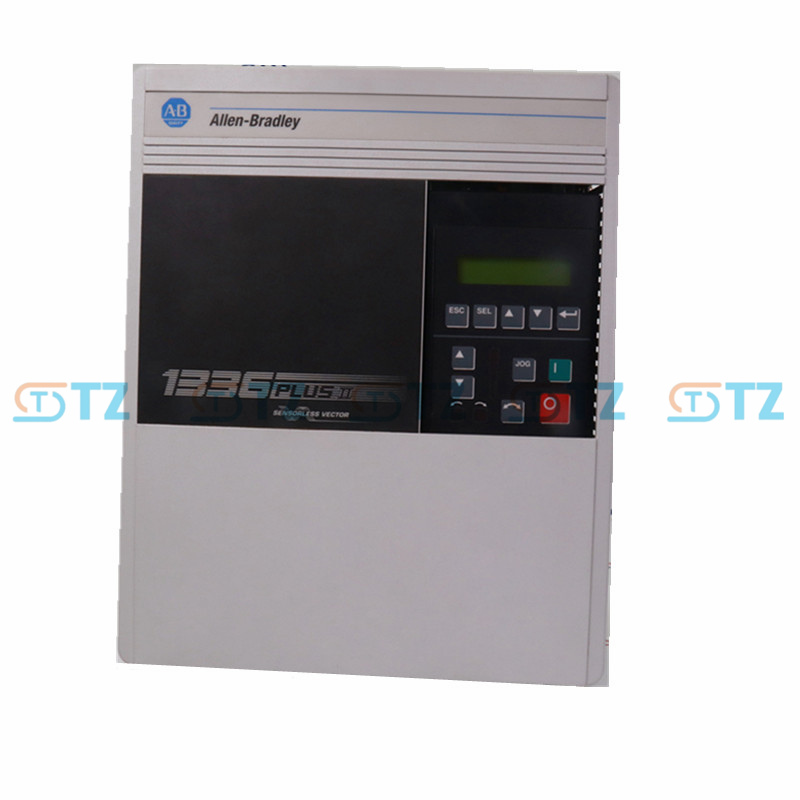
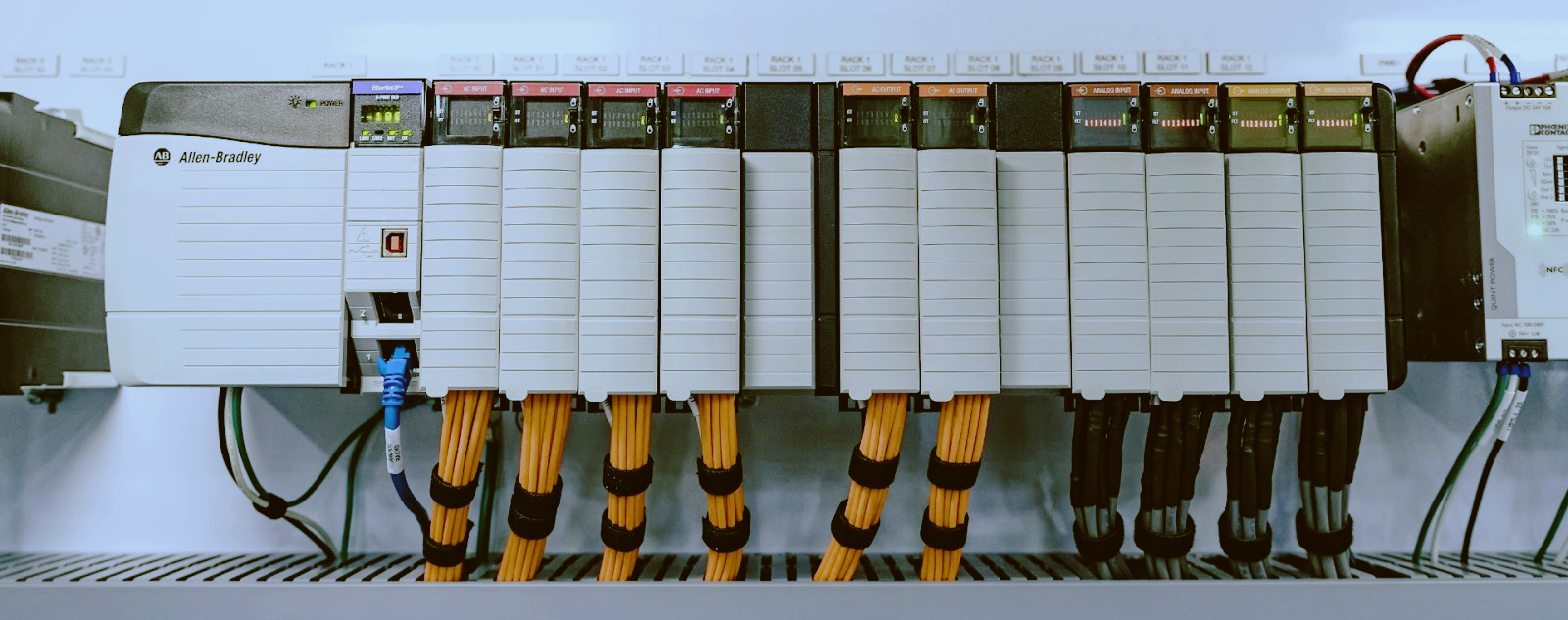
Studio 5000 is Rockwell Automation's unified design environment for the ControlLogix and CompactLogix families. It programs over EtherNet/IP using a tag-based architecture — every I/O point, timer, and counter is a named tag rather than a fixed memory address. This makes code more readable and reusable than older address-based systems.
The platform runs on dedicated hardware: a Logix controller with a real-time operating system baked into firmware. You don't install an OS. You don't manage Windows updates. The controller boots, runs your logic, and keeps running. For plants where "it just works" is the overriding requirement, this simplicity has real value.
Both platforms use IEC 61131-3 languages (ladder, structured text, function block, sequential function chart). Both support object-oriented programming extensions. Both can do motion, safety, and networking. The difference is where the boundary sits between software and hardware.
Beckhoff puts everything in software and lets you pick the industrial PC. Allen-Bradley puts the runtime in firmware on purpose-built hardware. Neither approach is wrong — but they lead to very different cost structures, maintenance models, and upgrade paths.
A mid-range Beckhoff system — C6030 ultra-compact IPC, TwinCAT 3 runtime license, EtherCAT I/O for 200 points — runs roughly $4,500 to $6,500 USD depending on licensing options. An equivalent Allen-Bradley setup — 1756-L82E ControlLogix controller, 1756-EN2TR EtherNet/IP module, 1756 chassis, 1756 I/O modules for 200 points — lands closer to $12,000 to $18,000 USD.
But purchase price tells half the story. The real cost difference emerges in expansion. On Beckhoff, adding machine vision requires a GigE Vision library license (~$400). On Allen-Bradley, adding vision means a separate camera system with its own processor and integration work — typically $3,000 to $8,000. On Beckhoff, adding OPC UA server functionality is a license key. On Allen-Bradley, it means buying an 1756-EWEB module or running Kepware on a separate server.
For projects in Saudi Arabia or the UAE where compute-heavy applications like predictive maintenance and energy monitoring are increasingly spec'd into new plants, the all-in-one PC approach avoids a cascade of add-on hardware.
Beckhoff engineers write code in Microsoft Visual Studio. This means proper source control with Git — branching, merging, pull requests. Team Foundation Server or Azure DevOps integration is native. If you have 15 programmers working on different sections of a packaging line, each can work in isolation, merge changes, and resolve conflicts the way software teams have done for years.
Studio 5000 uses Rockwell's own project file format (.ACD). Version control requires Rockwell's AssetCentre or third-party tools like VersionDog. Compare-and-merge between revisions is functional but not seamless. For a two-engineer maintenance department at a water treatment plant in Germany, this is fine. For a machine builder in Detroit shipping 50 similar-but-not-identical machines per year, managing 50 nearly-identical .ACD files becomes a headache that TwinCAT's Git-native workflow solves elegantly.
This is where Beckhoff pulls ahead decisively. EtherCAT is an open standard — any EtherCAT-compatible drive from any manufacturer works. You can mix Lenze, Yaskawa, and Beckhoff's own AX8000 series on the same network. The protocol processes telegrams on-the-fly at each slave, achieving sub-microsecond synchronization across dozens of axes.
Allen-Bradley's Kinetix motion platform runs on EtherNet/IP with CIP Motion. Performance is excellent within the ecosystem — but you're locked into Kinetix drives and servo motors. A 2 kW Kinetix 5700 servo drive runs about $3,200 USD. An equivalent EtherCAT drive from a competitive manufacturer runs $1,400 to $2,000. On a 20-axis machine, the drive cost difference alone can exceed $24,000.
In North America, Allen-Bradley dominates because integrators know it, distributors stock it, and plant managers trust it. The installed base advantage means finding a technician who can troubleshoot a ControlLogix system is easy in Houston or Toronto.
In Europe, Beckhoff has deep penetration — particularly in Germany, the Netherlands, and Scandinavia. The EtherCAT ecosystem is the default for machine builders exporting globally.
In the Middle East, the picture is shifting. New greenfield projects in Saudi Arabia under Vision 2030 increasingly specify vendor-neutral architectures. Beckhoff's open-standards approach resonates with EPC contractors who don't want to be locked into a single supplier's hardware ecosystem. That said, Allen-Bradley remains strong in oil and gas facilities where Rockwell's process control integration with PlantPAx is a known quantity.
The spec sheet numbers matter less than behavior under load. A ControlLogix 1756-L85E executes continuous tasks at roughly 0.5 ms per thousand rungs of ladder logic. It does this consistently because the controller processor does nothing but run your logic and handle I/O.
TwinCAT 3 on a Beckhoff C6030 (Intel Core i7, 4 cores isolated for real-time) can run the same logic in under 50 microseconds — roughly 10x faster. But this performance depends on proper core isolation. If Windows decides to run a background update during a critical motion sequence, you get a real-time violation. Beckhoff engineers solve this by dedicating CPU cores exclusively to the TwinCAT runtime and disabling Windows features that could interrupt.
For most applications — conveyors, pumps, packaging machines — both platforms deliver more than enough speed. The performance edge only becomes meaningful in high-speed applications: printing presses, CNC machining, semiconductor handling, or anything with sub-millisecond motion requirements.
The ControlLogix platform scales from the 1756-L71 (2 MB memory, ~1000 I/O) to the 1756-L85E (40 MB, ~128,000 I/O points). You buy the controller for the job and expand I/O by adding modules to the chassis.
TwinCAT scales differently. The same software runs on everything from a CX9020 embedded controller (ARM Cortex-A8, DIN-rail mounted, ~$600) to a C6670 rack-mount server (dual Xeon, 128 GB RAM). Your control logic doesn't change when you move between them. A machine builder can develop on a powerful engineering PC, then deploy the same code to a fanless embedded controller for the production machine.
This portability creates an interesting dynamic for OEMs. Design once, deploy everywhere — from a compact CX-series controller on a standalone machine to a full industrial server running 50 coordinated axes plus a SQL database and a web-based HMI.
In 2026, the line between factory floor and enterprise network has blurred beyond recognition. Plants that used to run isolated control networks now push production data to cloud analytics, integrate with ERP systems, and expose machine data via MQTT and OPC UA to plant-wide dashboards.
Beckhoff was designed for this convergence from day one. The controller is a Windows PC — it runs SQL Server Express natively, hosts a web server for dashboards, and communicates over standard TCP/IP protocols that IT departments understand and can secure. TLS 1.3 encryption for OPC UA is built into the runtime.
Allen-Bradley achieves IT/OT integration through additional hardware and software layers. FactoryTalk Linx provides the data bridge. FactoryTalk Analytics adds the intelligence layer. It works, but each layer adds licensing cost and integration complexity. For a plant manager who wants the machine data to show up in Power BI without a six-figure integration project, Beckhoff has a shorter path.
· Beckhoff C6030 IPC + TwinCAT 3 runtime: $3,000–$5,000 USD (IPC) + $1,200–$2,500 (licenses), available 2–4 weeks lead time in North America and Europe; slightly longer in Middle East via Beckhoff regional distributors
· Allen-Bradley 1756-L82E ControlLogix: $6,000–$9,000 USD (controller only), lead times have improved to 4–8 weeks after the 2022–2024 supply chain crunch; 1756 chassis and I/O modules add $3,000–$8,000
· Note: Both platforms have healthy stock levels in 2026. Beckhoff components (EtherCAT terminals, IPCs) ship from Germany with predictable EU lead times. Allen-Bradley availability is solid through Rockwell's global distribution network
· Discontinued models to avoid: Beckhoff CX1000 series (replaced by CX7000/CX9000); Allen-Bradley 1756-L6x ControlLogix (replaced by L7x/L8x series) — still available on the secondary market at tztechio.com/allen-bradley
Is TwinCAT harder to learn than Studio 5000?
If you come from a traditional PLC background with ladder logic, Studio 5000 feels familiar immediately. TwinCAT has a steeper learning curve — you're working inside Visual Studio, managing a real-time kernel, and thinking in terms of software engineering patterns. But for engineers under 35 who grew up with Git and object-oriented programming, TwinCAT's workflow actually feels more natural. Beckhoff offers free 3-day training courses at their regional offices.
Can I use Allen-Bradley I/O with a Beckhoff controller?
Not directly. Beckhoff uses EtherCAT for I/O, Allen-Bradley uses EtherNet/IP. You can add an EtherNet/IP master license to TwinCAT ($1,200–$2,500) to communicate with Allen-Bradley I/O as a scanner, but the latency won't match native EtherCAT performance. For new installations, use native EtherCAT I/O from Beckhoff or third-party EtherCAT manufacturers like WAGO or Phoenix Contact.
What happens when the Windows PC running TwinCAT crashes?
The TwinCAT runtime operates on a dedicated real-time kernel — a Windows blue screen does not stop your control logic. The I/O continues updating, motion continues executing, and safety functions remain active. The HMI goes dark, which is a problem for operators, but the machine doesn't fly apart. Beckhoff's TwinCAT/BSD alternative runs on FreeBSD for customers who don't want Windows on their factory floor at all.
Which platform is better for a Middle East water treatment project?
Both work. Allen-Bradley PlantPAx DCS has pre-built water treatment libraries that shorten engineering time. Beckhoff offers better integration with third-party analyzers through open protocols and lower total hardware cost. For brownfield expansions where the existing plant is Rockwell, stay with Rockwell. For greenfield projects with no legacy constraint, Beckhoff deserves a hard look — especially when energy monitoring and predictive analytics are in the scope.
What about cybersecurity — which platform is more secure?
Both support role-based access control, audit logging, and encrypted communications. Allen-Bradley benefits from its simpler network architecture (fewer OS-level attack surfaces). Beckhoff inherits Windows' security considerations but allows IT-standard hardening: Group Policy, Windows Defender, network segmentation, and domain authentication. Under NIS2 in Europe, both platforms can meet compliance requirements when properly configured — the difference is in the configuration effort, not the capability ceiling.
Can I migrate from Allen-Bradley to Beckhoff or vice versa?
Yes, but plan for a full engineering effort. IEC 61131-3 code can be manually translated between platforms, but there is no automated converter. The I/O wiring, network architecture, and HMI design all change. Budget 2–3 months of engineering for a mid-sized migration and run both systems in parallel during commissioning to avoid production downtime. See our migration guide for a step-by-step approach.

Please read on, stay posted, subscribe, and we welcome you to tell us what you think.


Sitemap | Blog | XML | Privacy Policy
In addition, with your permission, we want to place cookies to make your visit anointeraction with slOC more personal. For this we use analytical and advertisingcookies. With these cookies we and third parties can track and collect yourinternet behawior inside and outside super-instrument.com. With this we and third parties adapt super-instrument.com and advertisementsto your interest. By clicking Accept you agree to this. If you decline, we only usethe necessary cookies and you unfortunately will not receive any personalizedcontent. Please visit our Cookie policy for more information or to change yourconsent in the future.
Accept and continue Decline cookies